National Academies find radiation in cabins-WHAT DOES THAT MEAN???

Sometime in the near future, you may see your pilot or flight attendant wearing a dosimeter, like this—
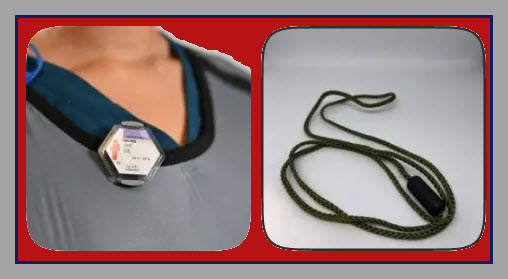
WHY??? The National Academies’ 2026 report (attached below) Assessing Radiation Exposure, Health Outcomes, and Mitigation Strategies for Flight Crewmembers (AREHOMSFC)makes a startling announcement about the effects that radiation may have on the professionals who assure your safety inflight. The Academies publication, considering the potential impact of this concern has drawn moderate acknowledgment:
FAA: commissioned and aware, pending policy response.
DOT: administrative sponsor, no public stance.
OSHA: silent so far.
Press: limited coverage, mostly within scientific and aviation circles.
Perhaps the public attention will increase after the Academies holds its public briefing webinar for June 29 2026, which may prompt broader media attention.
What did the Academies find? Airline flight crews appear to experience the highest average occupational radiation exposure of any U.S. worker group, primarily from galactic cosmic rays and occasional solar particle events. The researchers found that current monitoring and regulatory frameworks—especially within the FAA—are fragmented and outdated, lacking consistent dose tracking, health surveillance, and risk communication. The report recommends establishing a national radiation‑dose registry, integrating real‑time flight‑path‑based exposure modeling (e.g., CARI‑7A), and expanding medical research and protective standards to align aviation with other radiation‑regulated professions.
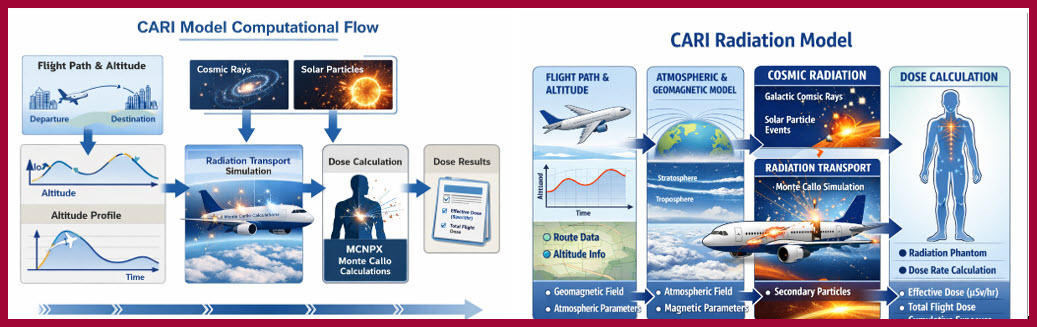
As the regulators review and act on the AREHOMSFC, it is quite possible that new radiation meters will accompany flights. A dose‑tracking system for airline flight crews could look and function like the personal dosimetry systems used by radiologists, but adapted for aviation’s unique exposure environment — cosmic rays, solar particle events, altitude profiles, and cumulative career dose. This bespoke health instrument could combine wearable sensors, aircraft‑integrated data, and cloud‑based dose modeling (e.g., CARI‑7A[1]) (see below). Think of it as a hybrid between a radiologist’s badge, a Fitbit, and a flight‑data recorder.
The study may result in 3 types of radiation monitors—
Wearable Dosimeter
A small, lightweight badge worn on the uniform or ID lanyard.
- Measures real‑time ionizing radiation (mostly high‑energy neutrons and protons)
- Logs time‑stamped exposure
- Syncs automatically after each flight
- Could be passive (TLD/OSL) or active (solid‑state microdosimeter)
-
- Solid‑state microdosimeter tuned for high‑energy neutrons
- E‑ink display showing dose rate, cumulative dose, and alerts
- Single LED indicator for elevated radiation events
- USB‑C or wireless charging
- Shock‑resistant, low‑profile housing
Aviation‑specific twist: The badge would also record cabin altitude, GPS, and flight phase, because dose rate changes dramatically with altitude and latitude.
Aircraft‑Integrated Sensors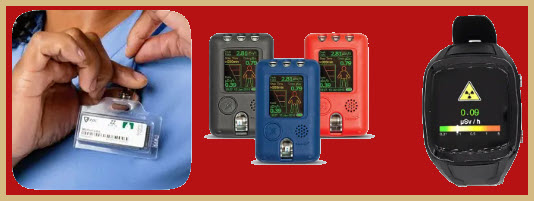
Mounted near the cockpit or avionics bay.
- Measures ambient cosmic radiation at cruise
- Detects solar particle events in real time
- Feeds data to the crew’s wearable device
- Provides alerts if dose rate spikes above thresholds
This mirrors how some long‑haul aircraft already carry neutron monitors for research flights.
CARI‑Model Integration
The system would automatically run a CARI‑7A dose calculation for each flight:
- Flight path
- Altitude profile
- Solar cycle conditions
- Geomagnetic shielding
- Aircraft type (shielding varies)
The wearable badge provides actual measured dose, while CARI provides modeled dose — the two together give a highly accurate exposure record.
Crew Dashboard
A secure app or portal showing:
- Dose per flight
- Dose per month
- Dose per year
- Lifetime cumulative dose
- Alerts when approaching recommended limits
- Comparison to ICRP occupational limits
This is exactly what radiologists see — just adapted to flight operations.
Airline Safety & Medical Integration
The system would automatically notify:
- Airline medical departments
- FAA‑approved occupational health systems
- Optional: crew member’s personal physician
Pregnant crewmembers could receive automatic routing restrictions (e.g., avoid polar routes during solar maximum).
These are hypothetical examples of what the first step in fully understanding radiation impact of flight crews[2]. Based on this experiential quantification, long term approaches may be designed. Hopefully, this flagging of the Academies findings will Allow Carriers, Unions, And Individuals to prepare for what the INFLIGHT MEASUREMENTS RECORD and then the design of a LONG TERM THREAT RESOLUTION OF RADIATION’S IMPACT.

FAA Urged to Revise its Approach to Radiation Exposure for Flight Crewmembers; Current Approaches Are Insufficient, Says New Report
By Solomon Self
Last update June 12, 2026
WASHINGTON — The Federal Aviation Administration should exert its existing regulatory authority over ionizing radiation as an occupational hazard to ensure the health and safety of airplane flight crews, says a new congressionally mandated report from the National Academies of Sciences, Engineering, and Medicine. The report finds that in-flight cosmic radiation exposure warrants attention as an occupational hazard, but current APPROACHES TO MONITORING EXPOSURE AND COMMUNICATING WITH AFFECTED WORKERS ARE INCONSISTENT AND INSUFFICIENT.
From natural radiation exposure during flight, crewmembers on commercial flights receive among the highest occupational exposures to radiation among workers in the United States, but they lack regulatory protections comparable to other radiation-exposed workers. Although the radiation dose received during any individual flight is generally low, evidence indicates the cumulative dose accrued over the course of a career may increase the risk of cancer and other adverse health outcomes, and therefore merits monitoring and tracking. Additionally, the tools for monitoring exposure and educating workers are available, but they are not uniformly used or deployed.
“Radiation exposure is an unavoidable part of a flight crewmember’s job, and we need to do more to ensure that flight crew health and safety are sufficiently prioritized,” said Jonathan Samet, professor of epidemiology and of occupational and environmental health and former dean of the Colorado School of Public Health, and chair of the committee that wrote the report. “We hope our report will be a guide to revising approaches to the problem, strengthen oversight, and empower crewmembers with the information they need to make decisions about their health.”
The report notes that while available evidence from studies of flight crew does not definitively establish associations between occupational radiation exposure and specific health outcomes, there are opportunities to improve understanding of cumulative exposure during a career and the associated risks. Additionally, there is a need for greater understanding and characterization of solar particle events, when higher doses may be received. The report concludes that current scientific knowledge, operational tools, and computational models provide a sufficient foundation to improve occupational radiation management now, while continuing to make progress in strengthening research and exposure assessment over time.
Immediate Actions
Existing regulatory and operation frameworks are limited. The FAA has recognized radiation exposure as an occupational consideration for flight crews since 1990, but monitoring and management practices are neither required nor formalized, in contrast to those used in other occupations. The FAA should begin exerting its regulatory authority over ionizing radiation exposure of flight crewmembers, the report says.
In addition to asserting its regulatory authority, the FAA should build upon its investment in the CARI dose model developed by the FAA’s Civil Aerospace Medical Institute, and create a user-friendly, web-based application for the model to help crewmembers track their own exposure levels, the report says. It noted that tracking radiation dose at an individual level is an interim step while more comprehensive methods are developed.
Short-Term Actions
In the near term, the report urges the FAA to require U.S. commercial airlines to implement comprehensive radiation safety programs aligned with best practices for occupational radiation protection.
In addition, the FAA should work with appropriate agencies to establish a DOSE-TRACKING SYSTEM FOR FLIGHT CREW that would allow airlines and individual employees to monitor radiation exposure. Such a system would also provide the data needed to facilitate epidemiologic research and support assessment of the population health of flight crew. Concurrently, the FAA should work in conjunction with other federal agencies such as the National Oceanic and Atmospheric Administration and NASA on sustained, real-world radiation characterization measurement campaigns to provide more data and modeling on radiation exposure under different flight conditions.
Airlines and labor organizations should collaborate on scheduling practices that reduce exposure for workers such as pregnant crewmembers seeking lower-dose routes, the report adds.
Long-Term Actions
To address the longer-term challenges and improve computational models for estimating radiation dose, the FAA and collaborating organizations should systematically evaluate and compare radiation exposure models under realistic operating conditions. The report recommends development of an ensemble modeling approach to do so.
The report also encourages federal agencies, industry stakeholders, and flight crew organizations to build a coordinated long-term research strategy to address occupational radiation exposure and health outcomes.
Undertaken by the Committee on Assessing Radiation Exposure, Health Outcomes, and Mitigation Strategies for Flight Crewmembers, the study was sponsored by the U.S. Department of Transportation.
The National Academies of Sciences, Engineering, and Medicine are private, nonprofit institutions that provide independent, objective analysis and advice to the nation to solve complex problems and inform public policy decisions related to science, engineering, and medicine. They operate under an 1863 congressional charter to the National Academy of Sciences, signed by President Lincoln.
Contact:
Solomon Self, Media Relations Officer
Office of News and Public Information
202-334-2138; email news@nas.edu
[1] According to the FAA’s documentation, “The CARI‑6 computer program, developed at the FAA’s Civil Aerospace Medical Institute, calculates the effective dose of galactic cosmic radiation received by an individual (based on an anthropomorphic phantom) on an aircraft flying the shortest route between any two airports in the world.” The latest version, CARI‑7 and CARI‑7A, extends altitude limits to 300,000 ft, includes particle‑specific dose calculations, and uses Monte Carlo transport codes (MCNPX 2.7.0) to model atmospheric radiation transport.
[2] The report does acknowledge that frequent fliers can accumulate non‑trivial radiation doses, especially on long‑haul and high‑latitude routes.
