INDIA’s DGCA is safe per 4 audits? Other factors? Time to consider an assessment void of geopolitical and other factors???
The journalists in India have chronicled the SERIOUS safety issues involving their DGCA and airlines, as demonstrated by the two articles linked below. That these shortcomings exist while all four of the international safety standards AUDITORS determine that the world’s most populous democracy complies with these global norms. WHY???

Since 1992, by virtue of a Congressional mandate, the FAA periodically reviews its PEER CIVIL AVIATION AUTHORITIES (CAAs)to determine whether another sovereign’s effort to assure SAFETY meets a set of exacting criteria. The International Aviation Safety Assessment program is intended to provide proper of the CAAs’ of their oversight of air carriers operating into the U.S., fulfilling congressional requirements for safety. Initially the FAA formulated the operational details, but Congress provided the legal framework and directives that necessitated the creation of the IASA program.
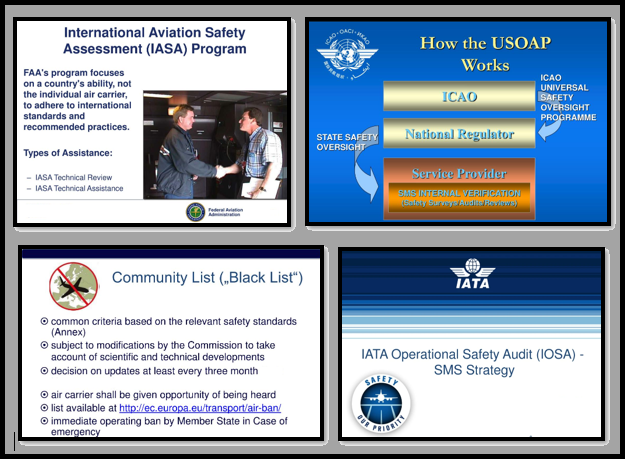
Aviation safety design is built on redundancy, but this auditing of CAAs is quadruplicated:
- ICAO’s USOAP evaluates a state’s aviation safety oversight system across eight critical elements.
- While not direct reviews of the CAAs, EASA’s Air Safety List (“EU Blacklist”) scrutinizes the airlines that they surveil, PLUS IATA’ Operational Safety Audits (IOSA) & Safety Rankings
The end result of these repetitive audits is a list of deficiencies. Items like local cultural standards, availability of requisite national talent and the political support ($$$) and help (patronage) are not part of the calculations. There is some reason to believe that the aviation professionals were aware of their problems; there may be real reasons why they do not match these preconceived standards of countries with sophisticated aviation industries. When one of the 4 visitors leave, the CAA, for example, have to install Safety Management Systems while they may not be fully knowledgeable about this sophisticated risk reduction tool, may not have the staff to implement it and may not be regulating a caliber of certificate holders with the resources to comply. It is not abundantly clear how the auditors expect that their criticism can be rectified without some external help.
Quickly skim the attached articles, this summary of a broader time record:
and then ask, “What say these arbiters of aviation safety CAAs?”
The EXPERTs have given the India DGCA a passing grade;
- FAA – IASA (International Aviation Safety Assessment)
- India holds FAA Category 1, meaning:
- DGCA meets ICAO safety oversight standards.
- Indian airlines may operate and expand service to the U.S.
- FAA reaffirmed Category 1 even after the AI‑171 crash scrutiny.
- ICAO – USOAP (Universal Safety Oversight Audit Programme)
- India’s DGCA has an Effective Implementation (EI) score of 85.65%, well above the global average.
- Strongest areas include:
- Airworthiness: 97.06%
- Operations: 94.02%
- ICAO awarded DGCA a Council President Certificate for progress in oversight.
- ICAO has not issued any Significant Safety Concern (SSC) for India.
- EASA – EU Air Safety List (“EU Blacklist”)
- No Indian airline is on the EU Air Safety List.
- This implies EASA has no systemic concerns with DGCA’s oversight.
- IATA – Operational Safety Audits (IOSA) & Safety Rankings
- Major Indian carriers (e.g., Air India, Vistara, IndiGo) maintain IOSA registration, which requires compliance with global safety standards.
- IATA’s global safety reports do not flag India as a systemic outlier.
How is this possible when…
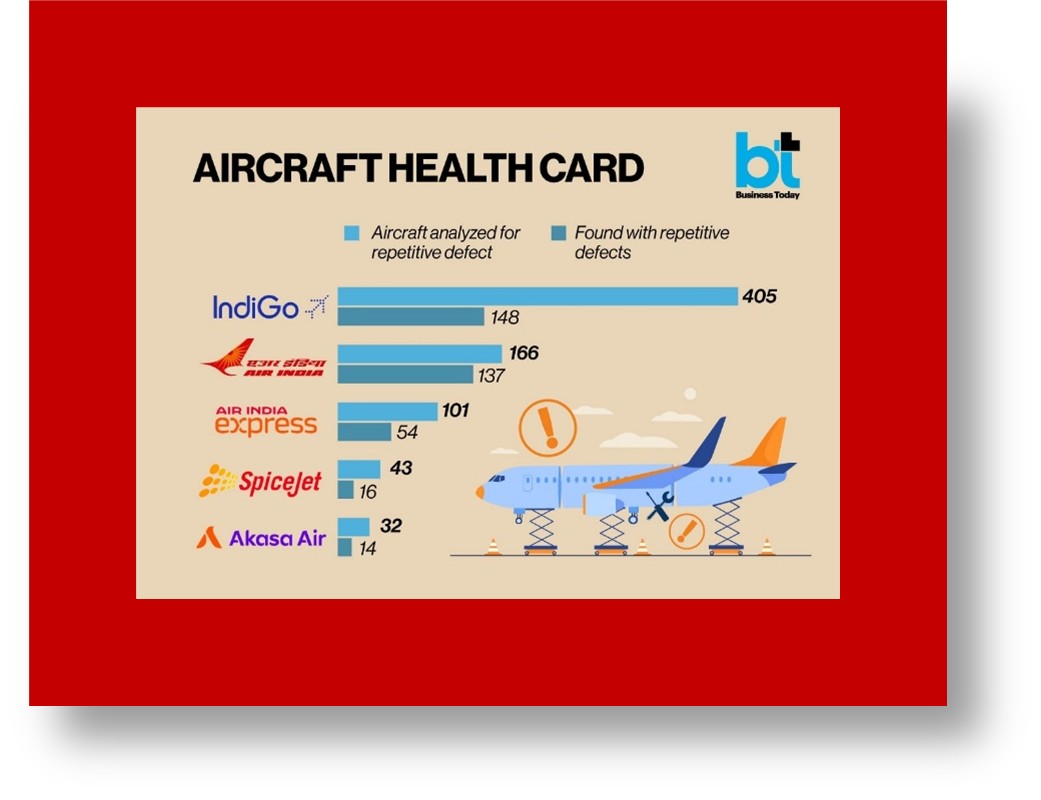
- 377 of 754 aircraft across six airlines had repetitive defects.
- IndiGo: 148 aircraft with recurring defects out of 405 audited.
- Air India Group: 191 aircraft with recurring defects out of 267 audited.
- Air India Express, SpiceJet, Akasa, and Alliance Air also showed significant defect rates.
- Defects ranged from cabin issues to technical snags; the data did not distinguish which were safety‑critical.
- DGCA conducted 3,890 surveillance inspections, 56 audits, and hundreds of ramp and night checks in 2025.
- Air India Flight AI‑171 Crash (June 2025)
- Pilot Fatigue and Controversy Over Flight Duty Time Limitations
- Aging Fleets and Cabin/Technical Snags
AND
- Severe Staffing Shortages in DGCA and AAI
- A major structural safety risk.
- Key facts
- Over 2,600 vacancies across India’s aviation bodies.
- DGCA alone has 787 unfilled posts, partly due to restructuring.
- AAI has 1,667 vacant executive positions.
This above identified problem of deficient staffing (the FAA can hardly make this complaint again) was ALSO in the FAA Category 1 report July, 2018[1] for India that it had CORRECTED the following:
- Severe staffing shortages in DGCA
- Inadequate training of technical personnel
- Weak oversight systems
- Insufficient documentation and surveillance capability
Something seems to have curried the US’s favor:
- India ranks roughly 17th–20th globally as a trading partner.
- India is the world’s 5th‑largest economy (IMF/WB consensus).
- India’s imports in FY 2024–25 were $854.8 billion (goods + services) .
- India is a top‑tier destination for U.S. exports (pharma, aircraft, machinery, energy) and EU exports.
- India is one of the fastest‑growing consumer markets globally, with a rapidly expanding middle class.
- Very important as a buyer (top 5–7 market).
- Moderately important as a trading partner (top ~20).
One would hope that these factors unrelated to safety might influence an IASA rating, but the involvement of geopolitical issues have been seen recently. Such a plausible insinuation defeats the purpose of IASA-TO PROTECT AMERICAN PASSENGERS as they travel to globe.
As Secretary Duffy proclaimed at ICAO’s 42nd General Assemly-
- He criticized ICAO for “wasting critical resources on social programmes or climate financing initiatives”, saying these have “nothing to do with the safety, security and efficiency of the global air transportation system.”
- He argued that ICAO had extended itself far beyond its proper mandate, diluting its ability to focus on core aviation responsibilities.
- He framed these social‑program efforts as distractions that undermine ICAO’s ability to prepare for the “rapidly approaching revolution in aviation.”
- He called for ICAO to “get back to basics” and eliminate bureaucratic or mission‑creeping initiatives.
At that same august convocation, , ICAO Council President Salvatore Sciacchitano set the tone of this Triannual Convocation by laying out out an ambitious vision and specified that this UN special agency should “safeguard growth in underserved markets by transforming aviation safety, security and sustainability.” FURTHER PRESIDENT SCIACCHITANO was introduced under the ‘NO COUNTRY LEFT BEHIND’ initiative, awarded the DIRECTORATE GENERAL OF CIVIL AVIATION OF INDIA a CERTIFICATE FOR ITS PROGRESS IN ESTABLISHING AN EFFECTIVE AVIATION SAFETY OVERSIGHT SYSTEM…India regarded the Council President’s recognition as a GLOBAL SEAL OF APPROVAL after the Air India Flight 171 disaster.
The Secretary’s casting aspersions on ICAO’S DEDICATION to its SAFETY Mission is justified by Sciacchitano award to India in the midst of its soring through the AI 171 wreckage.
Redundancy of examinations, geopolitical economic considerations and No Country Left Behind all mitigate for a single, apolitical, truly independent safety organization to assume these tasks. Further, the reduction in the expenditures by all four of the current auditors could fully fund this new, unified, approach to safety audits AS WELL AS include post “audit” support to assist the CAA in really bring their safety surveillance to BEST PRACTICES???
India’s press lambasts its country’s aviation safety state
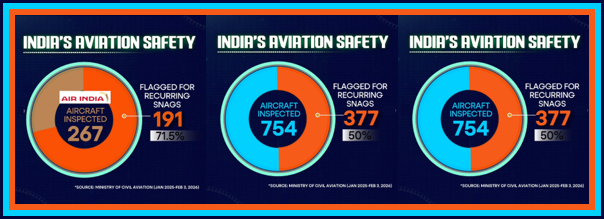
#FIRSTPOSTNEWS (INDIA): Eight months after the deadly Air India plane crash in Ahmedabad, fresh government data tabled in the parliament on February 6th has raised troubling questions about aviation safety in India. Information tabled shows that NEARLY HALF OF ALL AIRCRAFT EXAMINED ACROSS SIX MAJOR CARRIERS REPORTED RECURRING TECHNICAL DEFECTS. India’s two largest airlines, IndiGo and the Air India Group, account for the bulk of the cases, with more than 70 percent of Air India Group aircraft audited being flagged for repetitive issues. While Air India says many of the defects are low-priority and not directly linked to flight safety, a recent pattern of mid-air turnbacks, diversions and cancellations due to technical snags has added to concerns. Regulators say surveillance has increased, but questions remain about whether risks are being identified in time.
Aviation safety: Half of the passenger aircraft in India have had repeated defects
These were found during surveillance conducted by DGCA. On the regulatory front, there are about 2,645 vacancies across civil aviation offices and regulatory bodies
India’s aviation sector has seen strong growth in recent years, BUT aircraft maintenance has not kept pace with that growth. Surveillance by regulatory authorities since January last year has found repeated defects in half of India’s 754 aircraft across major domestic carriers.
According to data provided by the Ministry of Civil Aviation, the highest number of defects were found in Air India’s fleet, followed by Air India Express and IndiGo. The situation was similar even with SpiceJet and newcomer Akasa, as half their fleets were reported to have had repeated defects.
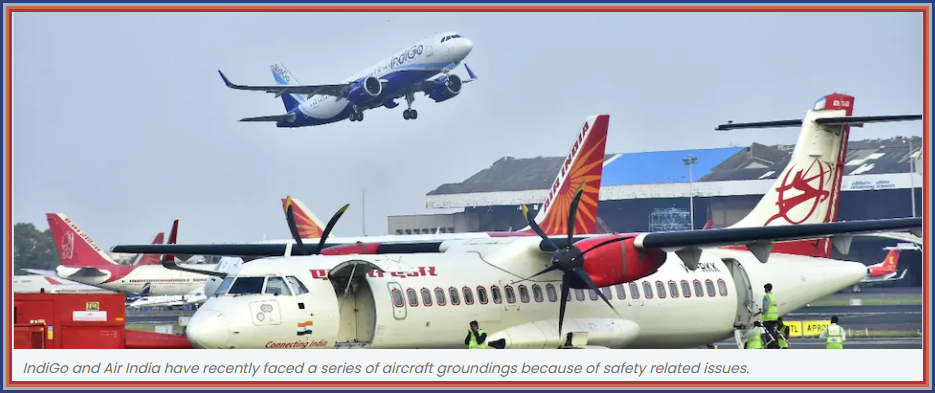
IndiGo and Air India have recently faced a series of aircraft groundings because of safety related issues. The most recent being the grounding of Air India’s B787 Dreamliner over issues related to fuel control switches[2].
The aviation industry was under scrutiny last year because of safety concerns after an Air India flight crashed in Ahmedabad in June, killing 260 people. That prompted the Directorate General of Civil Aviation (DGCA) to order a safety audit of its fleet. In December, IndiGo cancelled 5,689 flights due to operational challenges following the revised flight duty time limitations norm.
Vacancies
Concerns around aviation safety have also shone the spotlight on the regulatory ecosystem in the country. There are 2,745 vacant posts in various civil aviation regulatory and safety bodies, with 787 In the DGCA. This is because of the creation of 441 additional posts as part of the restructuring undertaken during 2022-2024, as per aviation ministry data.
In the Airports Authority of India (AAI), there are 1,667 vacancies pertaining to Direct Recruitment (executive) posts. The ministry said the AAI has expedited recruitment, redeployed staff at operationally sensitive airports, created additional posts in line with expanding airspace requirements, with such measures being continuously reviewed to ensure safe and uninterrupted civil aviation services.
There are 180 and 11 positions vacant in the Bureau of Civil Aviation Security (BCAS) and Airports Economic Regulatory Authority of India (AERA), respectively. As BCAS and AERA are deputation-based organisations, vacancy circulars are issued periodically to fill posts in accordance with the prescribed nor
Published on: Feb 6, 2026 3:47 PM IST
[1] The FAA conducted a full IASA audit of DGCA from 25–29 October 2021, covering:
- Aircraft operations
- Airworthiness
- Personnel licensing
- Final consultations in April 2022
- Further FAA reviews in July 2022 and September 2022
. FAA Concluded DGCA Meets ICAO Standards 12 April 2023
[2] “No Issues”: Air India Re-Inspects Fuel Control Switch Across Boeing Dreamliners
Air India probes if crew followed protocols in Boeing fuel-switch incident