IATA’s lament about AAIB tardiness points to a deeper issue!!!
IATA’s Director of Safety, Mark Searle, has penned the below primer on the need for the globe’s Aviation Accident Investigation Boards (AAIBs) to produce their ICAO Annex 13 reports in a timely fashion. His text includes instructive information from ICAO and his organization. The obvious audience for his paper is the AAIBs around the world.
The message should also impact ICAO, a UN organization created in 1944, in part to ensure consistent, independent, and technically credible accident investigations across countries — and this mission not only continues today but has recently been strengthened through major reforms. The wisdom of Mr. Searle is a subtle reminder of the Montreal-based safety vanguard to tighten up its reviews of the CIVIL AVIATION safety execution and FLAG the insufficiency of some of the AAIBs compliance with Annex 13. Annex 13, first issued in 1951. This consensus agreement among the members created the world’s first unified, binding framework for how States must conduct aircraft accident investigations — including objectives, responsibilities, evidence handling, reporting standards, and independence requirements.
- Annex 13 has since served as the global baseline for ensuring investigations are systematic, impartial, and comparable across borders.
- ICAO’s manuals and guidance (e.g., Doc 9756, Doc 9962) were developed specifically to standardize procedures and reduce variability in investigative quality among States.
This AI generated chart shows some significant deterioration[1] of AAIBs’ timely responses-
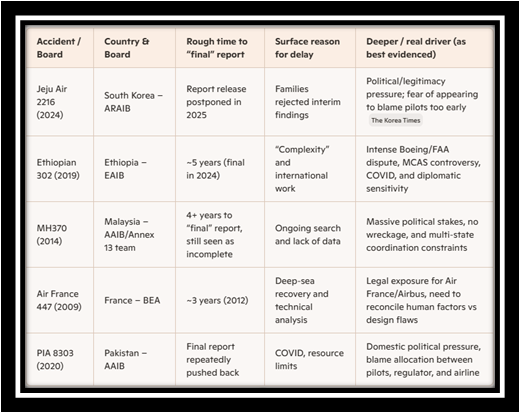
A fair summary of the real reasons behind these laggard responses cross these cases, the same themes keep showing up:
-
- High political and legal stakes
- When findings implicate national regulators, flag‑carrier airlines, or major manufacturers, reports get lawyered and negotiated, not just written.
- Victim‑family legitimacy pressure
- As in the Jeju Air case, strong public rejection of preliminary conclusions can force boards to slow down, reopen lines of inquiry, or postpone publication to avoid a legitimacy crisis.
- Data poverty or data overload
- Either there is almost no physical evidence (MH370) or there is a mountain of complex technical data (Ethiopian 302, AF447). Both extremes lengthen the path to a defensible narrative.
- Institutional self‑protection
- When the investigating authority is also the regulator or closely tied to the state airline, delays often track the internal struggle over how much systemic blame to admit.
- High political and legal stakes
The source of these problems are the very critiques that the ICAO Universal Safety Oversight Audit Programme (USOAP) issues after its periodic assessments; to wit—
USOAP audits each State’s AIG (Accident & Incident Investigation) capability as part of its global safety oversight program. The evaluation is based on compliance with Annex 13 and ICAO’s investigation manuals (Doc 9756 Parts I–IV). These documents define the required structure, independence, staffing, procedures, and reporting standards for an investigation authority. USOAP looks at whether a State has:
-
- Legislation guaranteeing independence of the investigation authority (Annex 13, Ch. 3).
- Proper organizational structure and staffing for investigations (Doc 9756 Part I).
- Documented procedures and checklists for conducting investigations (Doc 9756 Part II).
- Technical capability to investigate structures, systems, flight recorders, human factors, etc. (Doc 9756 Part III).
- Proper reporting processes, including timely, complete, and internationally compliant final reports (Doc 9756 Part IV).
- Mechanisms for issuing and tracking safety recommendations.
- Processes for notifying ICAO and other States as required by Annex 13, Ch. 4.
The FAA’s equivalent (IASA) and USOAP identify issues and then leave the AAIB with the unenviable task of trying to address problems beyond their legal authority and technical competence-
-
- FUNDING comes from a Parliament/Congress and the AAIBs are supposed to be APOLITICAL
- If high ranking ICAO and FAA (maybe even IATA and EASA) implored the keepers of the purse strings to assure that their citizens safety is adequately funded, might not there be a better result?
- Same quandary for INDEPENDENCE?
- Same elevated intervention.
- ORGANIZATIONAL, PROCEDURAL, REPORTING, TRACKING and ICAO notifications may well be beyond the capacity of the AAIB to rectify.
- Most AAIBs aspire to execute their duties at the highest levels,.
- What works in L’Enfant Plaza may not be easily translated to the cultures of these countries.
- The senior staff at an AAIB may not be there because of an extensive resume in accident investigation or as to the vagaries of managing a large non-military team.
- FOR THESE AND OTHER REASONS, the departure of the external audit teams diminishes the likelihood that the audited AAIB can “heal themselves”.
- Establish A SINGLE CONSULTING APPROACH (combine ICAO, FAA, EASA and ICAO resources . Have the consultants available to assist the AAIBs to convert the critiques into ACTION!!!
- FUNDING comes from a Parliament/Congress and the AAIBs are supposed to be APOLITICAL
Mr. Searle’s paper may be a catalyst to real change in all AAIBs.

The Safety Paradox: Fewer Accidents, Greater Responsibility
By Mark Searle[2], IATA Director of Safety
Commercial aircraft accidents are very rare. That’s a good thing. It is the most powerful evidence that aviation is the safest form of transport. And that is very good news for the five billion travelers who will fly this year.
But success has created a paradox. In the early days of flying, one of the biggest drivers of safety improvements were accident reports. In 2005 for example, there was one accident for every 268,703 flights. That gave us a lot to learn. By 2025 the accident rate had dropped to one in every 760,000 flights. There is still a lot to learn from each of these. And coupling that with our ability to crunch huge amounts of safety data gives each of these reports the potential to be even more powerful.
The paradox is that, because accidents are so rare, it seems that many states have SOMEHOW LOST THE CAPACITY TO INVESTIGATE them and DELIVER FINAL ACCIDENT REPORTS ON TIME AND ON SPEC—that is to say, in line with the standards and recommended practices outlined in Annex 13 of the Chicago Convention. We see that clearly in the numbers. BETWEEN 2019 AND 2023, ONLY 63% OF ACCIDENT REPORTS WERE COMPLETED IN LINE WITH THE COMMITMENTS THAT STATES MADE IN SIGNING THE CONVENTION. That’s a problem that we are working hard to fix.
One piece of good news is a series of amendments to Annex 13 that will provide some practical solutions. Among these is greater clarity on the freedom of states to get the help they need in conducting investigations by delegating the investigation to another State or regional body, and inviting independent observers. The amendments also try to remove potential blockers by emphasizing the need for unrestricted access to evidence and the importance of transparency both with respect to the public and, importantly, with the families of victims. The revision leaves no room for complexity or political sensitivities to become an excuse for not complying with Annex 13’s requirements.
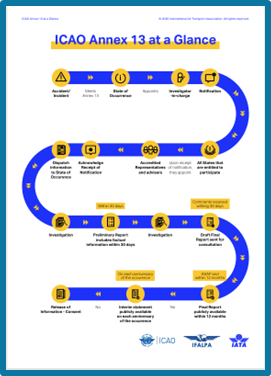
Simple measures can also have an impact. We are hoping that will be the case with an infographic (pdf) that IATA worked with ICAO and IFALPA to publish. It explains, step-by-step, how investigations must proceed to align with Annex 13. Of course, the experts in the field know this by heart. But that is not necessarily the case with many of the stakeholders who can have an impact on the successful completion of an investigations.
The infographic lays out clearly and simply how states and stakeholder need to collaborate, when information should be shared, and who is responsible for what in the accident process. Our hope is that, by making this more easily understood, we’ll have a better completion rate.
A third encouraging development is the release of an IATA centralized repository of safety recommendations from accident reports. This is the first time that such insights have been brought together in a single database. The obvious result is that this will enable more effective analysis and use of accident reports.
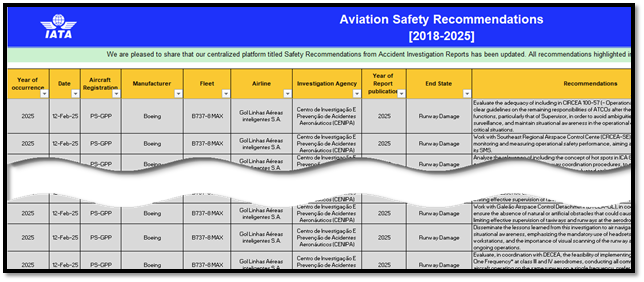
The motivational element of this is that by making it as easy as possible to use the results of accident reports, their importance becomes even clearer. As individuals, we are all motivated when we see our hard work put to use. It is the same for the individuals—and institutions—involved in accident investigations. That’s an important secondary aim for the database that we hope will bear fruit in the years to come.
There is NO ONE REASON WHY 37% OF ACCIDENT REPORTS ARE NOT COMPLETED IN LINE WITH ANNEX 13 REQUIREMENTS. Equally, there is no one magic solution to solve the problem. These three actions will surely help on their own. And they should serve as an important reminder for all involved of the critical nature of what we are trying to achieve. We often say, “making aviation safer”, but that is a sanitized way of saying “saving lives”.
Producing reports on time, sharing their content, and using that to make flying safer will save lives. And there is no higher calling of motivation than that.
[1] The US’ record is not exemplary either- Naples, FL – Bombardier CL‑600/CL‑604 freeway crash (Feb 2024) Final report issued April 24, 2026; LaGuardia Airport fatal runway collision (March 22, 2026)Status: Only a preliminary report has been released (April 23, 2026);Kauai helicopter crash (March 26, 2026) Preliminary report issued April 17, 2026.
[2] Mark Searle joined IATA as Global Director, Safety in August 2019 from the UK CAA where he held the post of Head of Safety Strategy. In both posts, he is/was responsible for overseeing a strategy to mitigate aviation safety risks, by the identification and implementation of safety initiatives, delivered through safety improvement programs. Prior to this, Mark had flown for 20 years as an airline pilot, accumulating 12,000 hours, on commercial passenger aircraft. During this time, Mark was Chairman of BALPA representing the interests of pilots operating in the UK both at home, and through IFALPA, on the international stage.
