After DCA and LGA crashes will the Administrator Bedford’s SMS office show the fortitude for REAL CHANGE
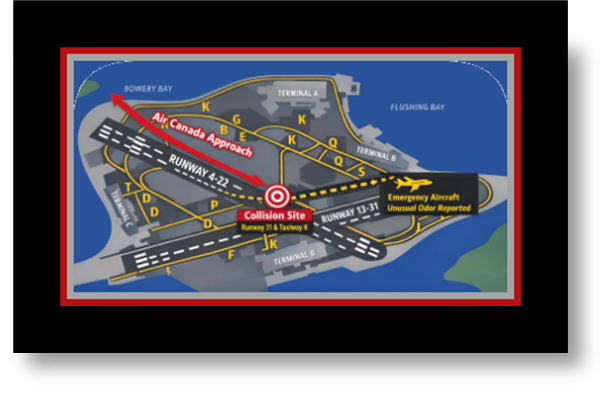
The AIR CURRENT has published an article about the March 22,2026 crash at New York’s LaGuardia Airport when an arriving Air Canada Express plane and a fire-and-rescue vehicle collided on a runway. This is not a typical news report that attempts to piece together what the NSTB is finding and has not yet revealed. Rather TAC researched the HISTORY OF SIMILAR ACCIDENTS/INCIDENTS.
Responding to tragedies was the basis for the derogatory term ‘Tombstone agency’–
“Our safety agency is called the tombstone agency… because they wait for major loss of life before they make a safety change.”
In part in response to this critique but more relevantly based on Peggy Gilligan’s understanding of Congressional math, she concluded that it was unlikely that appropriations for staff was likely to add positions commensurate with the growth of the regulated. The analytical basis for Safety Management Systems was, and should be, IS that FAA personnel would have access to and ability to analyze the airline’s safety data, spot trend lines. SMS is designed to analyze past trends from META data collected from safety certificate holders and use that information to identify risks before they become a problem. Her legacy has been the rubric for the FAA safety inspectors for their external responsibilities. The agency’s self-policing history has not been stellar.
Administrator Bedford’s recent reorganization reemphasized the importance as SMS is applied internally.
- “The Aviation Safety Management System (SMS) Organization—will lead an agency-wide safety management system by centralizing safety management activities previously conducted in five separate lines of business.”
The new team [ASMSO?]is likely working hard to assess the NTSB’s final report on the January 29, 2025 DCA midair collision. The Board’s recommendation concluded that the FAA had long‑standing evidence of a collision hazard between helicopter Route 4 and the Runway 33 approach path, failed to act on repeated internal warnings, and placed controllers in a workload environment that directly degraded their performance. ASMSO has ALREADY RESPONDED to the Board’s finding of air traffic system’s institutional overreliance on “see‑and‑avoid” in a complex, high‑density environment where visual separation was unreliable—
“Following the mid-air collision near Ronald Reagan Washington National Airport, we looked at similar operations across the national airspace,” [Administrator]Bedford said. “We identified an overreliance on pilot ‘see and avoid’ operations that contribute to safety events involving helicopters and airplanes.”
Controllers may no longer apply visual separation between helicopters/powered‑lift aircraft and fixed‑wing airplanes when their paths cross arrival or departure flows.
The LGA risk analysis likely will involve the FAA, NATCA, the PANYNJ, the airlines and the airport tenants with AOA movement privileges. ASMSO will either involve an outside facilitator or be tested as to its independence from its peer FAA offices (ATO, AFS/AVO, APT, Eastern Region, etc.)
The AIR CURRENT ARTICLE reviews past incidents (1996, 2000, 2012,2014, 2015, 2015, 2016 & 2021). Like the DCA tragedy, LGA involved:
-
- Controllers and ARFF personnel had long complained about vehicle movement complexity, visibility issues, and runway crossing coordination problems at LaGuardia.
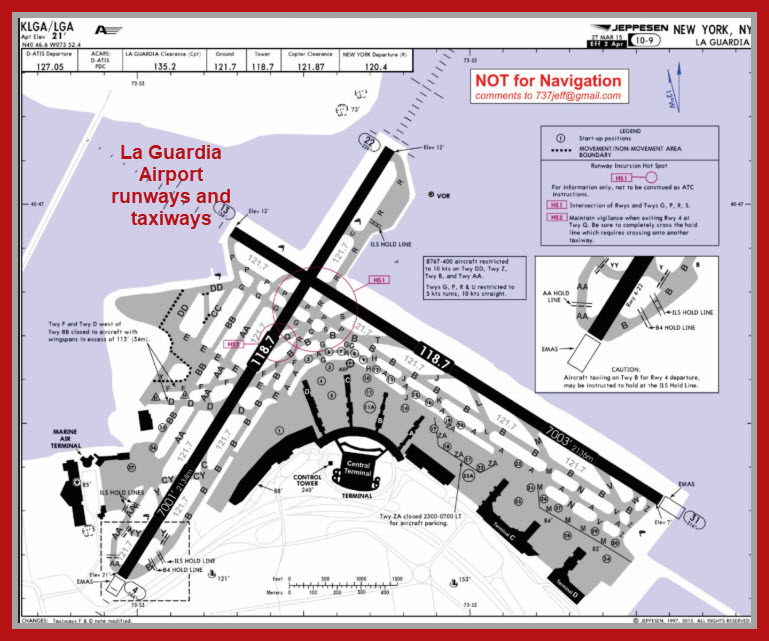
- The specific intersection—Runway 31 at Taxiway K—was already known as a high‑risk geometry with tight timing margins.
- Prior reports highlighted confusion about ARFF crossing clearances during emergency responses
- The controller was simultaneously handling multiple runway operations, late‑night staffing constraints, and an ongoing emergency response.
- The ARFF vehicle was cleared to cross, but the controller did not maintain awareness of the Air Canada aircraft on short final.
- The NTSB is examining whether the controller’s workload and task switching directly contributed to the failure to cancel the crossing clearance.
- Controllers relied on visual confirmation of runway occupancy at night, with glare, rain, and limited sightlines.
- ARFF vehicles had limited conspicuity, and the A220 crew had no realistic chance to see the truck in time.
- No surface‑movement safety net (e.g., ASDE‑X/Runway Status Lights) covering the specific intersection.
- ARFF vehicles lacked automatic runway incursion warning systems.
- The A220 had no cockpit alert that a vehicle was on the runway.
From a broader perspective it may be fair to say
The FAA has relied on procedural workarounds and human vigilance to compensate for known structural hazards, instead of redesigning the system or adding technological safety nets.
ASMSO’s processing of these two cases hopefully will demonstrate their fortitude to create real change in the FAA’s attention to the historical data points that must be addressed. Not just quick operational fixes but TRUE CORRECTIONS THAT WILL REDUCE THE LONG TERM RISKS so as to assure safety. The Administrator has set your mission and given you the authority. All in aviation are supporting ASMSO; safety may not attain 100% safety; but the people in all aspects of civil aviation will support ASMSO 1000%

Decades of aircraft and ground vehicle near misses at LGA preceded fatal crash
SEVERAL NEAR-MISSES BETWEEN AIRCRAFT AND GROUND VEHICLES AT NEW YORK CITY’S LAGUARDIA AIRPORT (LGA) preceded the late-night March 22 runway collision between an Air Canada Jazz CRJ 900 and a firetruck which killed both pilots and seriously injured dozens, according to a review of public safety data by The Air Current.
In 2015, an Embraer E190 came within about 1,300 feet of an airport vehicle that had driven across the aircraft’s take-off runway without authorization while assisting with scheduled maintenance. That same year, two snow plows crossed the runway hold markings after an air traffic controller had cleared a Boeing 737 for takeoff, placing the vehicles just 180 feet from the airliner. In 2012, a ground vehicle came too close to a runway without authorization and caused an aircraft on final to go around.
Safety reports in public databases show a long history of runway incursions and near-collisions on the ground at the geographically constrained New York City airport. Some of them appeared to have taken place under similar circumstances to the March 22 accident, which occurred as an airport fire truck crossed runway 4, which the CRJ was landing on, while responding to another aircraft experiencing an emergency at the other side of the airport.
In December 2000, an Airbus A320 overflew a snow plow by what pilots estimated to be as little as 50 feet while departing from LGA’s runway 4 late at night. Two public reports of that incident said the air traffic controller was working a combined tower and ground frequency, which also appeared to be the case for the March 22 accident, according to online air traffic control audio recordings. (It is not uncommon for air traffic controllers to work “combined” frequencies late at night as traffic winds down.)
In 1996, another airliner at LGA reported having to “abruptly” brake on landing to the same runway after the crew saw an airport vehicle cross in front of them.
The Federal Aviation Administration and the National Transportation Safety Board did not immediately respond to requests for comment.
Other reports in public FAA databases detailed situations that did not present a conflict to aircraft, but involved unauthorized movement of ground vehicles or entry into a runway area. Some occurred in the ramp area where aircraft park.
In 2021, pilots at the airport reported having to bring their aircraft to a sudden stop after a fuel truck failed to give way, as is generally required at airports. A flight attendant sustained minor injuries. The pilot as part of their report called it the “worst example of airport vehicle driving I have seen in a 30 year aviation career.”
In 2014, a pilot said they had to bring the aircraft to a “jarring halt” after a Port Authority of New York and New Jersey vehicle passed in front of them. A similar hard braking incident followed in 2016.
LaGuardia, the closest major airport to Manhattan, is one of the busiest airports in the U.S. that commonly sees tightly spaced approaches and long lines of aircraft waiting to take off. Its design is uniquely complex, with two 7,000-foot runways which intersect each other in a compressed footprint in the borough of Queens.
The March 22 crash is the third hull loss for the CRJ regional jet fleet in 14 months, after the January 2025 midair collision near Washington D.C. between an American Eagle CRJ700 and a U.S. Army Black Hawk helicopter and a landing accident in Toronto the following month involving a Delta Connection CRJ900. MHI RJ Aviation, a unit of Mitsubishi Heavy Industries, acquired responsibility for the fleet from Bombardier in 2020.
The incidents at LGA are part of a broader pattern of runway incursions in aviation that FAA and NTSB officials have been attempting to solve for decades. The FAA DEFINES A RUNWAY INCURSION as the “incorrect presence of an aircraft, vehicle or person on the protected area of a surface designated for the landing and take off of aircraft.”
To address the persistent problem of runway incursions, the FAA in 2023 initiated several efforts to improve controller staffing, awarded airport grant money to procure new safety systems and accelerated the deployment of ATC alerting technology.
FAA data shows that there has not been a sustained improvement in runway incursions across the National Airspace System since fiscal year 2023, in which there were 1,760 reported. The following year saw 1,758 incursions. In fiscal year 2025, there were just over 1,600 runway incursions, but fiscal year 2026 has seen 498 occurrences through January, which is more than 100 above what was reported in the first half of the 2026 fiscal year and on par with 2023.
The NTSB said in a statement Monday morning that it had deployed a “go team” to the site of the March 22 accident, headed by Board Chair Jennifer Homendy and newly-confirmed Board Member John DeLeeuw. Transportation Secretary Sean Duffy and FAA Administrator Bryan Bedford also said on social media they were enroute to New York City.

