Yogi knew aviation’s past could point to its future innovative utilizations
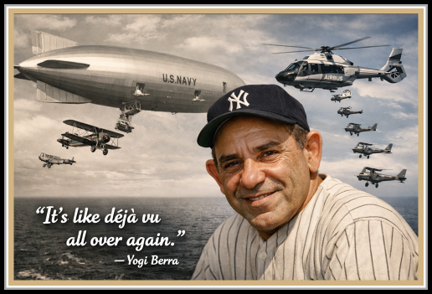
Aerial innovation isn’t just the technology, but the massive range of new commercial applications created by those new aircraft. UASs and eVTOLs product entrepreneurs are just at the initial stages of developing their creative uses.
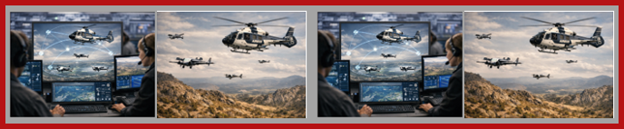
AIRBUS announced a dynamic integration of helicopters with unmanned aircraft. By linking these two aerial vehicles with an “intuitive, ruggedised tablet” {verbatim quote spelling} (HTEAMING) that facilitates the crew flying the helio while the software
- Mission‑level autonomy: The drones interpret intent‑based commands like “Scout Area A” or “Inspect Object B.” They plan routes, avoid obstacles, and execute sensor tasks without continuous joystick input.
- Dynamic replanning: Each UAS can adapt to environmental changes (wind, obstacles, signal degradation) and coordinate with the helicopter and other drones to maintain formation or coverage.
- Collaborative AI layer: The system fuses sensor data and mission logic so the helicopter acts as a command node, not a pilot‑in‑charge for each drone. The drones share situational awareness and can self‑deconflict.
- The flight crew retains strategic authority — they define objectives, boundaries, and safety envelopes. Think of it as tasking, not controlling.
- The crew can override or abort any drone’s mission instantly; the autonomy is bounded by airspace and mission constraints uploaded before launch.
- The human‑machine interface (HMI) shows live telemetry, health, and intent visualization — the crew sees what each drone “plans” to do, not just where it is.
- Airbus’s design philosophy: “Human‑in‑the‑loop, autonomy‑in‑execution.” The helicopter crew remains responsible for mission outcomes and airspace compliance, while the drones handle tactical execution.
The software control logic and autonomy stack are directed to the drones, not the helicopter. Airbus’s HTEAMING is a distributed autonomy model — the crew supervises and commands, while the drones handle tactical execution. The helicopter is the orchestrator, not a participant in the autonomy loop.
Airbus sees the following missions for its helicopter/drone wingman concept:
-
-
- Search and rescue
- Wildfire tactical management
-
Other possibilities may include:
-
-
- Disaster response hurricanes, earthquakes, or wildfires — before rescue operations begin:
- damage mapping
- road access assessment
- utility status checks
- debris field analysis
- Post disaster insurance and community redevelopment will be able to initiate plans without being on the ground—shortening time to recover
- Crime/Hostage situation- single helicopter (noisy) can launch multiple drones (quieter) to give LEOs better assessment of situation without the significant alert that a close helicopter.
- Disaster response hurricanes, earthquakes, or wildfires — before rescue operations begin:
-
The HTEAMING will likely add to the value of existing drone uses like:
-
-
- Powerline, Pipeline, and Utility Corridor Inspection
- Railway Network Monitoring
- Environmental Monitoring & Wildlife Management
- Agriculture & Forestry Not crop‑dusting — but:
- multispectral crop health surveys
- forest canopy mapping
- drought stress detection
- invasive species monitoring
- Infrastructure & Construction Oversight
- Surveying & Mapping
- Multiple simultaneous views may lead to more precise 3D
- Offshore Energy Support
-
That impressive array of uses which the helio/drone combination created is, as Yogi Bera once added this valuable bit of wisdom[i] said—
DÉJÀ VU ALL OVER AGAIN
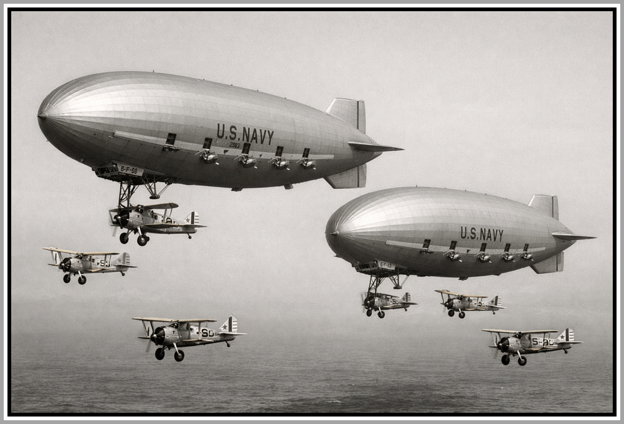
Aviation historians[1] would immediately use Yogi’s phrase to remind us of the USS Akron and USS Macon. Two dirigibles that served as aircraft carriers for airplanes, specifically designed to carry and launch small biplanes for reconnaissance missions. Both airships operated in the early 1930s.. They featured trapeze systems for launching and recovering aircraft while remaining airborne. This innovative APPROACH ALLOWED FOR LONG-RANGE SCOUTING BEYOND THE FLEET’S IMMEDIATE AREA.
Aviation appears to follow the words of Jean‑Baptiste Alphonse Karr in 1849–
“PLUS ÇA CHANGE, PLUS C’EST LA MÊME CHOSE.
[‘the more things change, the more they remain the same”]
The AIRBUS’ innovation, however based in the past, opens up a myriad of novel applications. THINK ABOUT ONE that really works and you could be rich. When you do, contact Mike Rioux to work your way the FAA certification maze.

Beyond the lone aircraft: The power of teaming for life-saving operation
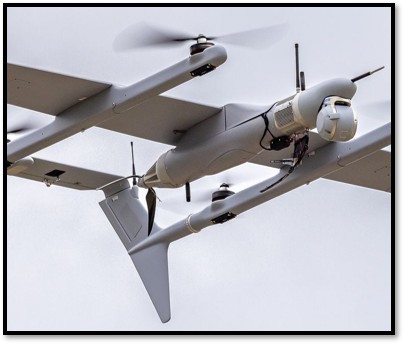
Airbus is challenging the “drones vs. helicopters” narrative. By combining human intuition with autonomous technology, a new era of teaming together crewed and uncrewed aircraft is transforming how we protect lives and landscapes during critical emergencies.
While drones are often viewed as the successor to the helicopter, Airbus is pioneering a different reality: one where the two do not compete, but collaborate. This advanced capability, known as crewed-uncrewed teaming, combines the endurance of uncrewed systems with the heavy-lift capability and rapid decision-making of a piloted helicopter.
Search and rescue missions: Finding the needle in the haystack
In the high-stakes environment of a search and rescue mission, deploying one solo helicopter to find a single person in a vast ocean is a challenge that demands precision. Through the use of teaming, a helicopter can arrive on the scene with several digital “scouts.”
These drones fan out to scan the surface using computer vision and thermal imaging, while the helicopter crew focuses entirely on the rescue plan. Once one of the drones identifies the victim, coordinates are instantly synced, allowing the crewed aircraft to fly directly to the location to conduct the rescue operation.

A proactive shield against wildfires
Early detection is critical for firefighting in the face of evolving climate challenges. While a single helicopter can monitor one ridge, a helicopter teaming with a fleet of autonomous drones can monitor an entire forest. They identify “hot spots” before they escalate, enabling more efficient resource deployment and a higher level of safety for ground crews. The result is fires that are quickly contained and extinguished, protecting crews and communities alike. 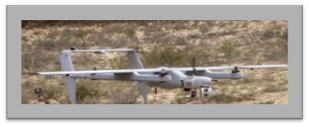
The tech: Solving the cognitive load
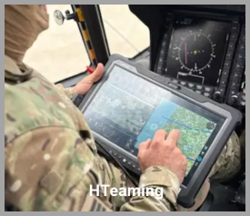
The greatest challenge in the collaboration between drones and helicopters is managing the pilot’s workload. Airbus has developed a specialised ecosystem called HTeaming which ensures seamless integration without overwhelming the crew. This solution features an intuitive, ruggedised tablet that can be integrated into a cockpit in just a few hours. The system relies on high-level autonomy where the crew “tasks” the drones with commands like “Scout Area A”. The drone’s onboard intelligence handles flight paths and obstacle avoidance, freeing up the crewed helicopter to focus on the mission at hand. Additionally, encrypted, low-latency data links ensure the entire connection remains cyber-secure. {n.b. the spelling is the author’s preferred version.}
Experience meets innovation
This technology is far more than a theoretical concept. Drawing on decades of vertical flight experience, Airbus has conducted successful field trials with the Singaporean authorities, the Spanish Navy, and the French Armed Forces. These exercises prove that teaming performs effectively in high-stakes civil missions, increasing the safety of crews and the efficiency of rescuers.
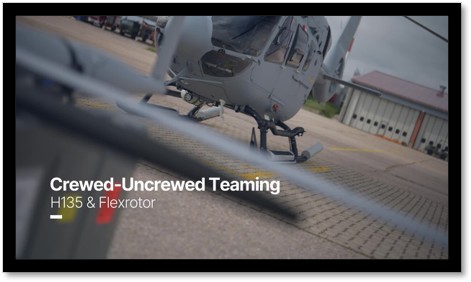
The future of aerial support
We are moving away from the era of the “lone aircraft” and into the era of the integrated fleet. By combining human intuition with autonomous tech, Airbus is redefining what is possible in the sky.
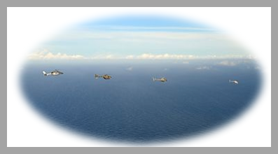
The collaboration between drones and helicopters isn’t just about a step up in technology; it also increases the safety of our crews, the efficiency of our rescuers, and the security of our borders. By combining the best of human intuition with the best of autonomous tech, we aren’t just protecting people – we are redefining what is possible in the sky.
[1] Self-disclosure: I may qualify as an amateur aviation historian- 54 years as an air lawyer (a/k/a airhead?), 10 years as a National Air & Space Museum (DC) docent and a far too large collection of books about pilots, engineers, pioneers, FAA, the OEMs (i.e., the designer of the Sopwith Camel was Thomas Octavious MURDOCK Sopwith) 😉
[i] A cunning linguist would call this phrase a Redundant Intensifier (Pleonasm)!!!
