What many steps BEFORE an AAM operating industry can be ACHIEVED ???
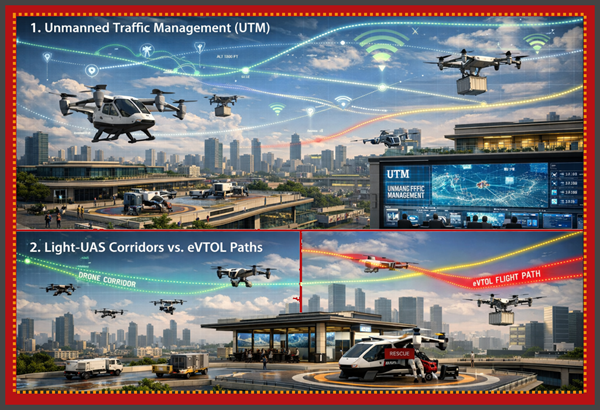
Honeywell has offered an extremely useful review of the steps that the AAM/UAM/eVTOL/UAS must occur before the high expectations that surround this nascent aviation industry becomes viable. The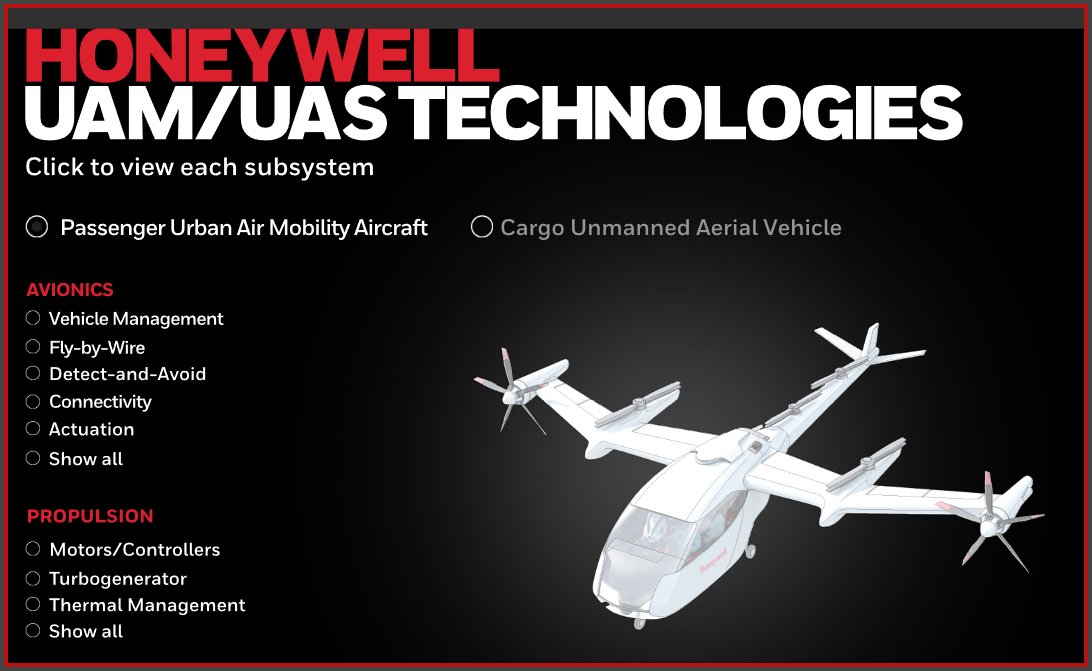 Company has an unusually broad perspective for the business and what it needs; plus it is very familiar with the two primary regulators. Its vision is insightful, but more macro than micro in its focus. Copilot AI has helped create this more granular check list (substantial revisions and additions by author):
- Supranational and national aviation level (EASA, FAA, ICAO, etc. )
1.1. Align core certification philosophy for eVTOL/AAM
- Define categories and use cases:
Regulatory standards that distinguish among eVTOL/AAM operations; i.e., passenger air taxi, cargo, medical, regional, etc.). Then assign these classes of operations into existing categories, i.e., powered‑lift, rotorcraft, small airplane, UAS.
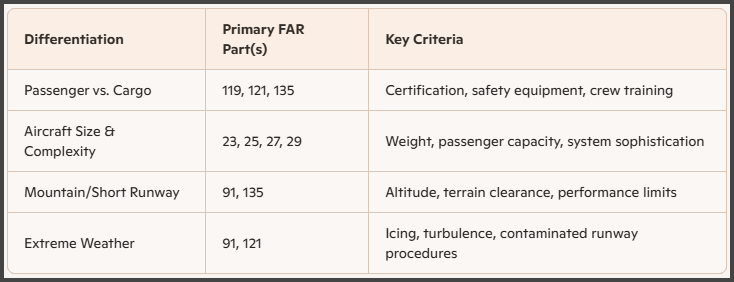
→ N.B. historic safety rules have differentiated by size of aircraft, cargo v. passengers, areas of operations, etc. as shown in this table. These distinctions require significant discussion and rulemaking.
- Harmonize safety objectives:
Agree on target levels of safety, redundancy expectations, and acceptable failure probabilities for critical systems. - Coordinate special conditions and means of compliance:
Map EASA SC‑VTOL, FAA powered‑lift rules, and other authorities’ frameworks so that an OEM can design once and certify with minimal redesign.
1.2. Establish aircraft certification pathways
- Type certification framework:
Define eVTOLs the processes and standards for type certification (TC) and production certificates (PC) and airworthiness certificates (AC) ,especially the innovative technologies–electric propulsion, distributed lift, autonomy, and novel materials. The engineering of these elements do not have well-known criteria for airworthiness determination; so, the tests for them will be a challenge and conformity between the 2 authorities will facilitate these processes. - System‑level assurance:
Create guidance for software, flight controls, energy storage, detect‑and‑avoid, and health‑monitoring systems tailored to eVTOL architectures. - Continued airworthiness:
Set consistent expectations for inspections, life‑limits, battery replacement, software updates, and configuration control. In the past, the initial set of rules usually are revised during the early operations; so, the parties must share data so as to be able to alter the limits as operational history accumulates.
1.3. Define operational rules and pilot/crew requirements
- Operational rule set:
Decide whether operations fall under adapted air carrier rules (e.g., Part 135 equivalents) or a new AAM framework, including maintenance and dispatch requirements. - Pilot licensing and training:
Define ratings, training syllabi, and recurrent checks for eVTOL pilots (and a roadmap toward higher automation and eventual single‑pilot or autonomous ops).
- Crew concepts and human factors:
Clarify roles of onboard crew vs. remote supervisors, procedures for abnormal situations, human–machine interface expectations and crew fatigue requirements (short hops and day/night shifts will characterize these flights).
1.4. Integrate AAM into air traffic management
- Airspace structure and procedures:
Define how AAM corridors, vertiport routes, and transition zones interact with existing controlled/uncontrolled airspace and helicopter routes. - Separation and surveillance concepts:
Decide what surveillance (radar, ADS‑B, multilateration, networked data) and separation minima are required for dense AAM operations. - Digital/UTM‑style services:
Develop a framework for highly automated flight planning, strategic deconfliction, and dynamic rerouting, potentially integrating UTM concepts with traditional ATC.
1.5. Set high‑level infrastructure and vertiport standards
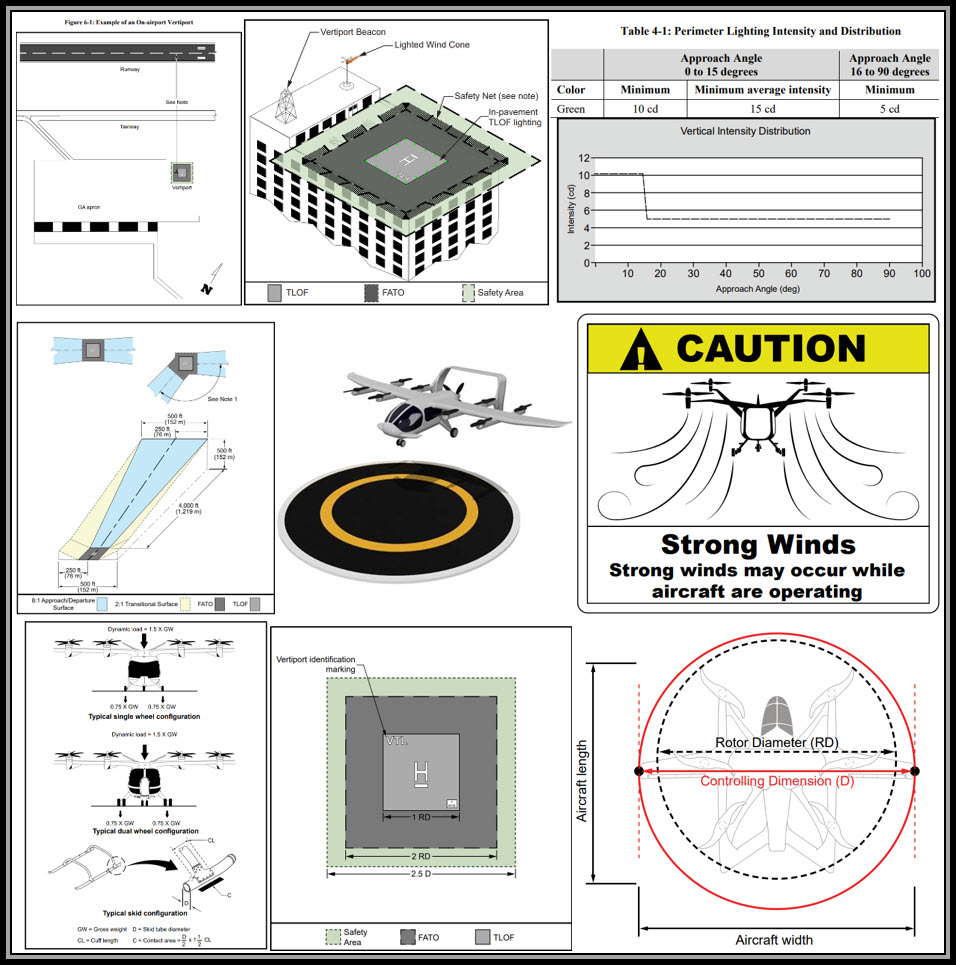
- Vertiport design criteria:
Publish baseline requirements for pads, safety areas, obstacle clearance, lighting, markings, firefighting, and emergency access. - Energy and charging standards:
Define interoperable charging interfaces, power quality requirements, and safety protocols for high‑power electric infrastructure and possibly hydrogen. - Security and access control:
Establish minimum security screening, perimeter control, and passenger flow standards appropriate to AAM risk profiles. SETTING OF THESE STANDARDS will actually involve additional governmental agencies.
1.6. Environmental, noise, and community‑impact frameworks
- Noise metrics and certification:
Agree on how to measure and certify eVTOL noise (procedures, metrics, contouring) and how to compare it to helicopters and ground traffic. - Emissions and lifecycle considerations:
Provide guidance on lifecycle emissions, battery disposal, and incentives for low‑carbon operations. - Community engagement expectations:
Set expectations that operators and authorities must conduct community outreach, noise studies, and public consultation before large‑scale deployment.
- State, regional, and local government level
2.1. Translate national standards into local policy
- Adopt national/ICAO‑aligned definitions:
Use the national categories and safety frameworks as the basis for state and municipal regulations to avoid local “one‑off” definitions. - Reference national vertiport and infrastructure standards:
Incorporate national design standards by reference into building codes, fire codes, and transportation plans. This effort could only realistically be done at a macro level, while implementing it is likely to be driven by local needs
2.2. Zoning and land‑use planning
- Identify eligible zones for vertiports:
Decide where vertiports may be located (commercial districts, existing airports, rail hubs, rooftops, industrial zones) and where they are prohibited (schools, sensitive neighborhoods). - Height, density, and setback rules:
Update zoning to account for approach/departure paths, obstacle limitation surfaces, and safety buffers around vertiports. - Integration with long‑range planning:
Embed AAM corridors and nodes into regional transportation plans, TOD (transit‑oriented development) strategies, and resilience plans.
2.3. Noise, environmental, and community protections
- Local noise ordinances aligned with national metrics:
Adapt local noise rules to use the same metrics and measurement methods defined nationally, then set local thresholds and operating hours—depending on whether in the US and EU (?) preemption prevails. - Environmental review processes:
Define when vertiports and AAM routes trigger environmental impact assessments and what mitigation (barriers, curfews, routing) is required. - Community consultation mechanisms:
Create formal processes for public hearings, complaint handling, and periodic review of AAM operations’ community impact.
2.4. “Police powers”: safety, security, and emergency response
- Emergency response planning:
Coordinate with fire, EMS, and law enforcement on response plans for vertiport incidents, off‑airport landings, and battery fires. - Local security requirements:
Implement access control, surveillance, and local law‑enforcement coordination consistent with national security guidance. - Operational restrictions and enforcement:
Define how local authorities may/may not (preemption?) restrict operations (curfews, weather minima, special events) and how violations are detected and penalized.
2.5. Ground transportation and intermodal integration
- First/last‑mile connectivity:
Ensure vertiports are integrated with buses, rail, micromobility, and pedestrian networks to avoid “islands” of access. - Curb management and traffic flow:
Plan for pick‑up/drop‑off zones, parking, and congestion management around vertiports. - Accessibility requirements:
Apply ADA‑style accessibility standards to vertiports and connecting infrastructure.
2.6. Local permitting and building processes
- Vertiport building permits:
Create clear permitting pathways for new‑build vertiports and rooftop conversions, referencing national design standards. - Inspection and compliance regimes:
Define how local building, fire, and electrical inspectors will certify and periodically inspect AAM infrastructure. - Data‑sharing expectations:
Require operators to share operational and noise data to support ongoing oversight and community transparency.
- Private‑sector responsibilities and build‑out
3.1. Vehicle OEMs and system suppliers
- Design to hopefully harmonized standards:
Engineer aircraft, batteries, and avionics to meet the converged EASA/FAA requirements and anticipate global validation. - Industrialization and reliability:
Develop production systems, supply chains, and maintenance concepts that can support airline‑like dispatch reliability. - Digital ecosystem:
Provide integrated flight‑planning, fleet‑management, and health‑monitoring tools that plug into ATC/UTM and operator systems.
3.2. AAM operators and airlines
- Business model and network design:
Define routes, frequencies, pricing, and target markets (airport shuttles, city‑to‑city, tourism, cargo) that can be profitable under regulatory constraints. - Operational safety management:
Build safety management systems (SMS), training programs, and maintenance organizations aligned with air carrier‑level expectations. 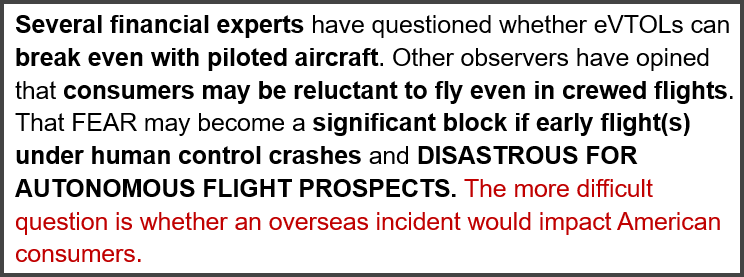
- Customer experience and trust:
Design booking, boarding, and customer‑service processes that feel intuitive and safe to non‑aviation customers.
3.3. Infrastructure developers and vertiport operators
- Site selection and feasibility:
Identify candidate sites based on demand, airspace feasibility, grid capacity, and local political support. - Design and construction:
Build vertiports that meet national standards and local codes, including structural reinforcement for rooftops, firefighting systems, and passenger facilities. - Energy and grid integration:
Coordinate with utilities to secure sufficient power, implement smart charging, and possibly integrate storage or on‑site generation.
3.4. Electric Source and distribution
- megawatt‑scale power and hundreds of kWh per aircraft—even for “average” AAM.
- Order‑of‑magnitude per aircraft
Most near‑term passenger eVTOL/AAM concepts (4–6 seats, ~20–40 min missions) are in this ballpark: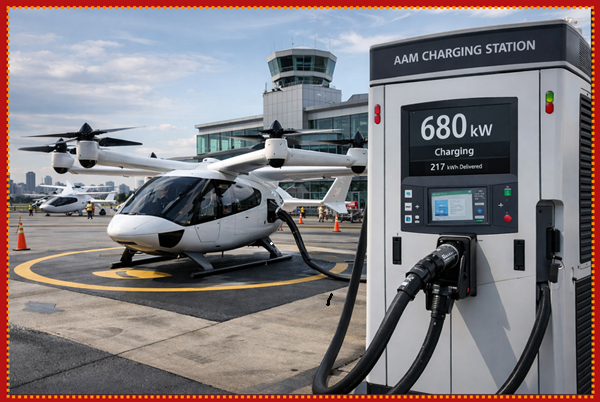
- Battery capacity per aircraft:
~150–300 kWh (some concepts higher, but this is a reasonable working range). - Turnaround recharge time target:
15–30 minutes at a vertiport to keep utilization up. - Implied charger power per stand:
- Vertiport‑level power requirement
Studies and industry analyses converge on this range:
-
-
- Continuous vertiport power:
Typical modeling shows ~1.5–5 MW continuous for a modestly busy vertiport, depending on:- Number of stands
- Turnaround time
- State‑of‑charge window (how deep you cycle the battery)
- Local climate (battery heating/cooling
- Peak power during busy banks:
- If you have, say, 4 stands at 400–800 kW each, peak charging load alone is roughly:
- Low: (4 \times 0.4 = 1.6\ \text{MW})
- High: (4 \times 0.8 = 3.2\ \text{MW})
- Add auxiliary loads (terminal, lighting, HVAC, IT, safety systems), and you’re easily in the 2–4+ MW range even for a relatively small site.
- Higher‑density concepts (10–12 simultaneous movements) can push >10 MW peak, comparable to a medium data center or a small town.
- If you have, say, 4 stands at 400–800 kW each, peak charging load alone is roughly:
- Energy per hour of operation
- Continuous vertiport power:
-
A quick way to think about energy, not just power:
-
-
- Example: 4 stands, each turning one aircraft per hour, each taking 200 kWh:
- Energy per hour:
[ 4 \times 200\ \text{kWh} = 800\ \text{kWh/hour} ] - That’s an average power of 0.8 MW, even if the instantaneous charging is spiky.
- Energy per hour:
- Scale that up to 8–10 movements/hour and you’re at 6–2.0 MWh/hour (1.6–2.0 MW average), with peaks several times higher depending on how synchronized arrivals are.
- What to use as a planning “average AAM” assumption
- Example: 4 stands, each turning one aircraft per hour, each taking 200 kWh:
-
If you need a single planning number per stand for early‑stage vertiport modeling, a defensible, conservative assumption is:
-
-
- Per AAM stand:
- Battery energy per turnaround: ~150–250 kWh
- Charger rating: ~500–800 kW DC
- Small vertiport (3–5 stands):
- Peak charging load: ~2–4 MW
- Total site peak (with auxiliaries): ~2.5–5 MW
- Average energy use: depends on schedule, but ~1–3 MWh per busy hour is a reasonable envelope for high‑utilization periods.
- Per AAM stand:
-
3.5. Technology and data providers
- Traffic management and deconfliction tools:
Develop software for strategic and tactical deconfliction, demand‑capacity balancing, and integration with ATC. - Navigation, mapping, and digital twins:
Provide high‑fidelity urban terrain data, obstacle databases, and digital twins to support procedure design and real‑time operations. - Cybersecurity and resilience:
Implement robust cybersecurity for aircraft, vertiports, and cloud systems to protect against interference and data breaches.
3.5. Financing, insurance, and risk allocation
- Capital for fleets and infrastructure:
Structure financing for aircraft, vertiports, and charging systems, often via public‑private partnerships or infrastructure funds. - Insurance products:
Develop hull, liability, and infrastructure insurance tailored to AAM risk profiles and operational concepts. - Performance and availability guarantees:
Create contractual frameworks between OEMs, operators, and infrastructure providers that allocate technical and operational risk.
3.6. Public acceptance and market development
- Demonstrations and pilot programs:
RUN EARLY SERVICES (CARGO, MEDICAL, LIMITED PASSENGER) TO PROVE RELIABILITY, SAFETY, AND NOISE PERFORMANCE. - Transparent communication:
SHARE DATA ON SAFETY, NOISE, AND ENVIRONMENTAL PERFORMANCE WITH COMMUNITIES AND REGULATORS. - Iterative refinement:
USE FEEDBACK FROM EARLY OPERATIONS TO REFINE ROUTES, PROCEDURES, AND INFRASTRUCTURE BEFORE SCALING.
That’s literally and figuratively a daunting set of tasks. So much of these steps cascade from the national level down to regional/state/local governments and finally the private sector; thus the places where these aerial vehicles will operate. For example, the private sector welcomes ONE COLLABORATED SET OF RULES, while the local players will bridle at being told what is allowable noise impacts to their neighborhoods. Some cities and other non-federal organizations are preparing for this likely surge of AAMs and others may not have the resources to face what appears to be inevitable. In either event, it would be advisable to connect with people knowledgeable about terms like TC, Ldn, LPV, LNAV,VNAV, OCS, PCN, ACH, air taxi, air carrier, Part 91, 121, 135,141,145 and 139 (Engineering Brief 105 / 105A — Vertiport Design; Draft AC 150/5390‑4 — Vertiport Design [future]; TLOF/FATO geometry; Obstacle surfaces; Lighting/markings; Safety areas).

Airspace Infrastructure and Regulatory Collaboration in the Skies We Share
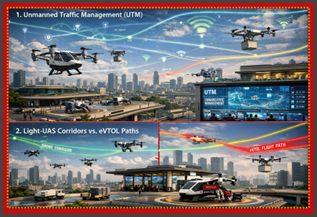
As advanced air mobility moves closer to scale, airspace infrastructure and regulatory collaboration are becoming the critical path. Sapan Shah shares how coordination will shape safe expansion.
If you go back several years, most of the focus in advanced air mobility (AAM) was on certification of the vehicles themselves. We were asking: how do you certify something that doesn’t look like a traditional fixed-wing aircraft or a helicopter?
For decades, we’ve known how to certify Boeings, Gulfstreams, Bells, Robinsons. These new electric and hybrid-electric aircraft required regulators to think differently. I would say we’ve largely put that part behind us.
There are now CLEARER RULES around HOW THESE VEHICLES WILL BE CERTIFIED AND HOW THEY WILL OPERATE. In the last couple of years, the Federal Aviation Administration (FAA) has issued final rules around air taxi operations, and now there are also draft rules for beyond-visual-line-of-sight (BVLOS) drone operations. So, progress is happening. BUT NOW THE FOCUS SHIFTS TO INFRASTRUCTURE.
New Types of Airspace Users
When we say, “new users,” it can mean many things. I tend to break them into three categories.
First, you have low-altitude drones. These are your package delivery operators flying in neighborhoods.
Second, you have AAM vehicles – the air taxis, and their operators that will initially integrate into the national airspace much like general aviation aircraft today.
Third, you have heavier drones. Unlike backyard delivery drones, these are larger – sometimes the size of a car – moving cargo from the outskirts of a city into the city center or even between cities.
We already hear stories about aging air traffic infrastructure and shortages of controllers. None of these three types of vehicles are operating at scale today. But as they begin to operate at higher tempo, the question becomes: can the infrastructure and processes we have in place today support that growth without compromising safety?
Infrastructure Is Becoming the Critical Path
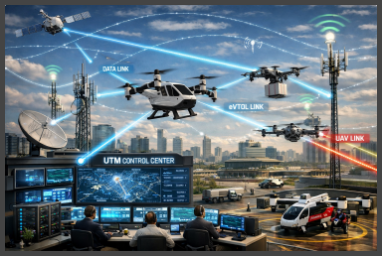
Earlier, the emphasis was on certification rules because that was the unknown. Now that clearer rules exist, the conversation naturally moves to infrastructure. Infrastructure is not just physical landing sites. It is also the processes and digital systems that manage traffic.
For low-altitude drones, there has been significant work over the past several years around unmanned traffic management (UTM). NASA and the FAA have been working with the industry to define how smaller drones can operate autonomously within certain geofenced areas without requiring involvement from air traffic control (ATC).
Field trials are already happening across the country and globally. The idea is that these systems manage themselves digitally within defined boundaries, while remaining integrated with existing ATC to avoid conflicts.
As we move up in altitude to air taxis, the initial operations will integrate into the national airspace much like general aviation aircraft today. But as scale increases, we cannot rely solely on human-controlled voice communication at current levels.
There has to be evolution – more digital exchange, more data sharing, and new frameworks like digital flight rules.
It is not about removing controllers. It is about shifting from purely active control to more active monitoring supported by digital systems.
Physical Infrastructure Is a Real Constraint
You can certify an aircraft, but that does not automatically mean you have places for it to operate. As AAM flights start to become more common, operations can leverage existing general aviation airports. The U.S. has thousands of them.
But the intended use cases go beyond airport-to-airport travel[ ED: contrary concern of UA CEO]. The idea is to connect suburbs to downtown areas or enable point-to-point operations that will not touch an airport at all, and creating those sites is not simple.
It involves local governments, zoning approvals, community engagement, and aviation certification processes. There’s physical infrastructure to install, digital connectivity to integrate and surrounding airspace to evaluate. Today, that part of the ecosystem is still developing.
Regulatory Harmonization Enables Scale
Another area that remains important is harmonization across regulatory bodies. It is critical that FAA and the European Union Aviation Safety Agency (EASA) continue narrowing gaps SO THAT OPERATORS CAN CERTIFY ONCE AND OPERATE GLOBALLY. That reduces duplication of effort and increases investor confidence.
In the U.S., I would say that several years ago the situation felt more uncertain. With recent activity from Congress and the FAA, there has been acceleration in rulemaking. But there are still areas where more clarity is needed, particularly around heavier drones and how they integrate into shared airspace at scale.
Infrastructure and regulatory frameworks have to move together. If one advances significantly faster than the other, progress will slow.
Scaling Requires Ecosystem Alignment
In this area, COLLABORATION ISN’T OPTIONAL.
You need alignment from airframers, suppliers, regulators, legislators, infrastructure providers, digital service providers, and local authorities. AAM is not something that can be solved by a company operating in a vacuum. It requires ecosystem coordination.
At Honeywell Aerospace, we provide systems that translate pilot input into aircraft motion – inceptors, flight controls, avionics, actuation. But we also work closely with regulators and newer entrants to support certification processes. Many of these companies are new to aviation and benefit from experience in navigating regulatory pathways. And beyond the hardware, we’re also part of the conversations shaping how this ecosystem develops.
If aircraft innovation accelerates but infrastructure planning lags, operations will still occur, except they’ll look more like demonstrations than scalable operations. You may see defined corridors, limited city pairs, or exhibition-style services. But the broader economic impact will be delayed.
“Infrastructure tends to be invisible when it works. When it doesn’t, everyone feels it.”
The aircraft are progressing toward certification. The regulatory direction is clearer than it was several years ago.
The next phase requires ensuring that infrastructure, both physical and digital, keeps pace.
That includes
- modernizing traffic management systems,
- aligning international regulatory standards
and
- engaging local communities where operations will occur.
If the ecosystem moves in coordination, this can scale safely. But deliberate alignment across all participants in the system will determine the pace of infrastructure modernization and regulatory progress.