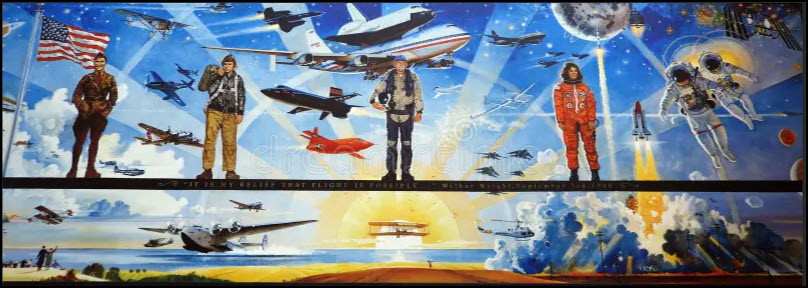
What has AVIATION done 223 years later- agree/disagree with AI rankings ???
By Sandy Murdock • December 16, 2025
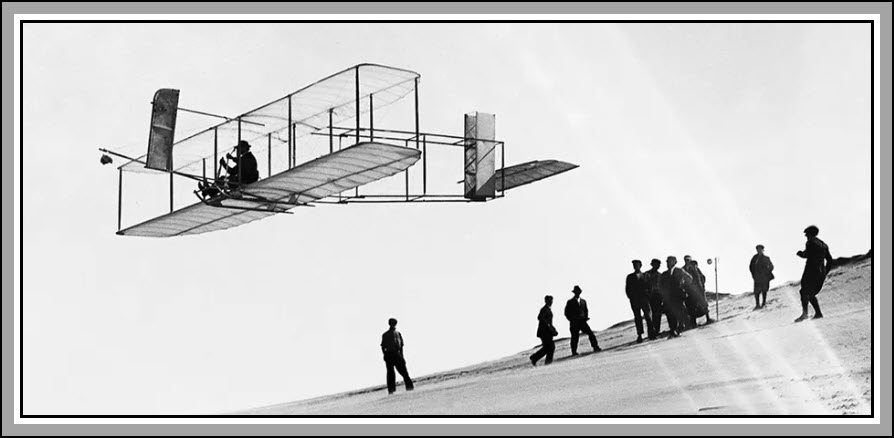
Today is the 223rd anniversary of two bicycle makers, the Wright Brothers,
-
operating a vehicle,
-
powered by an efficient engine designed and created by their mechanic, Charles Taylor,
-
controlled
-
ROLL by a hip cradle that adjusted the wing-warping
-
YAW by adjusting the vertical rudder
-
PITCH by adjusting the forward canard
-
these elements set the 1903 Flyer apart from predecessors!!!
-
-
Prior to this seminal date, contemporary experts had concluded that man would never fly. Below are two lists (both AI generated- PLEASE AGREE/DISAGREE by posting comment(s).
Here’s a curated list of the top 50 civil aviation safety advances since the Wright Brothers’ first flight in 1903. These milestones highlight how aviation evolved into one of the safest modes of transportation.
️ Early Foundations (1900s–1930s)
-
-
-
-
-
-
-
-
-
-
-
1908 – First recorded fatal crash (Lt. Thomas Selfridge) → sparked awareness of aviation risk
-
1919 – Paris Convention establishes international air navigation rules
-
1926 – U.S. Air Commerce Act mandates pilot licensing and aircraft inspections
-
1930s – Introduction of radio communications for air traffic control
-
1938 – Civil Aeronautics Act creates U.S. regulatory oversight
-
-
-
-
-
-
-
-
-
-
Mid-Century Safety Framework (1940s–1950s)
-
-
-
-
-
-
-
-
-
-
-
1944 – Chicago Convention creates ICAO
-
1947 – Standardized air traffic control procedures adopted globally
-
1948 – First crash investigation boards established
-
1950s – Introduction of pressurized cabins improves passenger safety
-
1958 – FAA established in U.S. to regulate safety
-
-
-
-
-
-
-
-
-
-
✈️ Jet Age Safety Innovations (1960s–1970s)
-
-
-
-
-
-
-
-
-
-
-
1960 – Weather radar introduced in civil aircraft
-
1963 – ICAO adopts standardized ATC phraseology
-
1967 – Flight Data Recorder (Black Box) mandated
-
1970 – Cockpit Voice Recorder requirement expanded worldwide
-
1972 – Ground Proximity Warning System (GPWS) introduced
-
1978 – U.S. Airline Deregulation Act includes safety oversight reforms
-
1979 – ETOPS rules for twin-engine transoceanic safety
-
-
-
-
-
-
-
-
-
-
️ Digital & Human Factors Era (1980s–2000s)
-
-
-
-
-
-
-
-
-
-
-
1981 – Crew Resource Management (CRM) training introduced
-
1982 – First glass cockpit avionics improve situational awareness
-
1988 – Enhanced GPWS (EGPWS) reduces CFIT accidents
-
1990s – GPS integrated into navigation for safer routing
-
1995 – ICAO adopts global safety oversight standards
-
1997 – Runway Safety Programs launched internationally
-
2001 – Post-9/11 security reforms (reinforced cockpit doors, screening)
-
2002 – Safety Management Systems (SMS) mandated by ICAO
-
2005 – ADS-B trials begin for collision avoidance
-
2008 – Fatigue Risk Management Systems introduced
-
-
-
-
-
-
-
-
-
-
Modern Era & Predictive Safety (2010s–2020s)
-
-
-
-
-
-
-
-
-
-
-
2010 – ICAO requires SMS for all operators
-
2012 – Data-driven safety analytics adopted by IATA
-
2014 – ICAO adopts global CO₂ and safety standards
-
2016 – Real-time aircraft tracking initiatives post-MH370
-
2017 – ICAO CORSIA includes safety/environmental monitoring
-
2018 – EASA introduces cybersecurity safety standards
-
2019 – Predictive maintenance using AI and big data
-
2020 – COVID-19 safety protocols reshape operations
-
2021 – ICAO adopts global cybersecurity framework for aviation safety
-
2022 – ICAO strengthens runway safety and loss-of-control prevention
-
2023 – FAA certifies eVTOL with strict safety protocols
-
2024 – Hydrogen/electric prototypes undergo rigorous safety certification
-
2025 – AI-driven predictive safety monitoring integrated fleet-wide
-
-
-
-
-
-
-
-
-
-
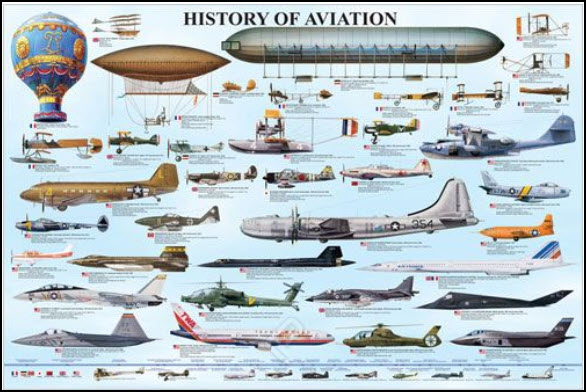
Here’s a curated list of the top 50 civil aviation milestones and technical advances since the Wright Brothers’ first flight on December 17, 1903. These events chart the transformation of aviation from fragile wood-and-fabric machines to today’s global air transport system.
Foundational Milestones (1903–1930s)
1903 – Wright Brothers’ first powered flight at Kitty Hawk
1909 – Louis Blériot crosses the English Channel
1914 – First scheduled commercial airline flight (St. Petersburg–Tampa Airboat Line)
1919 – First transatlantic flight by Alcock & Brown
1927 – Charles Lindbergh’s solo transatlantic flight (Spirit of St. Louis)
1930 – First modern airline stewardess service (United Airlines)
1933 – Douglas DC-1/2 development, precursor to DC-3
1935 – Douglas DC-3 enters service, revolutionizing airline economics
1938 – Civil Aeronautics Act creates U.S. regulatory framework
1939 – First jet-powered aircraft flight (Heinkel He 178, Germany)
✈️ Golden Age of Propeller Airliners (1940s–1950s)
1944 – Chicago Convention establishes ICAO
1947 – Chuck Yeager breaks the sound barrier (Bell X-1)
1947 – First pressurized cabin airliner (Lockheed Constellation)
1949 – De Havilland Comet first jet airliner flight
1952 – BOAC launches Comet jet service
1958 – Boeing 707 enters service, ushering in the Jet Age
1959 – FAA established in U.S.
1959 – Pan Am introduces transatlantic jet service
1960 – First weather radar in civil aircraft
1960s – Widespread adoption of jet engines in civil fleets
Jet Age Expansion (1960s–1970s)
1963 – ICAO adopts international air traffic control standards
1969 – Boeing 747 first flight, revolutionizing mass air travel
1969 – Concorde supersonic transport first flight
1970 – First widebody twinjet (DC-10)
1971 – Airbus founded, launching European competition
1976 – Concorde enters commercial service
1978 – U.S. Airline Deregulation Act, reshaping industry economics
1979 – First ETOPS rules for twin-engine transoceanic flights
1981 – Introduction of fly-by-wire (Airbus A320 program)
1982 – First glass cockpit avionics (Boeing 767)
️ Digital & Safety Advances (1980s–2000s)
1988 – Airbus A320 enters service with full fly-by-wire
1990s – GPS integrated into civil aviation navigation
1995 – Boeing 777 enters service, first all-digital design
1997 – ICAO adopts global safety oversight standards
2001 – Enhanced security post-9/11 reshapes civil aviation
2003 – Centennial of flight celebrations worldwide
2005 – Airbus A380 first flight, largest passenger aircraft
2007 – A380 enters service with Singapore Airlines
2011 – Boeing 787 Dreamliner enters service, composite materials revolution
2014 – ICAO adopts global CO₂ emissions standards
Modern Era & Sustainability (2010s–2020s)
2016 – First solar-powered circumnavigation (Solar Impulse 2)
2017 – ICAO CORSIA agreement on carbon offsetting
2019 – First electric regional aircraft prototype flights
2020 – COVID-19 pandemic reshapes global aviation operations
2021 – ICAO adopts cybersecurity standards for civil aviation
2022 – First hydrogen-powered regional aircraft test flights
2023 – FAA certifies eVTOL aircraft for limited operations
2024 – Sustainable aviation fuel (SAF) adoption accelerates
2025 – Hypersonic passenger prototypes under development
Ongoing – Integration of AI, automation, and greener propulsion systems
FEEL FREE TO AGREE OR DISAGREE IN THE COMMENTS SECTION OF THIS SITE