Space Launches and Air Space Intersect-WHAT’S UP?
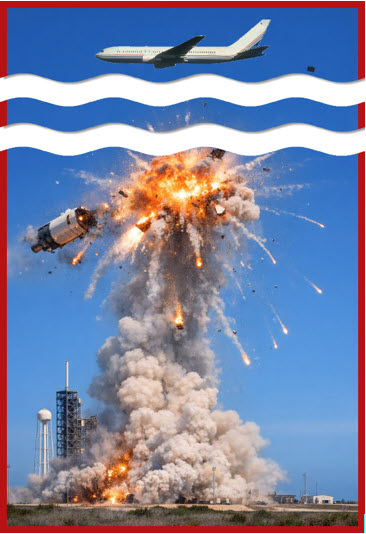
The subject of space has not been featured here because our focus is aviation safety. The recent interview inquired what the FAA is doing and is considering to deal with the almost doubling of launches (mostly by SpaceX) and the impact on all civilian flight around the Kennedy Space Center.
Below is a short interview with President Trump’s Secretary of Transportation, Sean Duffy about Brevard County, the heart of the U.S. launches— and how the balance between rocket missions and commercial flights has shifted in recent years, plus a VERY GENERAL description of what the FAA may do to change that imbalance going forward.
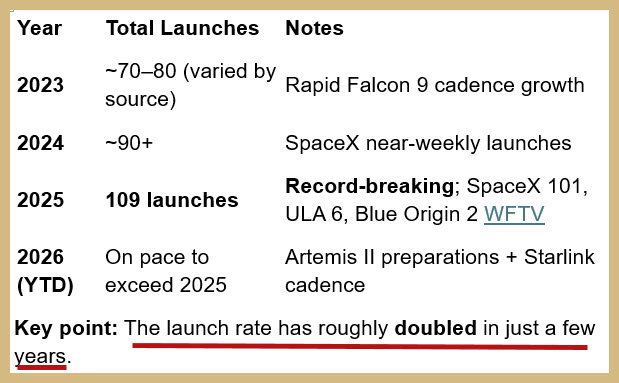
The County’s launch count has exploded to a record 109 liftoffs in 2025, overwhelmingly from SpaceX, and this surge has forced the FAA to pursue new airspace‑efficiency reforms to reduce the impact of rocket launches on commercial aviation. The FAA is now actively developing dynamic hazard areas, expanding Space Data Integrator, and evaluating new airspace procedures to keep commercial flight delays from rising as launch rates continue to climb.
The Current Scoreboard: Rocket Missions vs. Commercial Flights in Brevard County
Brevard County has become the BUSIEST LAUNCH REGION ON EARTH:
Space Launches Impact on Commercial Aviation in the Region
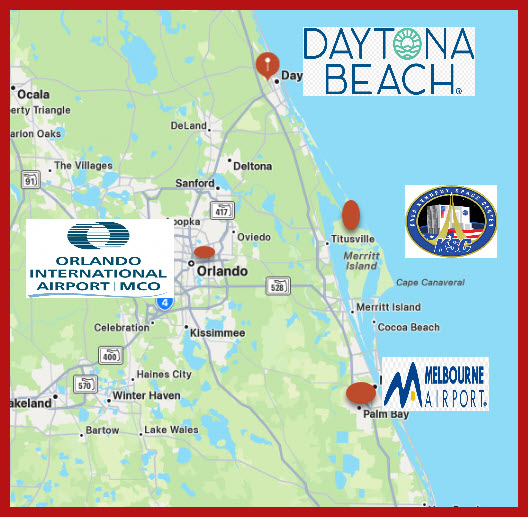
Brevard County area includes Orlando, Melbourne and Daytona Beach where launches directly affect:
-
-
 During launch windows, the FAA must close or restrict large blocks of airspace, causing:
-
-
-
-
- REROUTES
- GROUND STOPS
- FLOW DELAYS
- INCREASED CONTROLLER WORKLOAD
-
-
Summary of the Change
-
-
- In 2015, launches were occasional events.
- By 2025, launches were near-nightly, with SpaceX sometimes flying multiple missions in a single day.
- Commercial flight volume in Central Florida has grown modestly, but launches have grown far faster, shifting the operational balance toward spaceflight as the dominant airspace disruptor.
-
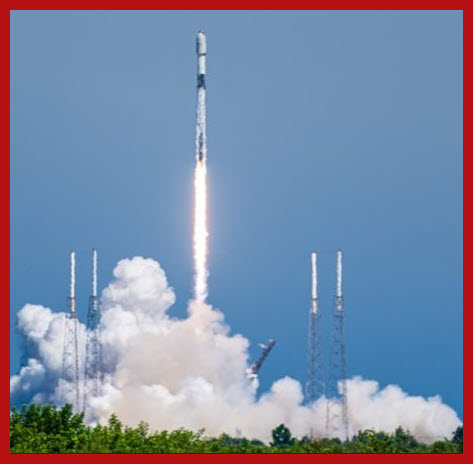
The impact of this surge in rocket flights have choked the civilian flight corridors along the Space Coast, a high volume traffic sector- see this image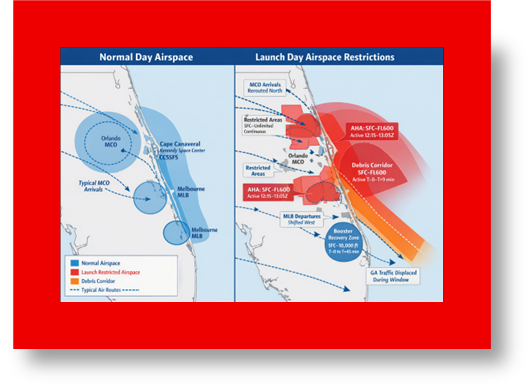
More than the quotes of President Trump’s DoT Secretary about how to manage space and civil aviation
-
- Dynamic Launch Hazard Areas (DLHAs)
Goal: Shrink the size and duration of closed airspace in real time.
-
-
- Instead of pre‑defined, oversized hazard zones, the FAA wants telemetry‑driven, dynamically updated
- This could cut closure times by 40–60%, based on early modeling.
-
DLHAs are the FAA’s most important long‑term lever for restoring balance.
Status: Under evaluation and early implementation phases.
-
- Space Data Integrator (SDI) Expansion
Goal: Reopen airspace faster after a launch.
-
-
-
- SDI streams real-time rocket telemetry to air traffic control.
- Allows ATC to release airspace minutes after the vehicle clears, instead of waiting for manual confirmation.
- Already deployed for SpaceX; expansion to all providers is underway.
-
- New Airspace Procedures for High-Tempo Launch Regions
-
FAA and DOT leadership have acknowledged that Florida’s launch rate requires:
-
-
- Revised ATC procedures for launch windows
- Better coordination between launch providers and commercial airlines
- Predictive modeling to minimize disruption
- More automation in hazard-area management
- Long-Term: Airspace Modernization & Integration Framework
-
The FAA is studying:
-
-
- Integrated airspace corridors for reusable boosters
- Standardized launch window scheduling
- Improved NOTAM automation
- Potential separation of commercial and spaceflight flows in congested regions
- Adoption of the “Airspace Management Plan” (AMP) Model
-
The FAA has publicly emphasized that Airspace Management Plans (AMPs) are now the core mechanism for handling launch and reentry operations.
AMPS are designed to:
-
-
- Minimize disruption to commercial aviation by tailoring hazard areas to actual risk.
- Replace large, static Special Use Airspace blocks with dynamic, time‑limited hazard volumes.
- Integrate FAA, DoD, and commercial space operators into a shared planning process
- Use of the Space Data Integrator (SDI) for Real‑Time Tracking
-
The FAA has deployed the Space Data Integrator, which streams real‑time telemetry from launch providers into FAA systems.
This allows:
-
-
- Dynamic Risk Areas (DRAs) to shrink or deactivate as soon as debris risk passes.
- Faster reopening of airspace after a launch or reentry.
- Reduced delays for commercial flights.
-
SDI is now operational and used for every major U.S. commercial launch.
-
- Transition to Risk‑Based Hazard Modeling
The FAA has publicly stated that it is shifting from fixed, conservative airspace closures to probabilistic, risk‑based modeling that:
-
-
- Calculates debris dispersion in real time.
- Tailors closures to the smallest necessary footprint.
- Supports “just‑in‑time” airspace management rather than long-duration blocks.
-
This is essential as launch cadence increases at Cape Canaveral, Vandenberg, and emerging sites.
-
- Integration of Space Operations into NextGen Modernization
FAA and NASA’s System‑Wide Safety (SWS) project are jointly developing:
-
-
- Automation upgrades to handle mixed aviation–space traffic.
- Digital communications and advanced navigation to reduce controller workload.
-
-
-
- Weather and trajectory integration tools to support high‑tempo launch operations.
-
This is part of the FAA’s broader modernization of the NAS to oversee new entrants.

- Strengthening the FAA’s Organizational Structure for Space Integration
- The FAA’s 2026 reorganization created new top‑level offices to manage emerging technologies, including commercial space.
The Office of Advanced Aviation Technologies is now the FAA’s central hub for:- Integrating advanced aviation and space operations into the NAS.
- Coordinating rulemaking and safety oversight for new entrants.
- Ensuring innovation does not degrade NAS safety margins.
- The FAA’s 2026 reorganization created new top‑level offices to manage emerging technologies, including commercial space.
This is the first major structural change in decades aimed at future NAS complexity.
-
-
- Publicly Stated Future Plans
- Expand automation for launch/reentry airspace management
-
FAA has stated it intends to:
-
-
- Increase automation in hazard area generation.
- Reduce manual coordination between ATC and space operators.
- Move toward real‑time, automated airspace release.
-
-
- Improve cross‑agency coordination (FAA–DoD–NASA)

- Improve cross‑agency coordination (FAA–DoD–NASA)

The FAA has acknowledged that inconsistent coordination—especially with DoD—creates unnecessary NAS disruptions.
Future plans include:
-
-
-
- Standardized data‑sharing protocols.
- Joint risk modeling.
- Unified national launch scheduling frameworks.
-
- Modernize ATC systems to handle higher launch cadence
-
FAA and NASA are working on:
-
-
-
- Upgraded ATC automation.
- Enhanced controller tools for spaceflight traffic.
- Integration of space operations into NextGen
-
- Continue refining Dynamic Risk Areas (DRAs)
-
FAA plans to:
-
-
-
- Reduce DRA size further as modeling improves.
- Shorten activation windows.
- Move toward predictive, rather than reactive, hazard management.
-
-
Over the past five years, launch‑vehicle failures have been rare and concentrated almost entirely in new or small launch systems, with mature vehicles like Falcon 9 maintaining extremely high reliability. The major incidents include
-
- Astra’s repeated Rocket 3 failures (2021–2022),
- Rocket Lab’s two Electron upper‑stage anomalies (2021 and 2023),
- Firefly’s Alpha test‑flight loss (2021),
- Virgin Orbit’s LauncherOne failure from Cornwall (2023),
- Relativity’s Terran 1 partial‑orbit shortfall (2023),
- Blue Origin’s New Shepard booster engine failure with a successful capsule abort (2022),
- SpaceX’s Starship IFT‑1/2/3 test‑flight losses (2023–2024).
Across all of these, the severity has been limited to loss of vehicle and payload, with no injuries or fatalities, and the events overwhelmingly occurred during early‑development test flights or upper‑stage anomalies, not during operational crewed missions. The overall picture is a launch sector with rapidly increasing cadence, very low casualty risk, and failures that are contained, non‑injurious, and typical of early‑stage vehicle maturation.
In the past two years, several senior commercial‑space executives have publicly argued that the FAA’s launch and reentry licensing system has become too slow, too data‑heavy, and too risk‑averse, slowing U.S. launch cadence.
- At a 2023 Senate Space Subcommittee hearing, SpaceX’s William Gerstenmaier said the FAA’s regulatory framework is “in great distress” and “at a breaking point,” arguing that licensing and environmental approvals “take longer than rocket development”—a sharp criticism given SpaceX’s rapid iteration model. He emphasized that many regulatory delays were unrelated to public safety, yet still held up Starship, Falcon, and Dragon operations.
- Caryn Schenewerk, a longtime industry regulatory expert, testified that FAA reforms had made licensing more cumbersome and costly, not less, and that operators now face unnecessary data demands and inconsistent review timelines.
- Blue Origin’s Phil Joyce added that “both the substance and administration” of FAA launch regulations need improvement, noting that the agency is under‑resourced for the current launch tempo.
→Collectively, executives argue that the FAA’s risk assessments are overly conservative, its processes opaque, and its staffing insufficient for a market now exceeding 100+ U.S. launches per year.
The FAA’s response—both in hearings and in GAO‑reviewed materials—has been that the agency is not intentionally slow, but is resource‑constrained, legally obligated to maintain public safety as its top priority, and operating under a regulatory framework that has not kept pace with launch volume. FAA officials point out that they have authorized operator‑led mishap investigations for all recent incidents, streamlined Part 450 licensing, and are working to modernize processes, but acknowledge that they need more staff, clearer criteria, and better tools to oversee the surge in commercial launches. The GAO has echoed this, noting that FAA’s mishap‑investigation process lacks clear criteria and needs evaluation to ensure it remains effective as launch cadence grows.
The words are encouraging and the recent record not a present threat, but the space entrepreneurs seem bent on pushing limits. Their endeavors’ tolerance for risk is 1800 from the regulators. Add that Florida intends to be home to the burgeoning eVTOL and UAS business, airspace may be challenged.

FAA eyes safety changes amid surge in Florida space launches
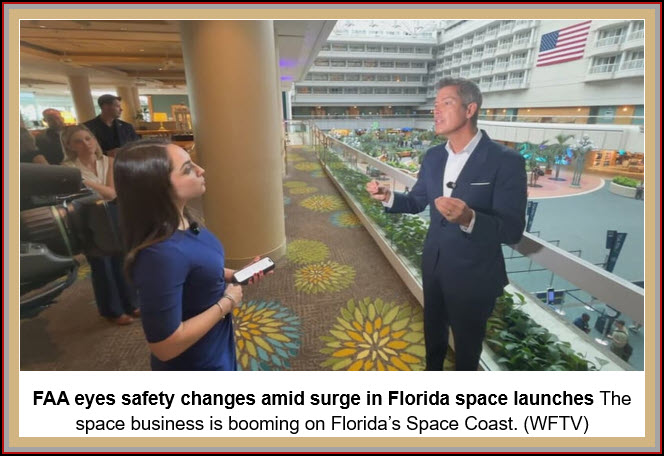
Florida’s Space Coast shatters records with 109 rocket launches in 2025.
- By James Tutten, WFTV.com April 02, 2026 at 10:03 am EDT
- ORLANDO, Fla. — The space business is booming on Florida’s Space Coast.
- Brevard County experienced a record-breaking 109 space launches in 2025, leading TRANSPORTATION OFFICIALS TO EVALUATE HOW THE INCREASED MISSION FREQUENCY AFFECTS COMMERCIAL AVIATION SAFETY.
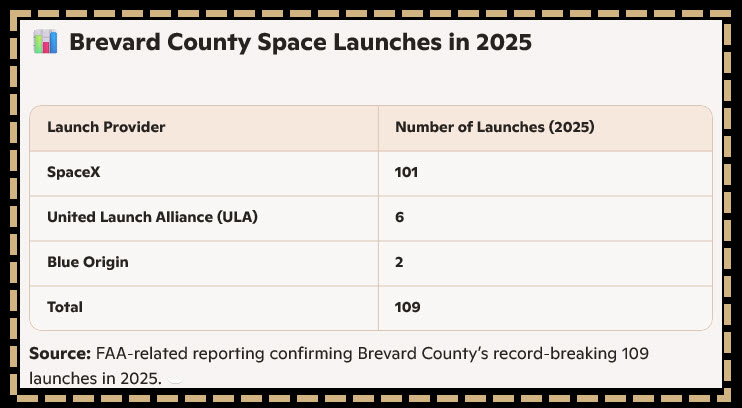
Of the 109 launches recorded in 2025, SpaceX conducted 101 missions. United Launch Alliance completed six launches and Blue Origin conducted two.
The surge in launches has prompted a closer look at the balance between rocket missions and traditional commercial flights.
Transportation Secretary Sean Duffy is overseeing efforts to manage the safety needs of the growing space industry while maintaining the efficiency of the national aviation system.Duffy provided a perspective with Channel 9 on the coordination necessary to prevent delays or hazards for traditional commercial flights during active launch windows.
