Real time aircraft data is going to Boeing-SAFETY USE???
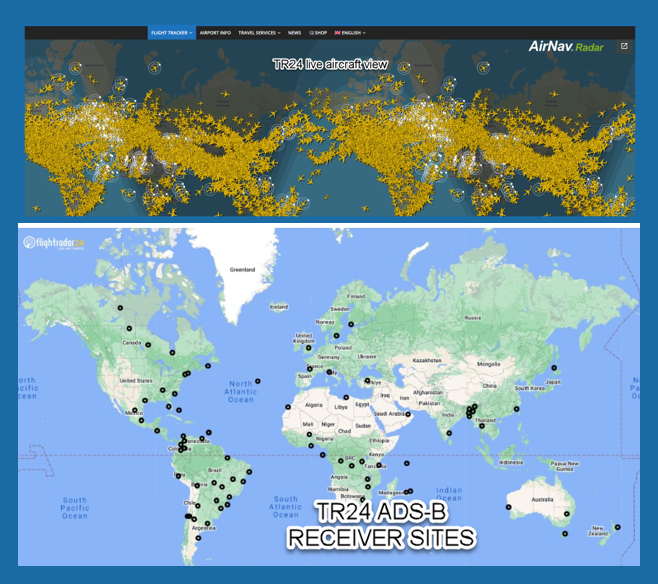
An incredibly important announcement– that through Flightradar24’s global network of 55,000 receivers, Boeing will have 24/7/365 coverage of the operational data[1] downloaded from the aircraft flying around the globe. The Simple Flying article only mentions that— the ADS-B link will deliver to Boeing–
- “comprehensive live and historic flight data, based on [its] global network of more than 55,000 ADS‑B receivers.”
- “…will offer consistent, time-stamped aircraft movement information that can be fused with Boeing’s existing analytics in order to produce actionable insights for airline customers…”
- ”…Cleaner operational truth set. It has to evaluate how its aircraft perform on tighter departure and arrival timelines, when diversions and holding patterns occur, and in other unique sets of circumstances. The manufacturer needs to have high confidence in the quality and coverage of the data that it is using to inform these decisions. This ultimately matters more for day-to-day airline operations as well as for longer-horizon analytics.”
And
- “… identifying route-specific inefficiencies, quantifying disruption patterns, and detecting outliers that may signal maintenance or performance issues…”
Curiously in the brief 874 words in the article and the Flightradar24 press release, there is no mention of SAFETY.
It is abundantly clear that Boeing’s paying for access to these vital data bits makes IMMENSE SENSE. It is not publicly available how or how soon, the company will decide to communicate to its customers (???other manufacturer’s operators about problems identified by its analytics to identify risks.
It is UNCLEAR whether the Boeing process, seemingly focused on trends relevant to its manufacturing, will also be alert to flagging more operational concerns, i.e. pilots flying below altitudes assigned by ATC or landings longer than acceptable on runways, ground maintenance times (either too long or too short), etc. Correction for those deviations and others may not reach the Seattle/Arlington data collectors’ list of priorities.
It would seem appropriate for Boeing to somehow provide the raw data and order their Flagged Information to FAA’s Aviation Safety Information Analysis and Sharing (ASIAS) and/or Flight Safety Foundation’s GAIN and/or ICAO and/or EASA, RIGHT??? Perhaps, it would be wise to seek approval under 14 CFR Part 193 — Protection of Voluntarily Submitted Safety Information. By voluntarily submitting the TR24 ADS-B data there for safety analysis the information would be protected from third parties.



The next competitive battleground for Boeing is not only new airframes but also what exactly these aircraft are capable of offering once they are in service. Boeing has signed an agreement to ACCESS LIVE AND HISTORICAL FLIGHT DATA, DRAWN FROM A GLOBAL NETWORK OF MORE THAN 55,000 ADS-B GROUND RECEIVERS. The idea is to feed this kind of stream into Boeing Global Services’ digital platform, improving fleet performance and maintenance outcomes for all the manufacturer’s various customers.
With more comprehensive receiver coverage, Boeing has ambitious plans to benchmark aircraft utilization and identify irregular operations. The company ALSO PLANS TO SPOT PATTERNS ACROSS FLEETS AND ROUTES. This will allow the carrier to turn raw tracking signals into recurring, high-margin insights. For Boeing itself, data-driven services are able to promise steadier cash flows than derivatives alone.
A Major Move That Is A Win-Win For Both Parties

Credit: Shutterstock
According to announcements made by Flightradar24 on December 22, 2025, the company has officially entered into an agreement to supply US aerospace manufacturer Boeing with comprehensive live and historical flight data. This helps power its network of more than 55,000 ADS-B receivers. Boeing has framed this deal as an enabler for its Boeing Global Services’ suite of product offerings.

The data deal has been described by industry analysts as just one element of a broader build-out of a digital services platform that is designed to improve fleet performance and maintenance outcomes. In other words, Boeing is not just buying a data feed but rather complete global observability.
This will offer consistent, time-stamped aircraft movement information that can be fused with Boeing’s existing analytics in order to produce actionable insights for airline customers. The SITE REINFORCES ITS POSITION AS AN INDUSTRY DATA SUPPLIER, NOT JUST A CONSUMER FLIGHT-TRACKING APP. The organization is clearly invested in developing its global receiver footprint.
A Global Network Behind This Data

Credit: Shutterstock
Flightradar24 has a massive global network of around 55,000 ground-based network receivers because flight-tracking quality is a coverage challenge, not necessarily a software one. Aircraft broadcasting ADS-B signals are only useful if someone else is out there listening. As a result, every receiver fills a geographic gap, strengthens redundancy, and reduces blind spots that appear over sparse regions or at low altitudes.
For Boeing, better coverage means that there is a cleaner operational truth set. It has to evaluate how its aircraft perform on tighter departure and arrival timelines, when diversions and holding patterns occur, and in other unique sets of circumstances. The manufacturer needs to have high confidence in the quality and coverage of the data that it is using to inform these decisions. This ultimately matters more for day-to-day airline operations as well as for longer-horizon analytics.
This is also especially relevant when it comes to identifying route-specific inefficiencies, quantifying disruption patterns, and detecting outliers that may signal maintenance or performance issues. Ground receivers are therefore the physical infrastructure that turns aviation’s ambient radio chatter into a usable dataset. The larger the network, the more that Boeing can scale its services on a global level without waiting for airline integrations as data arrives continuously, uniformly, and independently.
[1] Global ADS‑B data across all aircraft types, all operators, all manufacturers—per Copilot AI.

