NTSB’s P135 safety list detection may benefit from outside SME

Looking back at 2025, big stories have attracted the press’ attention, overlooking the concerns expressed by the NTSB about Part 135’s safety records. Below is an example that highlights Board’s warnings. A recent example is included; a single pilot crashed a Socata TBM700A. The information reported indicates that the plane was owned by DGW Enterprises LLC.
What has the Board flagged about Part 135 operations (the TBM accident is listed as a Part 91 flight):
==> an NTSB special investigation into 116 fatal and 460 non‑fatal Part 135 accidents from 2010–2022.
- Major issues identified include:
- Operational control failures
- Flight locating deficiencies
- Weight & balance errors (especially single‑engine)
- Lack of scalable SMS
- Need for flight data monitoring (FDM)
- Poor FAA data collection on Part 135 activity
A later NTSB Press Release (Aug 2024) added to its list of multi‑year investigation issues with its analysis of 500+ Part 135 accidents.
- Unsafe loading conditions
- Lack of certificated dispatchers
- Weak operational control
- Missing or inadequate FDM programs
- gaps in flight activity data
These warnings point to problems that are less intentional than deficiencies that accrete over time–
- Minor variations that are rarely noticed–once used without consequences, our alert systems tend not to flag the small variance.
- Internal processes may have been 100% right when implemented, but other similar processes of other operators have identified and implemented a practice that is less subject to inadvertent error.
- Changes in the flight and maintenance crews may not be matched by standardization of their joint obligations.
- A new SIC may not recognize the PIC’s jargon or expectations.
- Sequencing of the inspections between MX routines vary based on individual habits
These are points more likely to be identified by outside SMEs. Their job is to use their broad based experiences to add better practices. Without knowledge of what may have worked in the past, they are more likely to ask why this “accreted”practice is now an unintentional deviation. An external eye tends to be aware of better techniques, improved technologies and inconsistencies; their comments tend not to be considered as rebukes but more as “lets try this idea.” Internal audits are important but it is equally important to occasionally add an external prespective – try connecting with JDA HERE.


✈️ NTSB Preliminary Report — Socata TBM700A (N721MB)
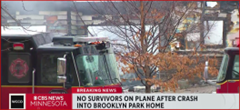
What is happening with the crash investigation?
Tim Sorensen, an aviation accident investigator with the National Transportation Safety Board, said he arrived in Minnesota on Sunday to begin documenting the site.
“We will begin recovering the aircraft later this afternoon, and the aircraft will be taken to a secure location where a more detailed examination will be conducted,” he said during a press conference on Sunday.
Investigators will also look at the weather, the background experience of the pilot, the status of the aircraft, the maintenance of the aircraft and other factors that could have caused the crash.
“The investigation is just getting started. We don’t have a lot of answers right now,” Sorensen said.
Sorensen said the fire caused “significant damage” to the plane.
Aviation Safety Network
| Date: | Saturday 29 March 2025 |
| Time: | 12:21 |
| Type: | Socata TBM700A |
| Owner/operator: | DGW Enterprises LLC |
| Registration: | N721MB |
| MSN: | 91 |
| Year of manufacture: | 1993 |
| Fatalities: | Fatalities: 1 / Occupants: 1 |
| Other fatalities: | 0 |
| Aircraft damage: | Destroyed |
| Category: | Accident |
| Location: | Brooklyn Park, MN – United States of America |
| Phase: | Approach |
| Nature: | Private[1] |
| Departure airport: | Des Moines International Airport, IA (DSM/KDSM) |
| Destination airport: | Minneapolis-Anoka County-Blaine Arpt(Janes Field) Airport, MN (KANE) |
| Investigating agency: | NTSB |
| Confidence Rating: | Information verified through data from accident investigation authorities |
Narrative:
On March 29, 2025, about 1221 central daylight time, a Socata TBM700A airplane, N721MB, was destroyed when it was involved in an accident near Brooklyn Park, Minnesota. The pilot was fatally injured. The airplane was operated as a Title 14 Code of Federal Regulations Part 91 personal flight.
According to Automatic Dependent Surveillance – Broadcast (ADS-B) data, the airplane initially departed from Naples Municipal Airport (APF), Naples, Florida, and flew to Des Moines International Airport (DSM), Des Moines, Iowa. According to the fixed base operator manager at DSM, the airplane was refueled to full fuel capacity. The airplane then departed from DSM enroute to Anoka County/Blaine Airport (ANE), Blaine, Minnesota.
Preliminary air traffic control information revealed that the pilot initially contacted ANE airport control tower and reported he was inbound for the RNAV runway 9 instrument approach. The controller asked the pilot to verify that he had the current weather information and then provided a landing clearance to runway 9. The pilot repeated the landing clearance and verified that he had the current weather information. About 4 minutes later, the controller issued a low-altitude alert to the pilot, with no response. About 3 minutes later, the controller attempted to contact the pilot again with no response.
According to ADS-B data, the airplane departed from DSM at 1112. About 1206, the airplane leveled its descent at 3,000 ft mean sea level (msl), about 28 nautical miles (nm) southwest of ANE. About 1220 and 6 nm from the runway threshold, inbound on the RNAV runway 9 instrument approach at ANE, the airplane began a descent from 3,000 ft msl. About 5 nm from the runway threshold, beyond the final approach fix, the airplane’s airspeed and descent rate rapidly increased, accompanied by a left turn.
The airplane struck trees and then impacted a residential home, where it came to rest about 340 ft northwest of the final ADS-B data point. A postimpact fire ensued and destroyed the airplane and the home.
A residential doorbell camera located near the accident site captured video footage of the airplane shortly before the accident. The airplane was in a steep descent with the nose of the airplane pointed down and the airplane rotating about its longitudinal axis.
ANE weather reported at 1149, wind from 030° at 12 knots, visibility 10 miles or greater, overcast ceiling 900 ft above ground level, temperature of 3°C, dew point of 2°C, and an altimeter setting of 29.92 inches of mercury. An Aviation Weather Center icing probability chart indicated that at 1230, the icing probability at 3,000 ft msl was at or above 50-60% in the area over the accident flight path and that a Graphical Airmen’s Meteorological Information for moderate icing and instrument flight rule conditions were active.
The main wreckage of the airplane was located in the basement of the home and was covered in debris from the surrounding structure. Broken tree limbs were observed about 100 ft southeast of the main wreckage. The tree limbs were observed to have angular cuts consistent with propeller strikes. Fragments of the left wing were found suspended in the trees and on the ground below the broken tree limbs. Separated portions of the airplane were found on the property of the residential home where the airplane came to rest and on the adjacent properties.
No mechanical anomalies were found with the airframe or engine during the onsite examination or wreckage layout. Damage to the airplane was consistent with impact forces and postimpact fire.
Flight control continuity was established from the cockpit to the center fuselage near the wing roots for the aileron controls and near the aft wing spar for the elevator and rudder controls. The flight control system was fragmented outboard of the wing roots and aft of the wing spar, consistent with impact forces during the accident sequence.
The airplane was recovered from the accident site and transported to a secure location for further examination.
Accident investigation:
|

U.S. Bank vice-chair killed in TBM 700 crash
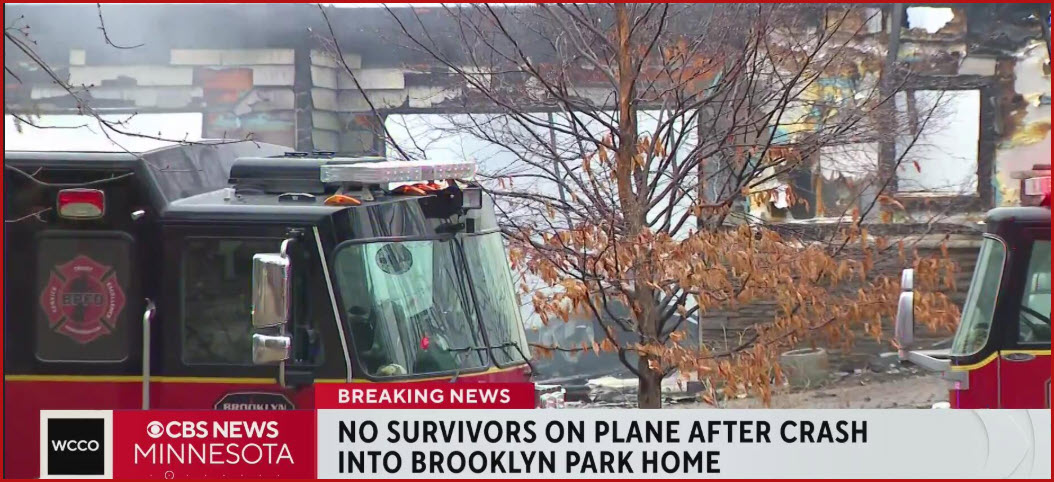
Photo of firefighters in agraphic from Brooklyn Park Fire Department Facebook
A Socata TBM 700 crashed into a home in Brooklyn Park, Minnesota on Saturday, catching fire and killing at least one. U.S. Bank said in a statement that the victim is believed {later confirmed} to be Vice Chair and Chief Administration Officer Terry Dolan. As of Sunday, the Medical Examiner was still working to recover and identify the identities of the person(s) on board the aircraft.
The FAA said the TBM 700 departed from Des Moines International Airport in Iowa and was headed to the Anoka County-Blaine Airport (ANE) in Minneapolis. At the time, it was unclear how many people were on board. The plane was registered to DGW Enterprises LLC in Edina, Minnesota. The FAA said it was investigating with the NTSB, and the NTSB will be in charge of the investigation and provide any updates. U.S. Bank told CNN in a statement that the plane was registered to Dolan, but the medical examiner’s office has not been able to confirm whether or not he was on board, but the company believes he was. CNN reported that preliminary information shows that one person was on the plane.
Brooklyn Park Fire Department said that they responded to an aircraft incident at 12:22 p.m. local time on Saturday. First-arriving units found the home fully engulfed in flames with exposures to the north and south. Several local fire departments came to help and the fire was brought under control within an hour, with no injuries to the occupants of the home or first responders…
In an on-scene news conference, Brooklyn Park Fire Chief Shawn Conway said that the aircraft was not apparent until after the structure fire was contained. He said there were no survivors from the aircraft. Aviation Safety Network reported that ADS-B data indicated that the plane was on a stable approach to Runway 9 before turning sharply left and losing altitude. A doorbell camera captured the plane flying fast in a downward angle before the crash…
U.S. Bank CEO Andy Cecery was an outstanding businessman, but more importantly, he was a wonderful person,” Cecere wrote in an e-mail to employees, reported by GV Wire. “He cared deeply about the people he worked with and the teams he led, and his legacy can be seen everywhere we look.”
[1] This may or may not be the final finding because multiple sources confirm the aircraft was owned by DGW Enterprises LLC. The pilot was Terry Dolan, a senior U.S. Bank executive, who was also believed to be the pilot at the time of the crash. Key point: The NTSB report simply identifies the operator as a Part 91 personal flight. A non‑owner flying the aircraft will change thre confirmed that Dolan died when the plane he was flying crashed, according to GV Wire.
“Our loss is profound. Tere regulatory classification. Under FAA rules, a flight remains Part 91 (i)No compensation is exchanged (ii)No “holding out” to the public occurs.

