New FAA UAS enforcement program DETER- who, why, how, and what???

The FAA has issued a new policy called Drone Expedited and Targeted Enforcement Response (DETER[1]) program. Historically, in an effort to ease into the nascent UNMANNED (no longer “unpersonned”) AERIAL VEHICLE SYSTEMs(UAS) flying by hobbyists and businesses, the FAA employed a policy labeled “education-first.” With UAS operations estimated millions of small UAS, the regulators decided to shift to mandatory legal enforcement for a wide range of infractions. This shift is driven by the Restoring American Airspace Sovereignty Executive Order (June 6, 2025), which requires “zealous enforcement” of UAS laws and other legal bases[2].
This change involves several important safety, surveillance, and staffing bases:
- The density of these UAS flights was growing so as to pose a safety risk AND the prospects of possible abuse of these aerial vehicles INCREASES with the USA being one of the venues for the 2026 FIFA games.
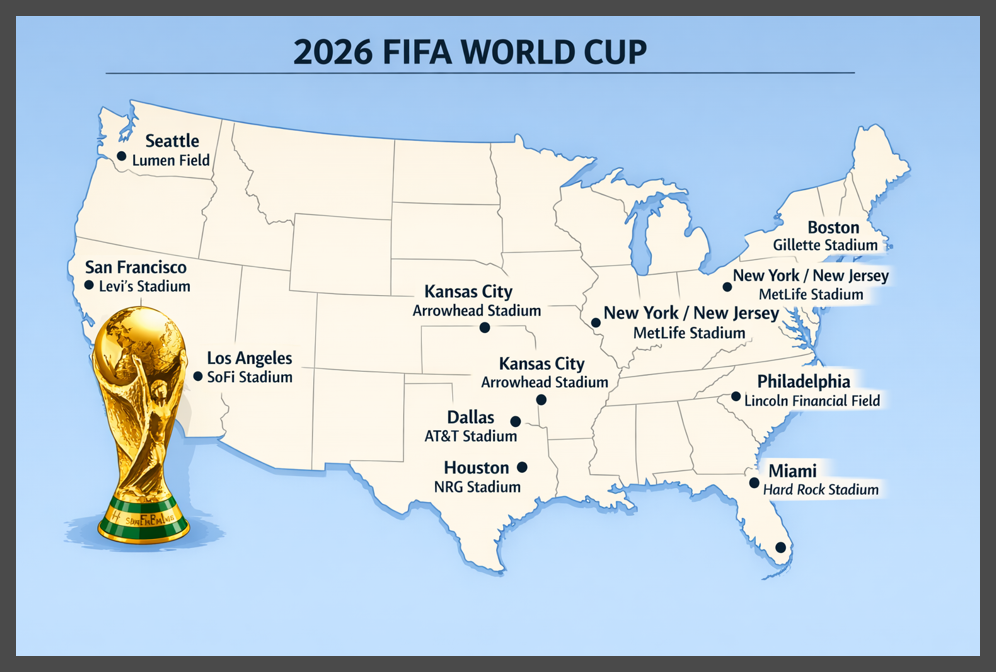
- Detection technology has become extremely fast and accurate (stadiums, federal agencies, major cities). This new surveillance/detection technology expedites the process with real-time law enforcement notifications to feed directly into FAA enforcement
- Enforcement remained slow, bureaucratic, and often invisible to the public. The processing of these violations created significant workload for the legal and investigative staffs (heavy paperwork, reviews by both disciplines, scheduling informal and formal conferences). The descriptions of DETER suggest that cases under its sphere will be largely automated.
The Federal Register explains DETER in 1,672 small print words and does so in wording that is needed to legally justify the new enforcement policy and procedures. In an effort to provide a more average consumer here is more compressible language and format:
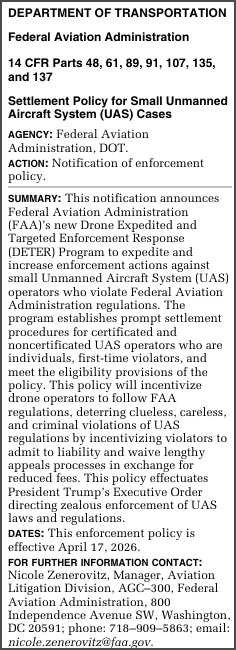
DETER APPLIES ONLY TO:
- Individuals
- First-time violators
- Less serious operational violations (e.g., careless flying, violating basic operating rules)
DETER DOES NOT APPLY TO:
- Restricted airspace incursions
- Operations that endanger people
- Drone flights tied to criminal activity
- These misfeasors will be subject to the full, traditional enforcement process.
SO HOW WILL YOU KNOW THAT YOU ARE SUBJECT TO THE LESS ONEROUS (PROCESS AND PUNISHMENT) OF DETER:
- Operators will receive a formal violation notice via FedEx and email (from UASNotice@faa.gov). The notice will include:
- Enforcement Investigative Report (EIR) number
- Investigator’s name
- Date, time, and location of the offense
- Specific 14 CFR regulations violated
- Proposed penalty or certificate suspension
WHEN YOU HAVE BEEN DETERRED, WHAT SHOULD YOU DO
Operators have 10 days[3] to complete all of these important predicates:
- CONSIDER CONSULTING WITH AN AVIATION ATTORNEY
- This is NOT recommended by the Fed Reg notice
- An AVIATION ATTORNEY is not your friend who practices real estate law or even a litigator. It is someone WHO knows UAS flights, what is legal and what is not (the FAA is not infallible) and who will fully comprehend (explain to you) the consequences of the steps listed below[i]
- Sign the settlement form
- Admit liability
- Waive all appeal rights
- Pay the civil penalty via pay.gov
- Complete corrective actions
- Surrender their Remote Pilot Certificate (if required)
- Failure to act within 10 days moves the case into full legal enforcement, with higher penalties and no fast-track option.
DETER is not a get out of jail free card- it is limited in its application. Violating the rules applicable to your UAS over your kids soccer game, for example, would put you at risk for the more time-consuming and costly normal enforcement.
- The FAA will not apply DETER uniformly nationwide. Instead, it will deploy the program:
- At select locations
- During high-visibility events
- During periods of expected high drone traffic
DETER’S IMMEDIATE POSITIVE IMPACTS
- Local, state, and federal law enforcement can notify FAA in real time when a drone violation is detected.
- Detection → Identification → Enforcement
can occur within hours, not months. - Likely the operators, who in the past flew without care because they assumed that there would be no consequences, will not experience immediate penalties
- It represents a philosophical shift: From
→ “educate and encourage compliance”
to
→ “swift, certain, and public consequences for violations.”
Of course, the best prophylactic step to avoid the FAA ENFORCEMENT JUGGERNAUT by performing a Safety Risk Assessment before your proposed operation. For a hobbyist that exercise would require a few thoughtful minutes reviewing a checklist like this:
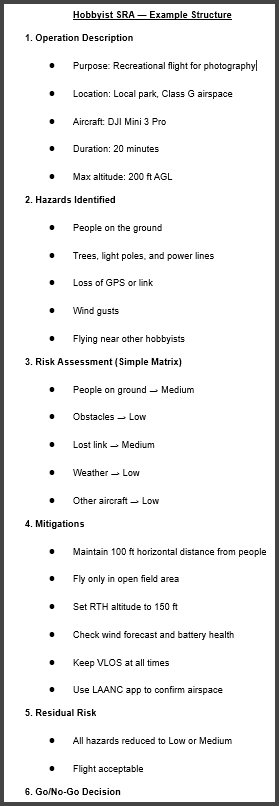
For any commercial operation, the critical nature of the FAA authorities that you hold makes the SRA process far more consequential. When you start your enterprise, it would be valuable to spend time with your team and an outside expert defining a number of checklists so as to prepare for the most likely challenges that your business will face.
Good news for the casual user whose error was inadvertent; a note of warning for the commercial operator

FAA Launches New Program to Accelerate Enforcement of Drone Violations

Thursday, April 16, 2026
WASHINGTON – The Federal Aviation Administration (FAA) announced a new enforcement initiative to resolve certain minor drone violations more quickly while maintaining safety.
The Drone Expedited and Targeted Enforcement Response (DETER) program supports President Trump’s Executive Order on Restoring American Airspace Sovereignty, which calls for stronger enforcement of drone laws to protect the safety and security of the U.S. airspace.
“This program will further deter violations by ensuring swift enforcement action and reinforce the agency’s commitment to protecting the National Airspace System.” said FAA Chief Counsel LIAM MCKENNA.
The program will support enhanced enforcement efforts around high-visibility events, including the upcoming FIFA World Cup matches from June 12 to July 19.
Under the DETER program:
- Eligible first-time operators may resolve cases through reduced civil penalties or certificate suspensions.
- Participants must admit liability and waive their right to appeal to receive expedited resolution.
- LAW ENFORCEMENT PARTNERS WILL BE ABLE TO NOTIFY THE FAA OF DRONE VIOLATIONS IN REAL TIME.
- The program is limited to less serious operational violations and will be implemented in select locations and timeframes.
- The FAA will continue to handle violations involving significant safety risks, including unauthorized operations in restricted airspace, through standard enforcement procedures. These violations are not eligible for expedited resolution.
[1] 1600 Pennsylvania Ave. must issue GOLD STARS for clever acronyms.
[2] Executive Order (June 6, 2025); FAA Order 2150.3C, Change 13 (Jan 21, 2026)
[3] It MAY BE POSSIBLE TO GET an extension. A call or email to the investigator with your EIR number and a meritorious need for time might gat you time to complete all of these steps. Call or email IMMEDIATELY when you first get your notice.
[i] A record of a violation is public; the admission of guilt of other FAR violations has had consequences for aviation jobs, although the impact of DETER is not yet known.

