Lesson from UA IAH runway asks should SMS re-review past ERC decisions?
The Houston Chronicle has published (below) an excellent exposition of a March 2025 United B-737 sliding off a runway at Houston’s Bush Airport. The writer carefully reviews the NTSB report and what US is now doing in response to the Board’s analysis. What is beyond the scope of the news report is the longer term lessons to be gleaned from this incident
Safety Mangement Systems are the keystone to current aviation safety, as recommended by ICAO 2006’s adoption of Annex 19 and implemented by the FAA and the 44 CAAs the leading aviation countries of the Free World. The process relies primarily on current data and assesses what must be done at this moment in time. United has an exceptional record of achieving the SMS mission[1].
The Chronicle’s timeline of the IAH rnway excursion identifies from the NTSB report that
- The B-737 was equipped on delivery from Boeing with an informational “Runway Awareness and Advisory System,” rather than the more advanced Runway Situation Awareness Tool alerts.
- The Heads‑Up Guidance Display System (HGS) system, while available as an option, had not been adopted by United for the initial delivery of its 737 fleet due to cost, training, and standardization considerations
- That the company started to install HGS equipment but did not complete that additional safety equipment due to the pandemmic. [not clear what year]
- In September 2025 that it was in the “final stages” of retrofitting all 103 Boeing 737 MAX aircraft with the RSAT system. The airline was still evaluating whether to install HGS across its entire 737 fleet
According to Aviation Outlook, United’s SMS teams set annual safety goals, which included– enhancing data integration for trend analysis and mitigation planning. Specifically in response to the NTSB’s report, United—
- United Airlines has confirmed that it is in the final stages of retrofitting its Boeing 737 MAX fleet with the Runway Situation Awareness Tool (RSAT), following the 2024 Houston runway excursion investigation. As of late 2025, United reported to the NTSB that 103 MAX aircraft were scheduled to receive RSAT installations.
- Regarding the Heads-Up Guidance System (HGS), United has not committed to fleet-wide implementation. The airline told investigators that it was STILL EVALUATING whether to install HGS across its 737 fleet. At the time of the incident, none of United’s 564 Boeing 737s had operational HGS units, and 16 aircraft had partial installations that were disabled.
Evidentially, the United SMS team sees the immediate value of the RSAT installation, but is still considering the merits (safety need/cost) of the HGS. Only Alaska Airlines has HGS on all of its B-737MAX (AA, WN, both major operators of the MAX ,have not bought the HGS).
This case study suggests that Airlines adhering SMS might well consider keep a list of past actions[2] (both decisions to act and not implement) of the Event Review Committee (ERC) . That organization is tri‑party group (airline, union, FAA) that evaluates safety reports and operational events, determines whether they are accepted into a voluntary safety program, and decides on corrective actions. The current purpose of the ERC documentation is to insure that their action recommendations have been carried out.
The Boeing decision during COVID to install RSATs, if re-reviewed sometime thereafter, might have appropriately enhanced UA’s safety performance by warning the IAH crew that addition brake and engine reverse were needed to prevent the excursion, which fortunately neither lost life nor hull. If the UA decides not to buy the HGS systems, a repeat review might add to the SMS results- experience might provide better risk analysis. Given that the initial ERC work papers provide much/most of the information, a second look should not be a significant burden, but a possible great plus in the safety performance.

Exclusive: United Airlines plans safety upgrades on 100 planes after Houston flight slid of RUNWAY

Octavia Johnson
Fri, January 9, 2026 at 7:00 AM EST
The United Airlines aircraft that failed to slow down on a wet runway and slid off the taxiway at a Houston airport in 2024 lacked safety systems designed to help pilots during landing, records show.
Records released by the National Transportation Safety Board reveal new details about advanced safety systems that were not installed on the Boeing 737 MAX 8 – the plane involved in the incident at George Bush Intercontinental Airport.
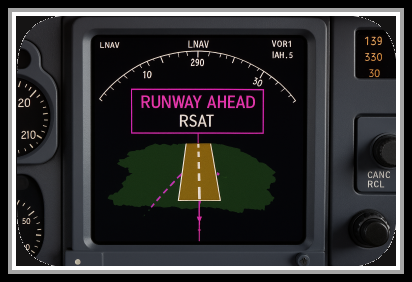
The aircraft was among more than 100 Boeing 737 MAX planes that didn’t have a “RUNWAY SITUATION AWARENESS TOOL” that warns pilots if a plane is at risk of overshooting a runway.
In addition, all 564 planes in United’s Boeing 737 fleet lacked another feature known as a Heads-Up Guidance Display System that provides information to pilots without requiring them to look down at their instrument panels. Sixteen of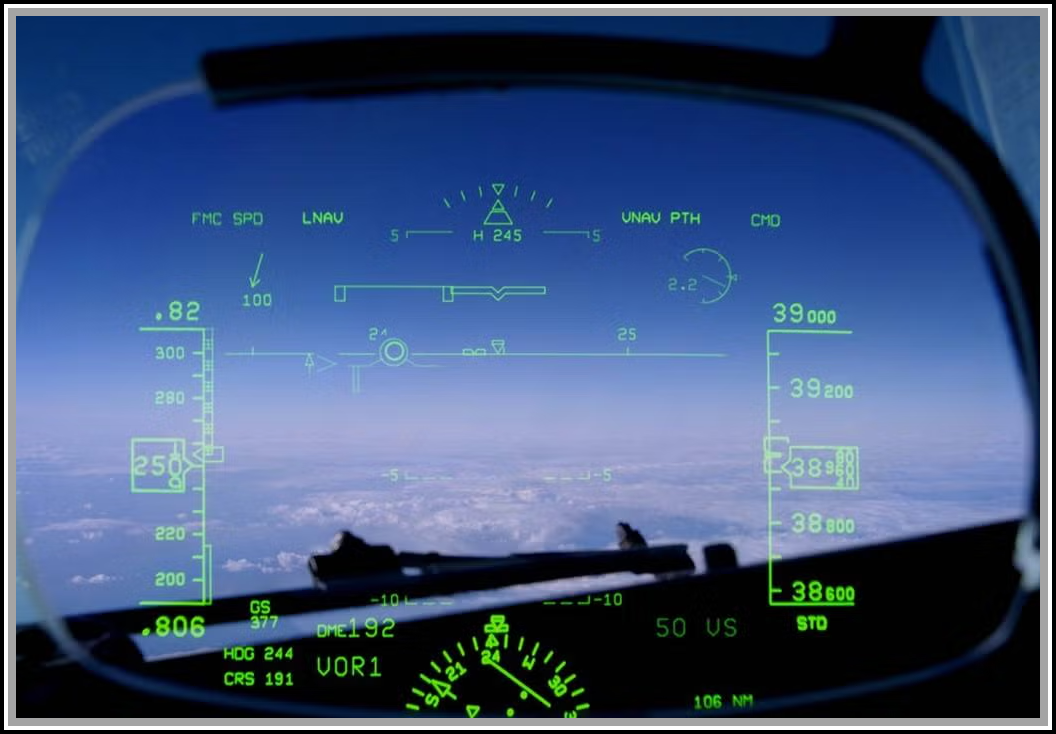 the planes were equipped with a single unit on the captain’s side, but the features were disabled.
United told federal investigators in September 2025 that the airline was in the “final stages” of retrofitting the 103 MAX planes with the runway awareness tool, and it was still evaluating whether to add the guidance display systems to the entire Boeing 737 fleet.
United spokesperson Joshua Freed said in an email that the company isn’t answering questions about the investigation because it’s still ongoing, but provided a statement thanking the NTSB for uncovering problems behind the incident in Houston.
The NTSB is an independent federal agency that investigates transportation incidents, and last week released records about the Houston mishap as part of its ongoing investigation. The agency has not yet determined the cause of the incident.
“We take every safety event seriously, and we’re grateful to the NTSB and other party members for their work to understand what happened with this flight,” United’s statement said.
Why weren’t safety systems installed on the plane?
The Boeing 737 MAX 8 that landed at Bush Airport on March 8, 2024, failed to decelerate sufficiently before trying to exit the runway, according to an NTSB performance study.
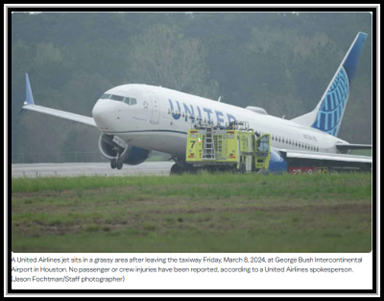
Investigators said the crew eased off key braking systems on the wet runway. While exiting the runway, the plane slid off the taxiway’s pavement and tilted slightly to the side in the grass. Its left main landing gear collapsed after striking a concrete electrical manhole. No one was injured.
United officials told investigators that the aircraft lacked a Runway Situation Awareness Tool and that the airline had not equipped its Boeing 737 fleet with an operational Heads-Up Guidance Display System.
The runway awareness tool, developed by Boeing, predicts when a plane may not stop in time on a runway and warns pilots if a problem is detected. The tool operates about 500 feet above the touchdown zone.
Joel Aiken, senior manager of United’s Standards for the 737, told investigators in May 2024 that the plane in Houston was among the first 95 MAX aircraft delivered to the airline. It had an informational “Runway Awareness and Advisory System,” rather than the more advanced Runway Situation Awareness Tool alerts.
The older advisory system functions like an odometer, telling pilots how many feet of runway remain. But it doesn’t warn them if there’s a risk of overshooting a runway, unlike the newer runway awareness tool.
When asked by federal investigators whether the runway alert tool would have changed the outcome of the plane sliding off the taxiway, he said, “I mean, it’s possible.”
The aircraft also lacked a Heads-Up Guidance Display System, manufactured by Collins Aerospace. Known as a “HUD,” that system projects an aircraft’s stopping point on a graphical runway and flight-path scale.
United BEGAN an initiative to install guidance display systems on its Boeing 737 fleet, but did not complete it due to the pandemic, United wrote to investigators.
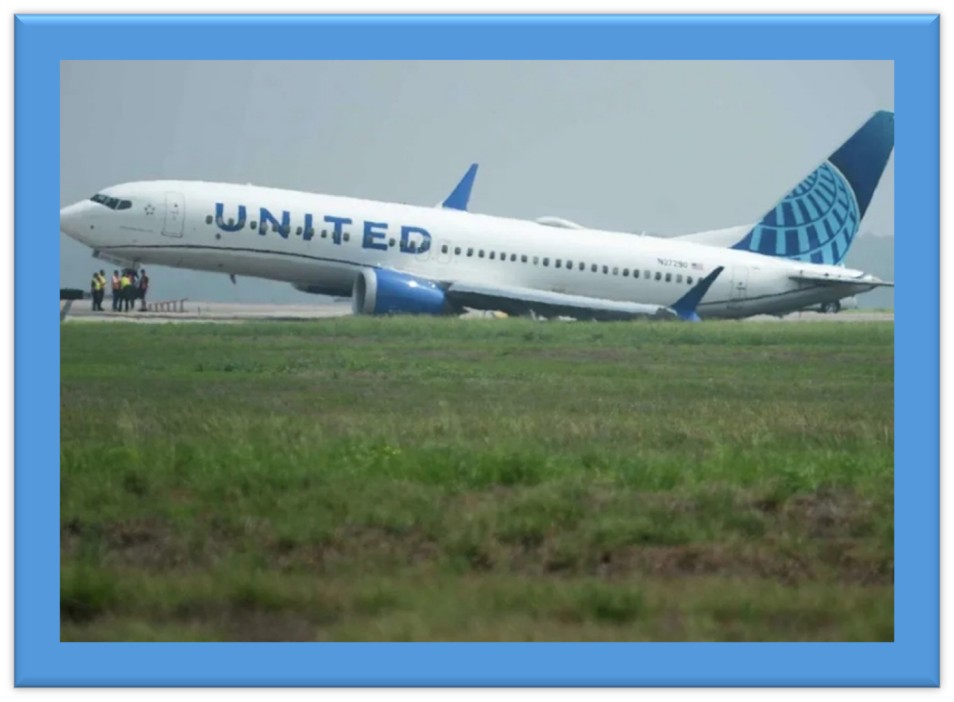
A United Airlines jet sits in a grassy area after leaving the taxiway Friday, March 8, 2024, at George Bush Intercontinental Airport in Houston. No passenger or crew injuries have been reported, according to a United Airlines spokesperson. (Jason Fochtman/Staff photographer)
United Airlines plans to add safety features
When the United Airlines pilot tried to slow the plane in Houston, he used minimal engine braking and insufficient manual braking, Aiken said – actions that the Runway Situation Awareness Tool is designed to flag with alerts.
He added that if a pilot disarmed the autobrakes and failed to apply sufficient manual pressure, similar to the landing in Houston, the Heads-Up Guidance Display System would show the stopping indicator moving “off the end of the runway.”
Aiken told investigators that the airline is planning to retrofit Boeing 737 MAX planes with the Runway Situation Awareness Tool.
“I am optimistic that that will happen in a matter of one to three months,” he said in 2024.
The airline told investigators that the Heads-up Guidance Display System is still in the long-term assessment phase, which will determine whether it’s feasible to incorporate the safety feature.
[1] No passenger fatalities due to aircraft accidents since 1991, excluding the September 11 terrorist attacks. Millions of flights operated without a fatal hull loss, reflecting robust operational safety.;
2024 FAA audit found no significant safety issues, even amid increased scrutiny following mechanical incident
[2] Best Practices for Event Review Committees 4.7 Maintain Complete Records of the Report Review Process

