IAM’s Ramp Threat Analysis is Right on; its path not expeditious; there is a WAY to risk reduction NOW
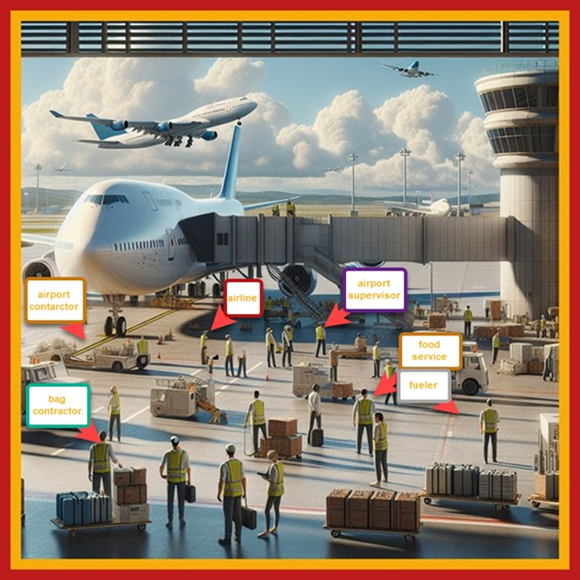
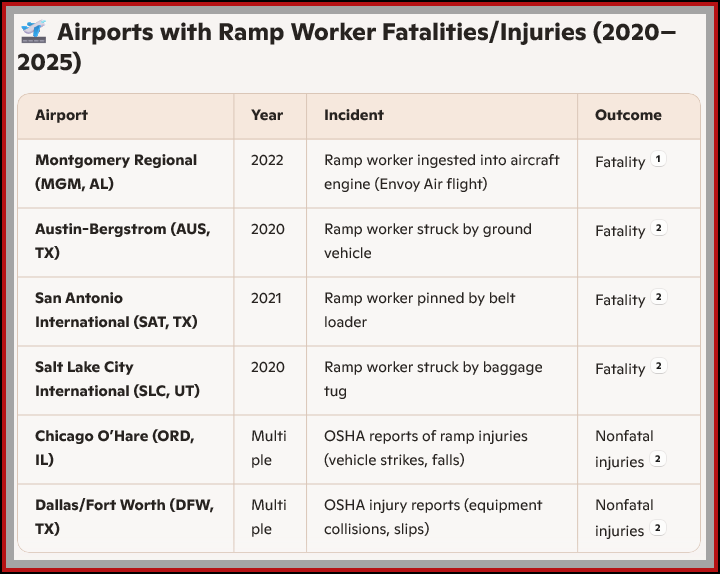
The IAM has written a letter to the FAA Airport Safety Policy Branch, Office of Airport Safety , Safety and Standards and the Union’s senior officer urges that the office addressed to mandate (word not used by IAM, but necessary to make the proposal work) the use of its effective. The underlying rationale is uncontested, as this partial list of incidents/accidents showing the risks incurred in the ramp area (a confluence of a number of airport stakeholders):

That said, the IAM letter is deficient in FILING, CLARITY and EFFECTIVENESS:
- If the FAA agrees with the IAM request, sending a letter to the airport office selected, does not advance the union’s cause-
- This is essentially a petition to amend 14 CFR Part 5 to require that the IAM UNION REPORTING SYSTEM must be filed under 14 CFR 11.71, which requires, inter alia
(a)…
(2) An explanation of your proposed action and its purpose.
(3) The language you propose for a new or amended rule, or the language you would remove from a current rule.
(4) An explanation of why your proposed action would be in the public interest.
(5) Information and arguments that support your proposed action, including relevant technical and scientific data available to you.
(6) Any specific facts or circumstances that support or demonstrate the need for the action you propose.
(b) In the process of considering your petition, we may ask that you provide information or data available to you about the following:
(1) The costs and benefits of your proposed action to society in general, and identifiable groups within society in particular.
(2) The regulatory burden of your proposed action on small businesses, small organizations, small governmental jurisdictions, and Indian tribes.
(3) The recordkeeping and reporting burdens of your proposed action and whom the burdens would affect.
(4) The effect of your proposed action on the quality of the natural and social environments.
-
-
-
- assuming that a letter is an appropriate vehicle, the office with the direct jurisdiction is the Safety Management Systems (SMS) for Airports and Airport Projects (Daria.D.Wonnacott@faa.gov). Not the office referenced in the letter.
-
-
[NOTE: much of the November 24, 2025, responds to the § 11.71information requirement.]
-
-
-
- CLARITY- the Union’s letter does not specify what entities would be required to participate in the IAM UNION REPORTING SYSTEM-
- AIRLINES are already subject to the SMS requirements; so, no substantial amendments would be needed
- AIRPORTS (only those under Part 139) have no mandate until 2027; IMMEDIATE APPLICATION would be highly unlikely
- CONTRACTORS are likely most impacted by the IAM UNION REPORTING SYSTEM because frequently the ramp area services are contracted out. It makes no sense to not include them in this worthwhile project.
- EFFECTIVENESS may be why the IAM did not file under Part 11; it recognized that the APA process is time consuming. To attain the IAM’s goal, to protect their members–and presumably their unionized ramp peers—from the risks associated in their work environment.
- CLARITY- the Union’s letter does not specify what entities would be required to participate in the IAM UNION REPORTING SYSTEM-
-
-
A possible solution? The introduction of SMS has been encouraged by the FAA through “Voluntary Adoption” of this global state-of-the-art risk management process. A list of US Part 139 organizations that have implemented SMS without a regulatory requirement includes:
Dallas/Fort Worth International (DFW),
Hartsfield–Jackson Atlanta International (ATL),
Chicago O’Hare (ORD),
Indianapolis International (IND)
Likely there are other airports that are already following this rubric. Any facility that has had a ramp are accident or incident would be willing or “compelled by public pressure” to utilize this well-received collaborative program to identify where future problems may arise.
Unlike an erstwhile NPRM, a voluntary SMS at the local level (risks are not uniform among ramps, taxiways, runways, etc.) is THE MOST EFFICACIOUS METHOD to respond to the IAM’s well-documented threat.
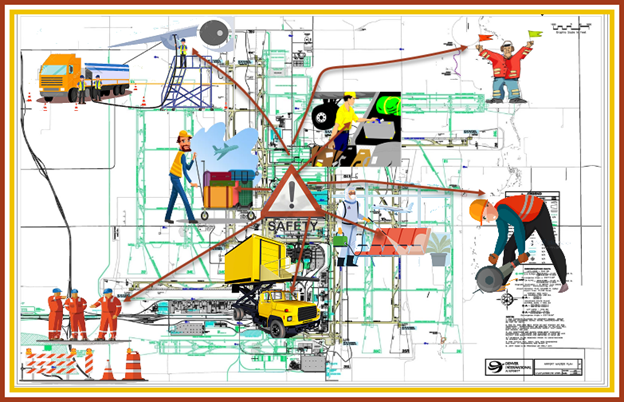
Even with an organization that has experience with SMS, the inclusion of all the relevant parties– airport management, airlines, airport contractors, FAA tower and safety representatives, OSHA (?) and unions– suggests that these exercises be led by an outside resource, one that has experiences with their particular perspectives and familiarity with the SMS’ steps, expectations of acceptance of other views, the data analytics and participants’ openness to outside-the-box thinking.
Action now makes tremendous sense; the risk is real; the possibility of harm cannot be ignored; the SMS steps have shown to be effective; and the experience will be valuable for all the participants!!!

IAM Union Calls for Stronger Data, Safety Measures in FAA Ramp Worker Survey
Air Transport December 3, 2025
WASHINGTON, Dec. 3, 2025– The IAM UNION (International Association of Machinists and Aerospace Workers), the largest air transport union in North America, recently wrote a letter urging the Federal Aviation Administration (FAA) to strengthen its plans to improve airport ramp worker safety significantly.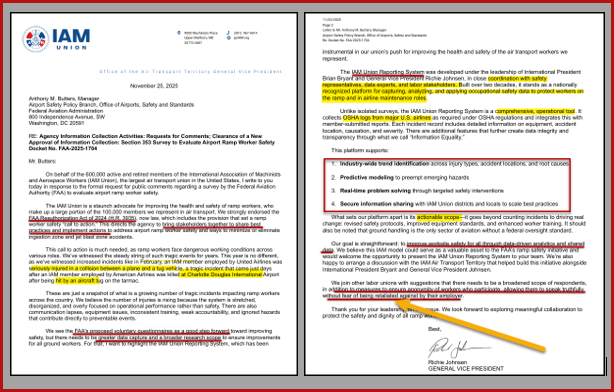
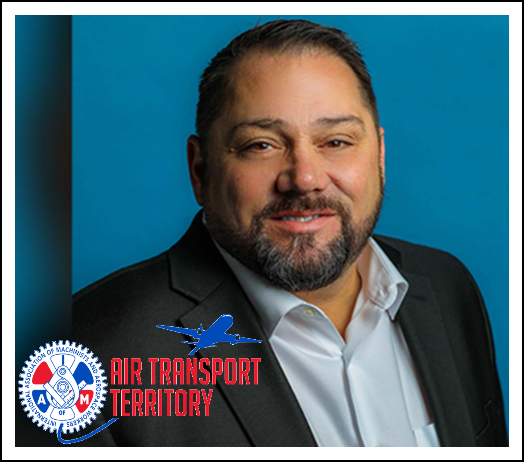 In formal comments submitted to the agency, IAM Union Air Transport Territory General Vice President RICHIE JOHNSEN[1] called the FAA’s proposed voluntary safety questionnaires “a good step forward,” but emphasized that a broader research scope and stronger data collection are essential to protecting frontline workers.
The FAA survey stems from a provision in the FAA Reauthorization Act of 2024, which directs the agency to initiate a RAMP WORKER SAFETY “CALL TO ACTION.” The effort aims to bring together stakeholders, share best practices, and implement measures to reduce hazards,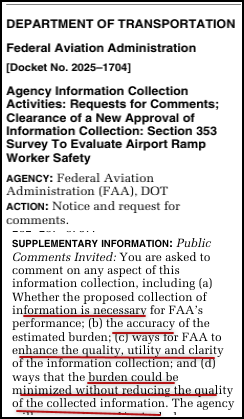 including ingestion zone and jet blast zone incidents.
“This call to action is much needed, as ramp workers face dangerous working conditions across various roles,” wrote Johnsen. “We’ve witnessed the steady string of such tragic events for years. This year is no different, as we’ve witnessed increased incidents like in February, an IAM member employed by United Airlines was seriously injured in a collision between a plane and a tug vehicle, a tragic incident that came just days after an IAM member employed by American Airlines was killed at Charlotte Douglas International Airport after being hit by an aircraft tug on the tarmac.”
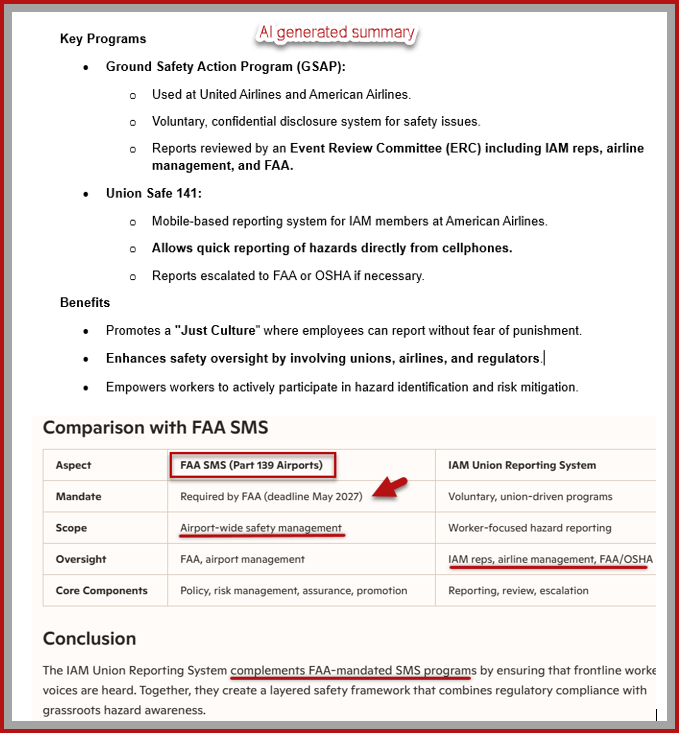
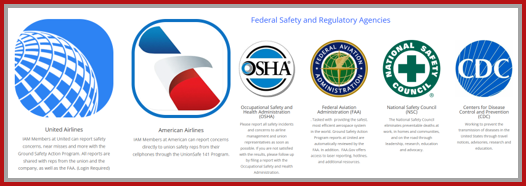
GVP Johnsen highlighted the IAM UNION REPORTING SYSTEM as a national model for effective, data-driven safety improvements The IAM Union Reporting System was developed under the leadership of IAM International President Brian Bryant and General Vice President Richie Johnsen, in close coordination with safety representatives, data experts, and labor stakeholders. Built over two decades, it stands as a nationally recognized platform for capturing, analyzing, and applying occupational safety data to protect workers on the ramp and in airline maintenance roles.
The IAM is urging the FAA to:
- Expand the scope of survey respondents to ensure ground workers are fully represented;
- Strengthen data collection parameters to align with real-world risks;
- GUARANTEE ANONYMITY FOR ALL PARTICIPANTS TO PREVENT EMPLOYER RETALIATION; and
- Leverage the IAM Reporting System as a proven model for comprehensive safety analysis.
The IAM Union offered to brief FAA officials on the system and invited collaboration with the IAM Air Transport Territory, which played a central role in developing the initiative.
[1] United Airlines in 1988 as a Mechanic Assistant, promoted to Mechanic in 1990; Assistant General Chairperson for District 141M (2000); Grand Lodge Special Representative (2001);Transportation Department Grand Lodge Representative; IAMRA President: Served as President of the IAM Representatives Association (2017–2021); Executive Council: Appointed Special Assistant to the International President (Feb 2021), then Chief of Staff (June 2021); Since May 2022, serves as General Vice President of IAM’s Air Transport Territory, representing airline and aviation workers across North America.