GAO report– go slow on BVLOS, but maybe not???
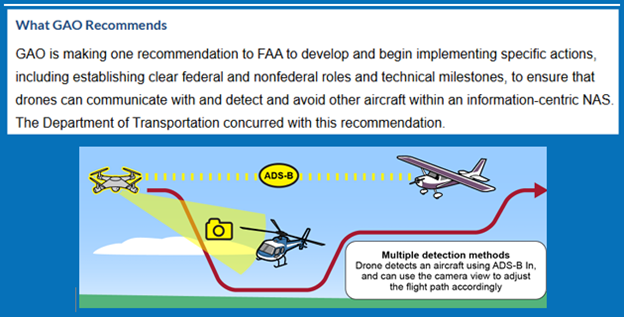
Congress in the 2024 reauthorization act instructed the Government Accountability Office (GAO PI) to:
“…review technologies for drones to detect and avoid manned aircraft operating at low altitudes. Our report examines:
-
-
-
- the technologies that exist for drones to detect and avoid low-altitude aircraft that may or may not broadcast position data;
- views of selected aviation stakeholders on the effectiveness of existing drone technologies to detect and avoid other low-altitude air traffic; and
- 3. efforts that FAA has underway related to drone detect and avoid technology and actions that could be taken to inform future planning activities.” [footnotes deleted]
-
-
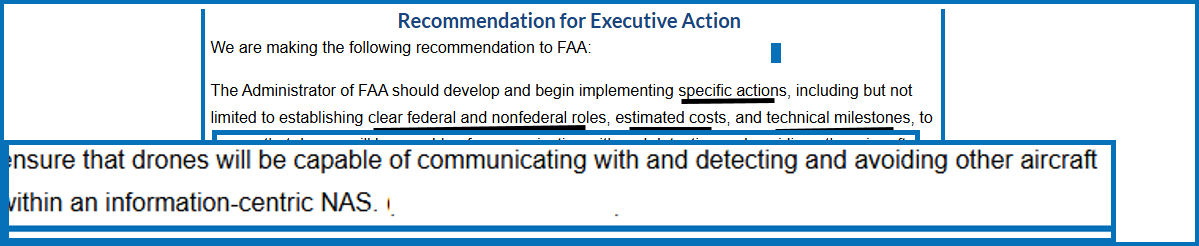
After years of extensive research, a 64 page report, prefaced with a safety concern (recent example[1]) and then made the following recommendation:
The full report identified that “the FAA, the DOT Highly Automated Systems Safety Center of Excellence, FAA Technical Center, Airborne Collision Avoidance System (ACAS) the MITRE Corporation and MIT Lincoln Laboratory’s development of ACAS and others are researching additional technologies that could be used in the future to help detect and avoid aircraft at low altitudes and make more aircraft electronically visible (i.e., “conspicuous”). For example:” [deletions to focus on the identified technologies].
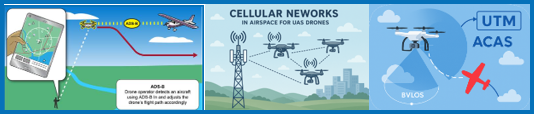
- Portable ADS-B devices
- Cellular networks
- Airborne Collision Avoidance System (ACAS).
While the GAO paper was likely at the GPO, on January 28, 2026, the FAA reopened the comment period for the BVLOS NPRM (Part 108), but ONLY to gather additional input on two unresolved and highly debated topics:
- Electronic conspicuity (EC) — what technologies should be required for drones to broadcast their position
- Right‑of‑way rules — how drones and crewed aircraft should yield to one another in low‑altitude airspace
Another very recent event could potentially influence the outcome of this rulemaking– FAA Administrator Bedford’s visit to Irish drone delivery company, MANNA, CEO Bobby Healey. The writer highlights that the Administrator’s purpose in visiting Dublin was to learn about the real world experiences (a/k/a OPERATING DATA) from 250,000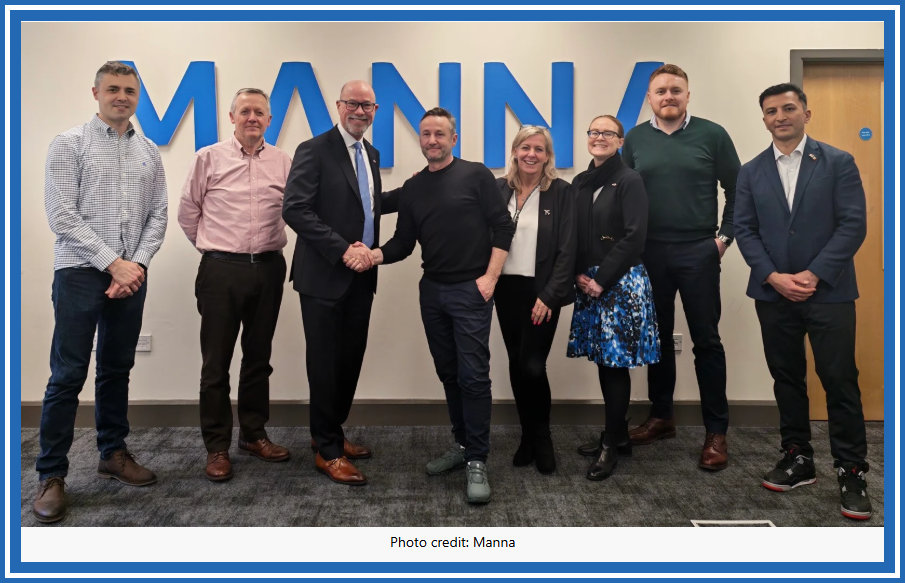 successful BVLOS flights in a densely populated community under EASA and IAI regulations.
The FAA’s reliance on data may have been enhanced by this meaningful visit and the Senior FAA officer may introduce his Irish-influenced?
Another late-added development from the Johns Hopkins Applied Physics Laboratory, which on February 10, 2026, said
“The Federal Aviation Administration’s long-awaited proposal to expand drone operations beyond visual line of sight marks a step toward transforming how unmanned aircraft operate in the nation’s skies — and one of the most consequential elements of the guidance emerged from pioneering work at the Johns Hopkins Applied Physics Laboratory (APL) in Laurel, Maryland. This new expansion of operations could accelerate use cases from rural package delivery to life-saving emergency response, while giving American companies a competitive edge in a global race for drone technology….
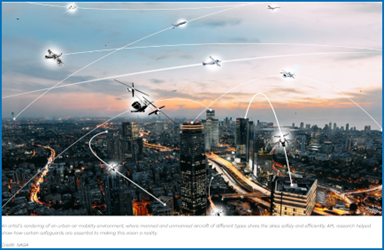
APL’s research built on work led by NASA and the Federal Aviation Administration (FAA) to evaluate two technical safeguards — strategic deconfliction and conformance monitoring — that are central to integrating drones safely into shared airspace. Strategic deconfliction prevents drones from being assigned overlapping flight paths before they take off, while conformance monitoring alerts operators when an aircraft deviates from its planned route once airborne.
Through extensive simulations, APL demonstrated how these systems, when used together, can dramatically reduce the risk of midair collisions — a finding that helped inform the FAA’s proposed new rule expanding beyond visual line-of-sight (BVLOS) operations, in which the pilot cannot directly observe the vehicle.
“This is foundational work,” said Sebastian Zanlongo, the project manager at APL for this research effort. “THE FAA WAS DECIDING WHETHER THESE FEATURES SHOULD BE RECOMMENDED OR REQUIRED, AND OUR ANALYSIS HELPED SHOW THE VALUE OF MAKING THEM PART OF THE PROPOSED RULE.”
On August 7, 2025, the FAA and the TSA first published an NPRM on BVLOS. The UAS industry has desperately wanted to add this mode of operation. Canada, EASA, Japan and most significantly the PRC have recorded positive experiences with these flights, thus the drone entrepreneurs and the think tank advocates[2] have voiced frustration with the glacier like movement of the FAA.
This Administration has emphasized the alacrity with which it moves and has clearly established a policy to aid US industry, specifically drones, in global competition. There are already federal efforts to create a record on drone operations—
- DHS Science &Technology Urban Drone Testing (NYC)
- FAA Drone Detection Testing Expansion to Off‑Airport Environments
- And drawing parallels with the eVTOL Integration Pilot Program(eIPP)
Observers, even more neutral ones, expect that ADMINISTRATOR BEDFORD will likely move the final rule towards promulgation expeditiously. The GAO concerns may be adequately addressed with the numbers of safe operations around the world.

Drone Deliveries Expected to Increase Substantially As Concerns About Safety Remain

Posted on February 10, 2026
Drones are increasingly being used to deliver packages and food orders. These commercial drones often fly beyond the line-of-sight of their operator—meaning the person piloting the drone can’t see it but instead relies on other means to detect and avoid collisions.
As you can imagine, these types of operations have raised some safety concerns, which are expected to increase as drone delivery use takes off.
Today’s WatchBlog post looks at our new report on the technologies that may improve drone safety and how the Federal Aviation Administration (FAA) is regulating this new form of air traffic.
Drones Used for Preparing and Executing Delivery Services in North Texas
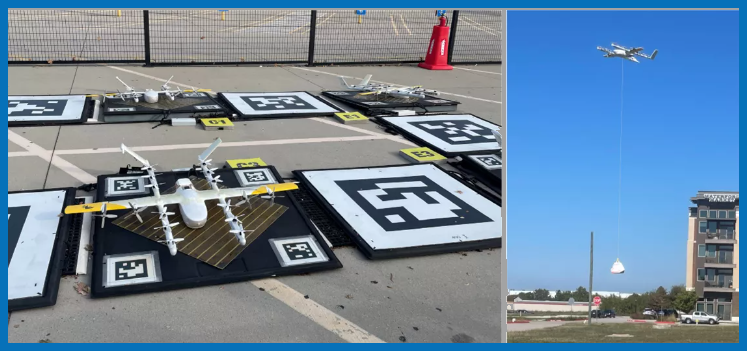
Out of sight, top of mind: detecting and avoiding other aircraft
By the end of last year, more than 1 million commercial drones were already being used for everything from delivering takeout to surveying disaster sites from above.
As commercial drone use increases, FAA is working with private industry to study drone traffic management and improve safety. For example, in North Texas, retailers are working with drone delivery companies and USING SOME DETECT-AND-AVOID technologies to enable package deliveries. As they do, they are also collecting data to inform future commercial operations. These technologies may help reduce risks of midair collisions when operating drones beyond line-of-sight.
Drone Applications That May Encounter Manned Aircraft at Low Altitude
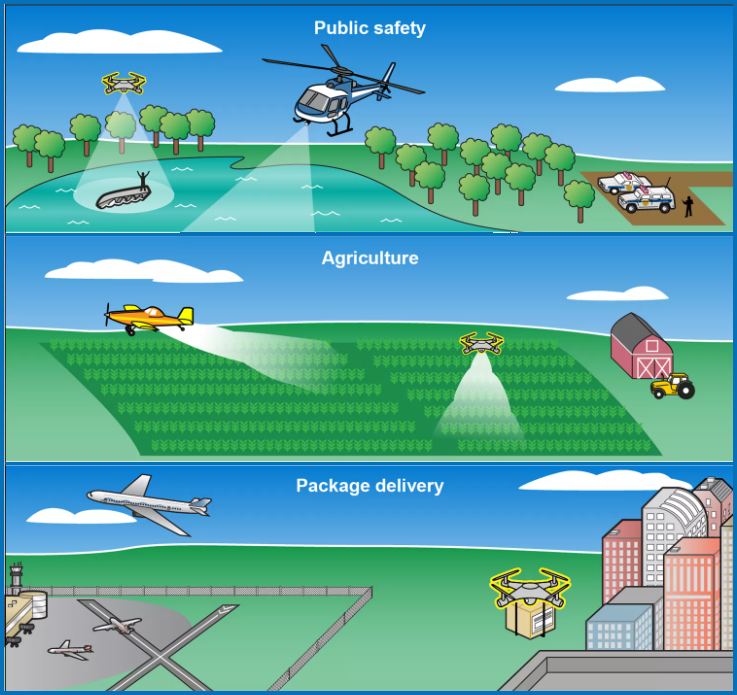
There are some existing technologies that drones use to avoid mid-air collisions. These include:
- Cameras mounted on the drone, ground, or both can provide operators with a 360-degree view around the drone.
- Acoustic sensors that use sensitive microphones and audio analysis to detect and identify the sound of other aircraft. This tech can even determine the general direction of the sound source.
- Ground-based radar information that allows operators to detect other aircraft and maneuver away.
- ADS-B—or automatic dependent surveillance-broadcast—an advanced technology that conveys an aircraft’s location, altitude, and speed. Aircraft may be equipped to broadcast their own data (ABS-B Out), receive data from others (ADS-B In), or both.
ADS-B is the MAIN TECHNOLOGY used by manned aircraft to communicate with each other, but it is not as simple as drones using the same technology to communicate. Drones are allowed to receive ADS-B information from other aircraft but they are generally prohibited from broadcasting their own information. This is because if too many drones transmitted ADS-B Out signals, it could overwhelm the system potentially endangering manned aircraft like passenger planes, helicopters, and more.
Integrating drones into the National Airspace System
Because of the risks associated with flying drones in the same airspace as manned aircraft, FAA WILL NEED TO MAKE CHANGES BEFORE COMMERCIAL DRONE USE IS MORE WIDELY ADOPTED. The lack of two-way communication between drones and other aircraft presents a big challenge. In the future, FAA hopes to transition to a new, information-centric National Airspace System in which all users share location information. To achieve this, NEW TECHNOLOGY is needed.
The FAA has already proposed new rules requiring drones that fly beyond line-of-sight to detect and avoid other aircraft. However, FAA has not developed specific plans to address how drones will communicate with other aircraft. In our recent report, we recommended FAA do so.
To learn more about drone detect-and-avoid technology and the future of drones in the National Airspace System, read our full report.
[1] An Amazon Prime Air delivery drone crashed in Richardson, TX, on Wednesday after it apparently hit a building.

[2] Reason Foundation; Mercatus Center (George Mason University); Competitive Enterprise Institute (CEI); R Street Institute– Waiver system is inefficient; FAA is slow to finalize rule; Lack of data-driven decisions; Overregulation of low-risk ops; and Need for performance-based rules.

