FAA spotlights the dedication and innovation of its talented workforce

The FAA Office of Communications issues frequent information about what that important safety that the organization does. That history of releases appears to have focused the subject on the process, rather than the individuals involved. Significant actions in which a SENIOR EXECUTIVE (career and political) who is responsible for an action or initiative are mentioned in the stories. HOWEVER, IT SEEMED RARE TO READ ABOUT ONE OF THE THOUSANDS OF FAA CAREER EMPLOYEES WHO DO THE WORK. That impression recently appeared to change, a significantly increase in positive mentions about the men and woman who spend their days assuring  the safety of passengers, cargo, and aviation professionals.
Such a subjective observation is hardly a basis for a post here. With CoPilot AI that surface impression would not merit an article and more importantly justify praise to FAA Administrator Brian Bedford and Assistant Administrator for Communications Hannah Walden.
The full complex statistical analysis can be read in the attached file and is summarized in this conclusory table-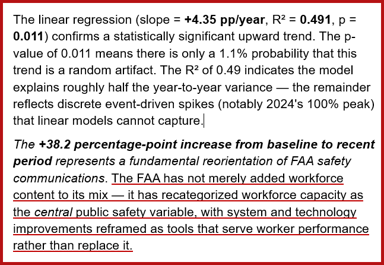
CONGRATULATIONS to the current team responsible for appropriately giving attention to these public servants. It has been reported that the DOGE impacted the agency’s rank and file as follows:
- Reduced FAA career‑staff numbers, especially in technical and safety‑support roles.
- Targeted employees based on employment status, not competence.
- Removed both early‑career and highly experienced staff, weakening institutional knowledge.
- Degraded FAA’s operational competence, increasing strain and risk across the system.
Articles, like the three below, tell the public in general, the staff, and their families how much the FAA leaders value their vital contributions to aviation safety. THIS BOOST TO THE TEAM’S DEDICATION IS AN ANTIDOTE TO THE GENERAL MALAISE INFECTING THE MEDIA’S AND POLITICAL COMMENTARIES ABOUT FEDERAL SERVICE AND AVIATION.
Keeping the Skies Safe for Every Pilot, Passenger, and Future Aircraft
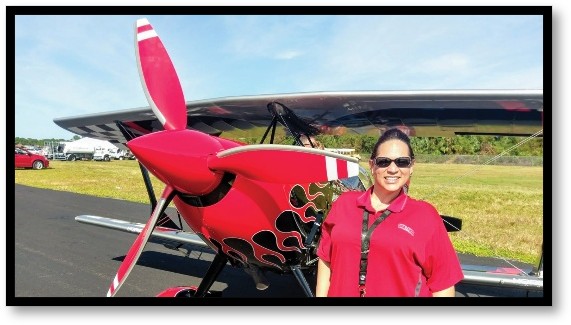
From the flight deck of a Boeing 747 to the cutting edge of advanced air mobility, Laurie Armetta’s aviation journey is driven by a profound love for aircraft and an unwavering commitment to safety.
As a manager focused on advanced air mobility safety assurance within the FAA’s Emerging Technologies Division, Armetta is helping to pave the way for the next generation of flight.
Born in Brooklyn, New York and grounded in her Italian roots, Armetta’s early life was defined by travel, including regular summer trips to visit family in Sicily. Her passion for aviation was ignited at age 5 during a flight out of JFK Airport. Wandering away from her mother upon boarding an Alitalia Boeing 747, she headed straight for the cockpit. Instead of being sent back to her seat, the pilot sat her in the co-pilot’s chair and showed her the flashing instruments. That experience planted the seed for her future in aviation.
When her family moved to Boca Raton, Florida, Armetta pursued every opportunity to get closer to airplanes. At 15, while seeking a flight training scholarship, she began volunteering with local airframe and powerplant (A&P) mechanics. “As much as I liked flying, I learned that I loved fixing airplanes,” she recalls.
At 17, Armetta joined the Navy as an aviation machinist’s mate, maintaining F-18 engines. After her military service, she earned her A&P certificate and an associate degree in aviation maintenance management. Her career grew rapidly as she worked as a night shift mechanic, chief inspector, and quality assurance inspector for commercial airlines and repair stations. She later completed a bachelor’s degree in aviation administration and ran her own successful aviation consulting firm for six years.
Seeking to make a lasting impact on aviation safety, Armetta joined the FAA in September 2010, taking a position at the Flight Standards District Office (FSDO) in Anchorage. Her time in Alaska was filled with unforgettable experiences, including serving as the principal maintenance inspector for aircraft operating around Denali National Park and experiencing her first glacier landing. She later transferred back to Florida to care for her ailing mother, eventually stepping into a frontline manager role at the South Florida FSDO.
In February 2026, Armetta stepped into her current role within the Emerging Technologies Division’s Safety Assurance Branch, which was established to unify FAA oversight of drones and advanced air mobility (AAM). Today, Armetta’s team manages the transition of pioneering electric vertical takeoff and landing (eVTOL) manufacturers into certificate management.
A major pillar of her current workload is the eVTOL Integration Pilot Program (eIPP), an initiative to safely deploy AAM vehicles into the National Airspace System (NAS). In March 2026, the FAA selected key state departments of transportation and city entities as partners to build out this framework.
“We perform the same duties as a standard FSDO, but our focus is strictly on UAS and integrating revolutionary eVTOL aircraft into the skies safely,” Armetta explains.
Armetta offers clear reassurance — these systems are built with multi-layered safety protocols and are not “flying blind.” She highlights three core concepts for safe co-existence:
- Fly Cooperative: Keeping active transponders or ADS-B Out enabled ensures autonomous aircraft can instantly track traditional planes.
- The Corridor Model: Initial AAM routes will be segregated into specific altitudes and predefined transit corridors, keeping them safely separated from traditional traffic.
- Detect-and-Avoid: Autonomous systems utilize onboard radar, optical vision, and transponders to detect and avoid nearby aircraft faster than human reaction time.
Looking ahead, Armetta envisions a transition from piloted to fully autonomous operations, driven by digital traffic management networks and hybrid-electric propulsion systems. Through it all, her mission remains clear: keeping the skies safe for every pilot, passenger, and future aircraft.
The Architects of Innovation
How the FAA’s Emerging Technologies Division is Shaping the Future of the NAS
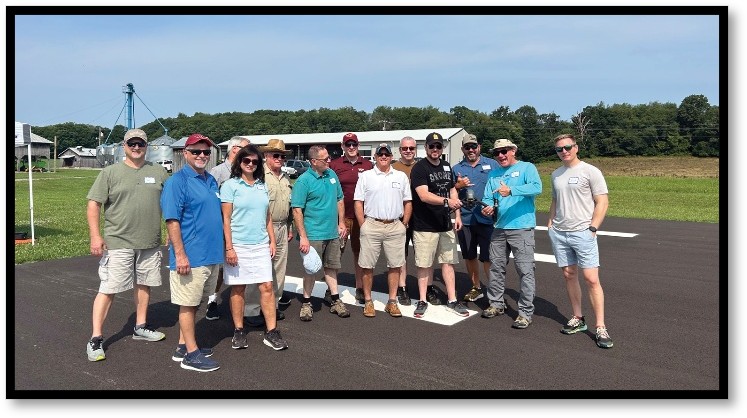
Employees within the Emerging Technologies’ General and Commercial Aviation Branch attend a drone pilot training event at Virginia Tech in Blacksburg, Va.
As the National Airspace System (NAS) continues to evolve, the integration of drones and advanced air mobility (AAM) has moved from theoretical discussion to operational reality.
Central to this transformation is the FAA Flight Standards Service’s Emerging Technologies Division. It provides a single, unified point of oversight within Flight Standards for these rapidly advancing technologies. The division’s complex yet vital mission is to ensure innovation flourishes without compromising a century of American safety standards. From package-delivery drones to the next generation of electric vertical flight, the Emerging Technologies Division serves as one of the agency’s primary architects for normalizing advanced operations and new entrants.
 IT’S WORTH LEARNING ABOUT THIS GROUP and how they’re turning emerging concepts into standardized procedures and what these changes mean for pilots, controllers, and operators.
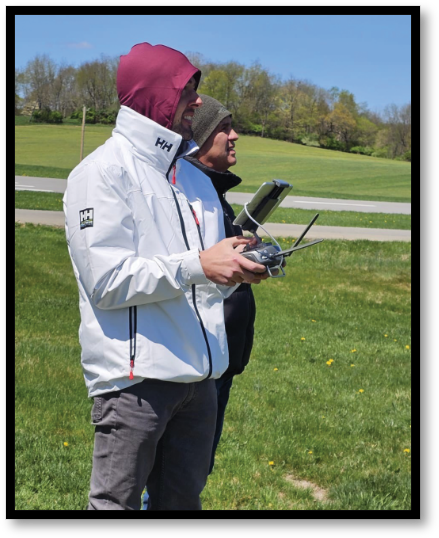
UAS Safety Specialist Roberto Ingrao and Aviation Safety Inspector Sergio Lopez practice drone piloting at Virginia Tech.
The ‘Unified Hub’ Strategy
Centralizing drone and AAM operational oversight within the Emerging Technologies Division simplifies the landscape for both operators and the general aviation community. The service ensures consistent, repeatable decision-making across the board that accelerates policy development, while the division remains grounded in risk management. “We do not always ‘get to yes,’ but we do produce carefully considered decisions that provide options for forward movement, aligned with the safety-risk continuum in mind,” shared Joe Morra, the manager of the division.
To make that forward movement as efficient as possible, the division functions as a “one-stop shop” for operators and manufacturers. Rather than trying to navigate complex regulatory requirements alone, industry partners enter a structured path early on.
“We have what we term a ‘product development lifecycle’ for emerging technologies,” said Morra. “Interested parties can start with the Integrated Proposal Document (IPD) process, where we answer questions and begin a working relationship.”
Through this unified lifecycle, novel technologies progress seamlessly through aircraft evaluation, policy development, live operations, and oversight under the division’s Safety Assurance Branch.
From Waiver to Normalization
Keeping pace with rapidly advancing technology requires clear pathways to normalize operations within the NAS. The Emerging Technologies Division plays a central role in guiding new concepts from the “experimental” stage into routine integration. The key to this evolution is data collection — leveraging lessons learned from the high volume of waivers and exemptions the division processes.
“Once we have identified safe and scalable pathways for normalizing a particular technology or type of operation through waivers and exemptions, we can use the data to solidify policy,” said Morra.
Ideally, this shift would occur through rulemaking; however, rulemaking is not the only mechanism for establishing policy.
“We have been able to normalize drone light shows, first responder operations, and agricultural operations through standard waiver and exemption templates,” shared Morra. “When something is new, we gather data, conduct operator site visits, and continue to modify the provisions in the waivers until we have sufficient knowledge and data to show we can create a standard waiver for low-risk operations that are similar in nature.”
A prime example of data driving regulatory change is 14 CFR section 107.29. Between 2016 and 2021, the FAA PROCESSED THOUSANDS OF INDIVIDUAL PART 107 NIGHT-OPERATION WAIVERS. Analyzing data across those approvals allowed the agency to establish proven safety standards. Rather than continuing to require repetitive individual waivers, the FAA codified those requirements directly into section 107.29, permanently streamlining the process for operators.
The Innovation Onramp
Regardless of what the new technology is, the Emerging Technologies Division follows an established process for how Flight Standards intakes, evaluates, and manages new entrants. Lessons learned from working with drones have built a strong foundation for other new technologies, and the process embodies the FAA’s longstanding safety management system (SMS) principles.
However, the steps below do not account for the critical work of engaging industry, building relationships, and considering new ideas before they’re brought to the FAA. Often, meaningful work to understand new technologies and the industry players developing aviation innovations is already happening before formal requests are received. This is a key component of the division’s success.
The Emerging Technologies Division’s process for new entrants: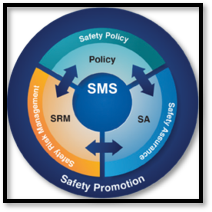
- Intake/Initialize/Hypothesize — intake new concepts and technologies, analyze, identify hazards, develop safety risk management (SRM) plan
- Test — research, evaluation/validation, operational suitability demonstrations (OSD)
- Record — document SRM, draft policy, retain artifacts
- Incubate/Implement — implement safety assurance, transition to the field when appropriate
The building blocks of SMS — SRM (identify hazards, test/validate); policy (create policy, implement); safety assurance (monitor) — have informed our drone work and serve as the basis for our process to safely enable new and emerging entrants. By maintaining an unprecedented level of safety, this process is keeping the United States the leader in global aviation technological development.
Looking Ahead
With AAM functions growing, the division is focused on normalizing electric vertical takeoff and landing (eVTOL) aircraft operations. A key driver is the FAA’s eVTOL Integration Pilot Program (eIPP), which partners with eight state and local agencies across 26 states. The division is leveraging real-world insights from these initial eIPP operations to shape effective safety standards and policy.
“In the drone sphere, we learned early on that the key to effective drone integration was incremental implementation,” said Morra.
This “crawl-walk-run” approach allowed small-scale operations to generate vital safety data without disrupting broader airspace. Flight Standards is applying this same proven blueprint to eVTOL integration.
For traditional pilots and aviation professionals wondering how these changes affect their daily environment, the division’s message is clear: the NAS can increase in complexity while simultaneously becoming safer.
Automation plays a pivotal role in this shift. By pairing human oversight with automated systems, the industry can reduce workload while enhancing overall airspace safety. Integrating SMS principles ensures that these automated systems are evaluated using proactive, data-driven decisions.
Ultimately, modern collision avoidance requires shifting from relying solely on visual “see-and-avoid” out the cockpit window to establishing shared electronic situational awareness across all aircraft — traditional and new entrants alike.
Centralizing this work ensures new entrants are normalized safely. It is not merely about adding aircraft to the sky, but creating the standards that allow traditional flight operations and emerging technologies to seamlessly coexist.
Learn More

Flight Path to a Just Culture
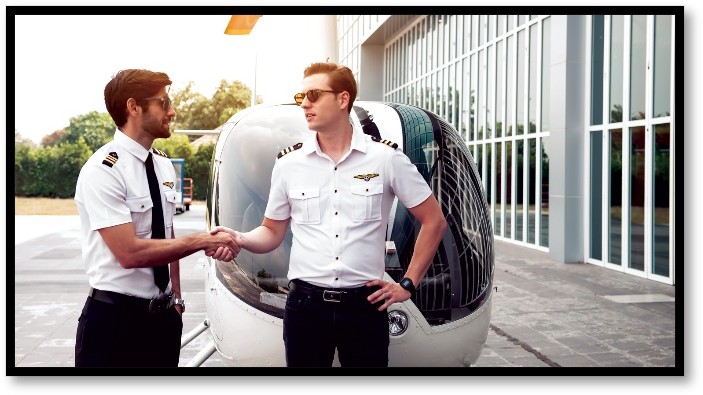
As a wide-eyed, eager, and oh-so-naïve helicopter student pilot, Leah Murphy, FAA Safety Team Representative, walked into her flight school one afternoon, prepared for a ground lesson, when she noticed an unusual energy among the instructors. The chief pilot’s door was shut, but muffled shouting leaked through the walls. Gaggles of instructors and students whispered to each other, glancing nervously toward the office. As she set her backpack down, she wandered over to a small group and asked what was going on.
A flight instructor, Joe (not his real name), had an engine overspeed.
With no more than twenty hours in her logbook, she didn’t fully understand what that meant. But she understood enough from the room’s tension that it wasn’t good, and that whoever “Joe” was, his day was not going too well. The instructors’ hushed tones and the chief pilot’s raised voice made one thing abundantly clear: mistakes were punished, not learned from. That moment was her earliest exposure to negative safety culture, and it shaped her understanding of how deeply culture influences safety outcomes in helicopter operations.
Today, industry has evolved far beyond those closed-door reprimands and whispered post-incident rumors. One of the most significant drivers of this shift has been the implementation of a structured safety management system (SMS), not only as a best practice, but now as a regulatory requirement. In 2023, the FAA expanded the
14 CFR part 5 SMS requirements to tour operators flying under section 91.147 and charters operating under part 135.
SMS implementation marks a deliberate move toward a proactive, data-driven approach to helicopter safety. It formalizes processes to ensure hazards are identified early and addressed systematically rather than reactively. At its core, SMS comprises four key components: Safety Policy, Safety Risk Management, Safety Assurance, and Safety Promotion.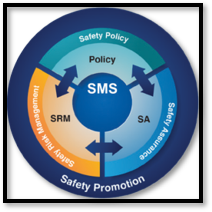 Together, they create an environment where you do not wait for an accident or incident to reveal weaknesses in training, procedures, or communication.
Safety Policy establishes organizational expectations, leadership accountability, and a just culture — something that was starkly absent in the “Joe” scenario. The required SMS implementation means leaders can no longer rely on fear-based management or inconsistent responses to errors. They must define clear policies that support reporting, transparency, and constructive learning.
Safety Risk Management provides operators with a structured process to identify hazards and assess associated risks before they escalate into an event. Under the FAA’s requirements, SRM is no longer optional or informal; it must be continuous, documented, and integrated into every operational decision.
Safety Assurance verifies that risk controls are working through trend analysis, audits, data collection, and feedback loops. For helicopter operators, this can include monitoring approach profiles, reviewing recorded flight data (if equipped), analyzing maintenance discrepancies, or tracking procedural compliance.
Safety Promotion reinforces the cultural transformation. Training, communication, and shared lessons learned help normalize reporting and reduce the stigma associated with errors. In a required SMS environment, operators must ensure that every employee understands the SMS and their role within it. This would have completely changed the culture I witnessed as a student pilot; instead of a closed-door scolding, there would have been an open discussion, a teaching moment, and a safety bulletin or debrief for the greater learning of the school.
The FAA is building systems that actively hunt for hazards, verify the effectiveness of their controls, and, most importantly, foster an environment where reporting an error, such as Joe’s preventable engine overspeed incident, is seen as a contribution to collective safety, not a career-ending mistake. Ultimately, the successful implementation of SMS is what makes helicopter operations not only compliant but fundamentally safer.
Learn More