FAA NPRM proposes ON BOARD MEDICAL kits to be PERFORMANCE BASED- good idea?
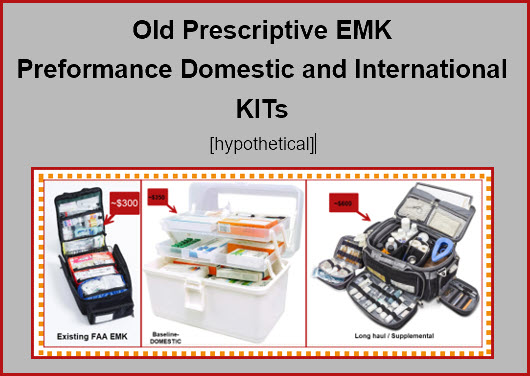
The Federal Register of August 5 includes a NPRM that would amend the basic medicine, instruments and materials that are specifically required to be included in 14 CFR 121.803, Emergency medical equipment. In lieu thereof and consistent with the evolving regulatory approach to aviation safety, it is proposed that the carriers must include a kit that is “practical and sufficient to allow crewmembers to address common emergency illnesses or accidents that may occur onboard commercial aircraft.” The NPRM notes that this shift to a performance based medical kit reflects this prospectively applied standard-
“Medical science and medication innovation often evolve, and FAA’s proposal would allow operators’ EMK or FAK to evolve with them…
Therefore, FAA proposes in this rulemaking for operators to equip their aircraft with an EMK that includes adequate supplies for medical personnel to provide basic evaluation and initial treatment for medical conditions and events described in section 368 and other life-threatening conditions as proposed in § 121.807.”
Copilot AI indicates that analyzing the passenger profiles for US carriers and their operation systems may create 2 types of Medical Kits that airlines will fit the proposed PERFORMANCE standards:
DOMESTIC U.S. SYSTEM
Most U.S. domestic flights are short‑ to medium‑haul (1–5 hours) with rapid access to diversion airports. Medical events tend to cluster around:
-
-
-
- Syncope / presyncope (fainting, dizziness) — the single most common event
- Gastrointestinal distress — nausea, vomiting
- Respiratory issues — mild asthma, anxiety‑related dyspnea
- Minor trauma — cuts, sprains, burns from hot liquids
- Allergic reactions — mild to moderate
- Hypoglycemia — diabetic passengers missing meals
-
-
These events rarely require advanced interventions. Domestic operations benefit most from basic assessment tools, antihistamines, glucose, airways, AED, and bandaging/splints — exactly the items historically required in Appendix A.
INTERNATIONAL LONG‑HAUL ROUTES
Long‑haul flights (8–16 hours) introduce two major differences:
-
-
- Time to diversion is longer, so crews must manage conditions for longer periods.
- Passenger demographics shift — more elderly travelers, more chronic conditions, more fatigue‑related issues.
-
Medical events on long‑haul flights show higher incidence of:
-
-
-
-
-
-
- Cardiac symptoms — chest pain, arrhythmias, angina
- Severe allergic reactions — anaphylaxis (rare but critical)
- Respiratory distress — COPD exacerbations, severe asthma
- Diabetic emergencies — hypoglycemia or hyperglycemia
- Deep‑vein thrombosis symptoms — leg pain, swelling
- More complex GI issues — dehydration, severe vomiting
-
-
-
-
-
These events require longer stabilization, not necessarily different equipment. The same core kit works, but quantities (e.g., more gloves, more saline flushes, more antihistamine doses) may need scaling.
However, the analysis suggests that there may be a “universal” kit that includes:
The variation in medical‑event types across domestic vs. international operations is not large enough to justify different kits. Instead, airlines should adopt:
A single, standardized emergency medical kit with scalable quantities.
This kit would include:
-
-
-
-
-
- Assessment tools — BP cuff, stethoscope, pulse oximeter
- Airway management — oropharyngeal airways, pocket mask
- Cardiac support — nitroglycerin, aspirin, AED (already required)
- Allergy/anaphylaxis — epinephrine auto‑injector + antihistamine
- Diabetic support — oral glucose gel + IV dextrose
- Respiratory support — bronchodilator inhaler with spacer
- GI support — antiemetic (if allowed), oral rehydration salts
- Trauma supplies — bandages, splints, gloves
- Crew‑usable instructions — simple, algorithmic, QR‑linked guides
-
-
-
-
The only operational difference would be:
-
-
-
-
-
- Domestic flights: baseline quantities
- International long‑haul: increased quantities of consumables (gloves, saline, antihistamine, glucose), and possibly one supplemental kit stored near the galley.
-
-
-
-
This aligns with FAA’s performance‑based philosophy: contents must be “practical and sufficient” for the most common onboard emergencies, not tied to a fixed list.
The analysis even provides justification for its single kit solution:
Medical emergencies are statistically similar across route types
The types of events do not change — only the duration of management changes.
Diversion capability is the real differentiator
Long‑haul flights need more quantity, not different types of equipment.
Crew training is standardized
Part 121 requires uniform crewmember training for medical events. A single kit simplifies training.
Operational simplicity
One kit reduces:
-
-
-
-
- stocking errors
- maintenance burden
- regulatory compliance complexity
- crew confusion during emergencies
-
-
-
Medical consultation services (MedAire, STAT‑MD)
These services guide crews through interventions using standard kits. They do not require route‑specific kits.
These opinions are based on macro data and individual carriers may determine that they can meet the proposed Emergency Medical Kit Efficacy and Flexibility in Commercial Airline Operations performance standards with different medical bags. Even with a 2 kit option, the complexity of assuring that the individual aircraft meets the new 14 CFR 121.803 performance criteria becomes difficult. Today, there are planes that may fly overwater (>30 minutes >100 nm from shore) and some may not. It is not uncommon for a plane to fly one or more domestic legs and then take an international trip.
Giving the airlines the ability to design their safety approaches based on their knowledge of their risks is one of the principles of SMS. Further, the FAA in aircraft certification processes have explicitly moved from PRESCRIPTIVE REQUIREMENTS to performance-based, accepted by FAA as standards. It is unclear here whether the FAA will add its stamp of approval to Carrier X’s proposed compliant kit under new §121.803.
The medical malpractice bar is large, very litigious and very capable. Aviation accidents against the manufacturers and operators, while highly visible, are difficult because of the FAA’s setting of safety standards as explained in this summary[1]:
Meeting FAA prescriptive safety requirements gives an airline a powerful liability defense because it shows the carrier met the legally defined standard of care for aircraft operations. In negligence cases, plaintiffs must prove the airline breached a duty; demonstrating full compliance with FAA rules helps negate that element by showing the airline followed every mandatory safety protocol governing maintenance, operations, crew qualifications, and airworthiness. Courts often treat regulatory compliance as strong evidence that the operator behaved reasonably under the circumstances, reducing the plausibility of negligence per se claims.
Compliance also helps the airline frame the accident as the result of unforeseeable events rather than operational misconduct. FAA regulations are designed to embody minimum national safety standards, so an airline that can document adherence to each applicable requirement can argue that it satisfied all federally recognized precautions. While compliance does not automatically eliminate liability—especially in areas not federally preempted, such as certain product‑liability claims—it provides a structured evidentiary shield showing disciplined safety management and reduces exposure by narrowing the plaintiff’s ability to argue that the airline failed to take required measures.
This is not to say that performance standards are inadvisable, but thought should be given as to what impact they may have on litigation.
The individuation that the Improving Emergency Medical Kit Efficacy and Flexibility in Commercial Airline Operations NPRM will enhance the airlines’ capabilities to respond to passenger needs. It looks as though a universal kit may meet the flight emergencies’ needs. Hopefully the latitude that performance based standards will not have unintended side consequences.
FAA proposes ‘performance-based’ approach to aircraft medical kits
August 25, 2026
Washington — The Federal Aviation Administration wants to replace the standardized list of items for airline first aid and emergency medical kits with a “PERFORMANCE-BASED REQUIREMENT.”
According to a notice of proposed rulemaking published Aug. 5, FAA is seeking to “ensure (kit) contents are practical and sufficient to allow crewmembers to address the most common medical emergencies that occur onboard commercial aircraft.”
The FAA Reauthorization Act of 2024 directed the agency to consider changes to these kits.
“The 2024 reauthorization directed that the proposed rule consider the benefits and costs of any new medications or medical equipment to address the emergency medical needs of
-
-
-
-
- children and pregnant women,
- opioid overdose reversal,
- anaphylaxis,
- and
- cardiac arrest,”
-
-
-
the notice states. “The 2024 reauthorization further directed the proposed rule to consider to what extent emergency medical kits should be readily available for use by flight crews without prior approval by a medical professional.
The agency is also proposing changes to Appendix A in Part 121 of FAA regulations.
“The problem with the current Appendix A is it prescribes SPECIFIC MEDICATIONS AND QUANTITIES of each medical item,” the notice states. “Medical science and medication innovation OFTEN EVOLVE, and FAA’s proposal would allow operators’ emergency medical kits or first aid kits to evolve with them. However, Appendix A’s prescriptiveness that specifically names certain medications and specific quantities of each medication in the emergency medical kit prevents operators’ emergency medical kit or first aid kit contents from keeping up with the most modern medical scientific developments.
“In addition, medication shortages occasionally impact operators’ abilities to acquire an adequate supply for their emergency medical kit.”
The deadline to comment on the proposed rule is Oct. 5.
[1] 1st paragraph Commercial Drone Liability: Navigating FAA Regulatory Compliance Frameworks – Smalley & Sharples | Legal Review 2nd paragraph No Field Preemption for Aviation Product Liability Claims – Sikkelee v. Precision Airmotive (2018) Continues to Hold Sway