DOT reorganization of FAA- Quick (needed) but MYOPIC???

Today’s blog will invert the usual order of presentation;
-
the blog post begins with the Press Release,
-
followed by a set of charts that show the changes
and
-
finally, some thoughts (actually more like questions)
-
I-
Trump’s Transportation Secretary Sean P. Duffy & FAA Administrator Bryan Bedford Unveil New Agency Structure to Enhance Safety, Embrace Innovation, & Increase Transparency
Monday, January 26, 2026
Long overdue re-org of FAA will also support modernization of our skies
WASHINGTON, D.C. – U.S. Transportation Secretary Sean P. Duffy and Federal Aviation Administration (FAA) Administrator Bryan Bedford today announced their plan to implement a long overdue overhaul of the FAA’s organizational structure.
The comprehensive re-organization – the largest in the agency’s history – includes the creation of a new safety oversight office. This office, which was supported by Congress in the 2024 FAA Reauthorization, will implement a single safety management system (SMS) and risk management strategy for the entire FAA. Now, instead of different safety metrics siloed in individual offices, the agency will be able to share safety data more freely. Other key changes include:
- Launching an Airspace Modernization office to ensure the installation of a brand-new air traffic control system moves at Trump Speed.
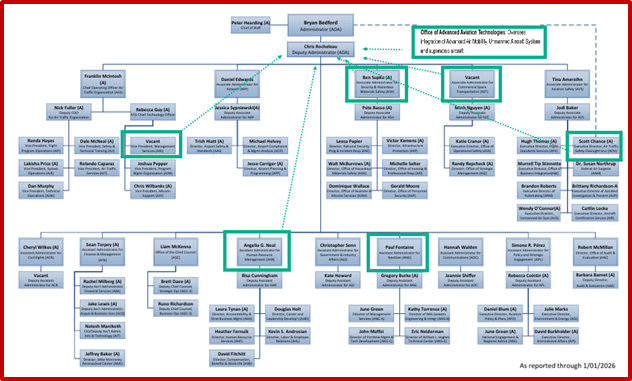
- Creating a new Advanced Aviation Technologies office to oversee the integration of drones, eVTOLs, and other advanced air mobility vehicles into the airspace.
- Shifting more key leadership posts to permanent positions.
- Consolidating the management of finance, IT, and human resource divisions under the administrator.
The restructuring will not result in reductions in force.
“Thanks to President Trump and Republicans in Congress, we received an unprecedented $12.5 billion down payment to modernize our skies,” said U.S. TRANSPORTATION SECRETARY SEAN P. DUFFY. “But funding is only one piece of the puzzle. With these critical organizational changes, the FAA can streamline the bureaucracy, encourage innovation, and deliver a new air traffic control system at the speed of Trump – all while enhancing safety.”
“It’s important that we have the right people in the right places to do the best work possible,” said FAA Administrator Bryan Bedford. “These actions will put permanent leaders in place who embrace innovation, share safety data and insights freely and are focused on deploying a brand-new air traffic control system all while integrating key innovation technologies into the new National Airspace System (NAS).”
Additional Information:
The FAA’s new structure will be well positioned to implement Flight Plan 2026, the agency-wide strategy that positions the FAA to meet aviation’s current challenges and future opportunities. The plan is built on three pillars: people, safety and NAS modernization. It reflects FAA’s commitment to strengthen our safety foundation, modernize the NAS, and invest in the people who make the FAA the global standard of aviation safety and efficiency
The new organizational structure is below.
- The Administration and Finance Office—will include the following organizations: the Office of Finance and Management; the Office of Information and Technology; and the Office of Human Resource Management.
- The Policy and Legal Office—will oversee strategic policy, legal, stakeholder engagement, and financial assistance functions. It will also include the agency’s rulemaking and regulatory office, as authorized by the FAA Reauthorization Act of 2024.
- The Airspace Modernization Office—required by the FAA Reauthorization Act of 2024, the office will be responsible for modernizing the National Airspace System (NAS), including planning, research and development, systems engineering, and portfolio management.
- The Air Traffic Organization—will continue its mission providing the safest, most efficient air navigation services in the world.
- The Aviation Safety Management System (SMS) Organization—will lead an agency-wide safety management system by centralizing safety management activities previously conducted in five separate lines of business.
- The Office of Advanced Aviation Technologies—consistent with the FAA Reauthorization Act of 2024 and President Trump’s Executive Orders, the office will be the designated point for activities related to the integration of advanced aviation technologies including Advance Air Mobility, Unmanned Aircraft Systems, and Supersonic aircraft in United States.
- The Office of Commercial Space Transportation—will continue regulating the U.S. commercial space transportation industry.
- The Security and Intelligence Organization—will continue conducting security and intelligence activities.
- The Aviation Safety Oversight and Certification Organization—will continue the safety oversight and certification activities of the former Aviation Safety Organization.

II
Series of
Charts
OLD
as of 01/01/26
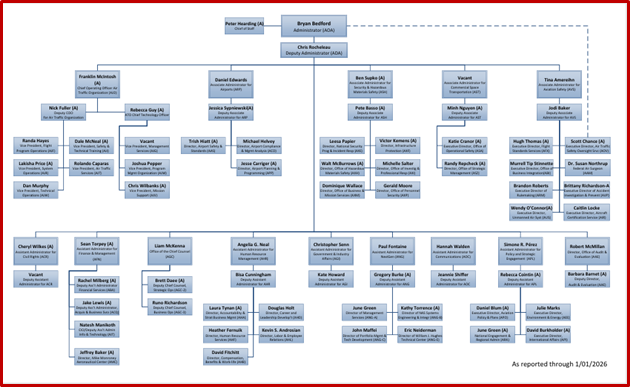
CURRENT SENIOR STAFFING

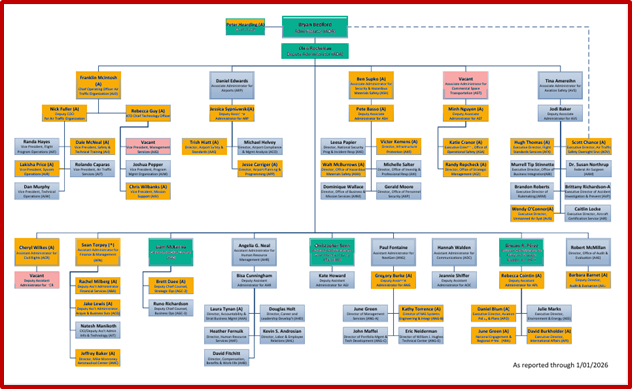
As best that can gleaned from the Press Release, here are the existing and modified positions,
NOW reporting DIRECTLY to the Administrator
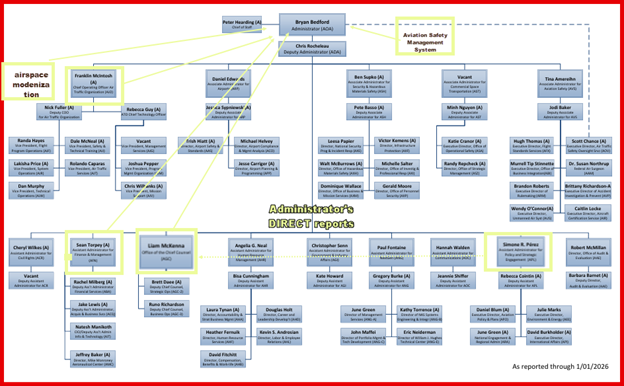
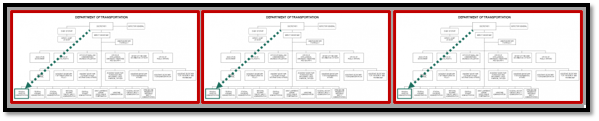
Again, trying to discern what the Press Release, here are the existing (and modified ) positions that
NOW report directly to the Deputy Administrator
III
Thoughts
&
Questions
(not prioritized)
- The Press Release indicates that a goal is to put “the right people in the right places”. That’s a point with which no one could disagree.
- The question is with SO MANY ACTING and VACANT positions, i.e. the career staffers who do the work, why not fill them as a Their positions on the organization chart strongly suggests that their work function is HIGH LEVEL and critical to WORK FLOW.
- The term ACTING basically places the person in that position IN LIMBO. The people who report to the position recognize that such a designation means that the directions issued by her or him, are likely to change, soon. So, delay of the throughput may actually economize the subordinate’s workload.
- OPM has designed a management process that ties individuals’ future earnings to productivity. However, the staffer who delays is not likely to suffer the consequences because the BOSS likely will not be around for the PER.
- Laterals are more likely deal with an A differently; not giving them the same level of deference or respect to the Acting’s positions.
- Many of the New Offices look more like special, integrated Task Forces, designed to address specific problems. WHAT HAPPENS WHEN THE REFORMS ARE ACHIEVED?
- EXAMPLE- Airspace Modernization Office (AMO?)is being created to ensure the installation of a brand-new air traffic control system in TRUMP SPEED.
- Sec, Duffy has committed that “Brand New, State‑of‑the‑Art Air Traffic Control System” will be completely installed by FY2028.
- So as of 09/30/2028 what does AMO do? Nothing more to acquire? Continuous enhancement of the NAS?
- Does AMO include the “client” experts on what is needed to safely and efficiently control traffic? If, yes, what jobs can they return to in ATO?
- If there are no client ATCers in AMO, is there a mechanism for the operators of the system to demand more capabilities than AMO has?
- More briefly—
- Aviation Safety Management System (SMS) Organization—will lead an agency-wide safety management system by centralizing safety management activities previously conducted in five separate lines of business. GREAT IDEA. But if Aviation Safety disagrees with this new SMS office on applying this critical safety tool to a specific case; what Happens? The recent NTSB hearing highlighted that the safety data existed; how will the super SMS team know about such failures at almost 800 facilities spread across the country?
- Office of Advanced Aviation Technologies (AAT) —the traditional method for certification of all new aircraft is based on DATA . Innovative TC applications are challenged to create a basis of proof that state-of-the-art aviation technologies, such as advance air mobility, unmanned aircraft systems, and supersonic aircraft, are safe. No doubt about it the UAS and AAM road through the FAA has been bumpy. Defining a team that can both assure safety and encourage creativity would be EXCELLENT. If this AAT mission was assigned to a team drawn for all of the relevant offices (power, structure, controls, environment, operational parameters, rule writing, etc.) that would expedite the final decision. But if the AAT does not include all of those perspectives, the consequences could be disastrous)
- The Policy and Legal Office (PLO?) —includes overseeing strategic policy, legal, stakeholder engagement, financial assistance functions, rulemaking and regulatory office. When a lawyer is involved in both:
- shaping or advocating for a policy, and
- issuing legal opinions about the legality of that same policy,
- EXAMPLE- Airspace Modernization Office (AMO?)is being created to ensure the installation of a brand-new air traffic control system in TRUMP SPEED.
there is a risk that the legal analysis becomes outcome‑driven rather than objective. The ABA has given advice on such dual roles-
ABA Model Rule 2.1 — Advisor
A lawyer must exercise independent professional judgment and give candid advice.
If the lawyer’s policy role compromises independence, this rule is implicated.
-
-
-
-
- ABA Model Rule 1.7 — Conflict of Interest
-
-
-
A conflict exists if:
-
-
-
-
- the lawyer’s personal interest (e.g., commitment to a policy)
- materially limits their ability to provide objective legal advice.
-
-
-
Even if the lawyer is not personally benefiting, A STRONG POLICY PREFERENCE CAN BE A “PERSONAL INTEREST.”
-
-
-
-
- ABA Model Rule 1.13 — Organization as Client
-
-
-
GOVERNMENT OR INSTITUTIONAL LAWYERS MUST ACT IN THE BEST INTEREST OF THE ORGANIZATION, NOT THE POLITICAL OR POLICY PREFERENCES OF INDIVIDUALS.
If the lawyer becomes a policy architect, the line between “advisor” and “advocate” can blur.
More relevant to the FAA, the DOJ’s Office of Legal Counsel (OLC) has repeatedly emphasized that government lawyers must:
- avoid “advocacy‑driven legal analysis,”
- separate policy development from legal review,
- maintain a “detached and principled” interpretive stance.
It is fair to say that there are many ways in which the FAA can be revamped to deal with its critical safety mission as well as deal with the legitimate concerns of passengers, operators, airports, the ATC and a vast array of associated interests. Some of the plan disclosed certainly will address these concerns. Change is a trying even to any institution and the FAA, in part due to the inherent nature of SAFETY’s systematic aversion to RISK, needs to realign its policies, procedures and practices.
The most dramatic change to the FAA’s basic way of doing its mission has been the introduction of SMS. This globally recognized standard and CERTAINLY a more efficient method of assuring SAFETY has yet to be fully inculcated into the rank and file of the FAA career staff [there’s a VERY long debate about why]. The Trump-Duffy-Bedford plan has the potential to permanently improve the agency functioning. The above, almost instant reaction points to some apparent worries. Speed is essential, but an initiative that may include serious flaws may lead to a quick spring forward followed by long and lasting reversion to bad habits.