Do the LANDMARK DoW/FAA drone test and agreement inspire confidence in the use of LASERS in the NATIONAL AIRSPACE ?
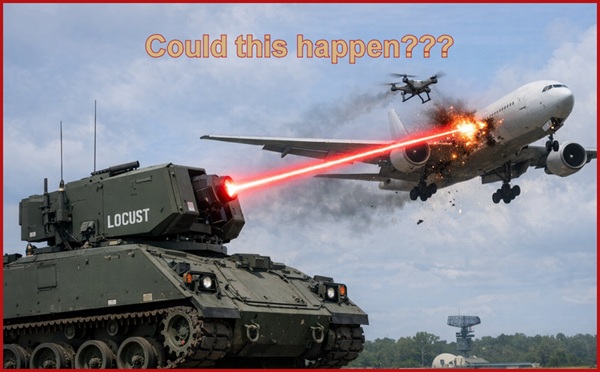
Fast Company (below) has reported on the Landmark Safety Agreement between the FAA (oddly not DoT?) and the DoW for “regular deployment of HIGH-ENERGY LASER WEAPONS on American soil for air defense amid the expanding threat of low-cost weaponized drones.” The article lays out in considerable convincing detail that this defense weapon, after field testing and a Safety Risk Assessment, “do{es} not pose undue risk to passenger aircraft.” A significant case is articulated that the laser is needed because use of missiles to bring down drones is expensive and further strains the DOW’s missile inventory.
The key premise behind the SAFETY conclusion is the reliance on the test conducted by the Joint Interagency Task Force 401 (JIATF-401)— a “’LOCALIZED’ FIRING of the AMP-HEL from various distances at the fuselage of a BOEING 767 AIRLINER that testers lugged {i.e., The plane was not flying } on to
White Sands to assess the system’s damaging effects, ‘or lack thereof’ on aircraft material… the laser was fired at its ‘maximum effective range for up to 8 seconds’ at the grounded fuselage, “demonstrating that even at full intensity, the laser caused NO STRUCTURAL DAMAGE TO THE AIRCRAFT.”
These tests are critical to the validity of the LANDMARK SAFETY AGREEMENT and there are standard testing step that are not addressed by the FAA and DOT press releases. (their omission may have been intentional for valid reasons, but the mere absence of mentioning them is a plausible concern):
- The FAA has an extremely competent cadre of structural engineering experts at
- Aircraft Certification Service (AIR)
- FAA William J. Hughes Technical Center
- Mike Monroney Aeronautical Center (MMAC)
- Were any of them present at the test and A laser strike test to assess whether there was any structural damage on a 767 would not rely on a single NDT method. It would and should use layered inspections, starting with visual and expanding into eddy current, ultrasonic, Dye Penetrant Inspection and thermography, tailored to the laser energy level and material impacted. If there are RESULTS might they disclosed with some specificity???
- If a strong enough laser fired at less than maximum range could “disable navigation, control, and safety‑critical systems” if accurately pointed and held on a vulnerable spot long enough, could damage specific external components (antennas, radomes, sensor windows) and, with more difficulty, potentially burn through to wiring or an avionics bay. That could degrade or disable some navigation or communication functions, and in extreme, very well‑aimed cases, affect control systems.
- The most realistic near‑term effect is pilot incapacitation or disorientation (via cockpit illumination) and loss of specific external sensors/antennas, not a clean, instant “kill” of all safety‑critical systems. Even low‑power laser illumination of aircraft is treated as a serious offense because of the risk to pilot vision and flight safety. A 20 kW class system is a weapon, and using it against a civil aircraft would be a severe criminal and national‑security event.
Perhaps the most disconcerting aspect of this FAA/DOW announcement is this analysis of the documentation by the Fast Company writer:
First, the agreement doesn’t appear to clarify who has final say in authorizing a laser engagement when U.S. military, CBP, and FAA jurisdictions overlap—the precise ambiguity that yielded February’s airspace closures and, until resolved, will complicate future engagements during a fast-moving crisis.
The inability of the parties to come to an agreement that resulted in the El Paso airspace closure suggests that the relationship between the primary participants is not great. El Paso was not seen as an urgent threat, but something that needs to be scheduled. A LOCUST may be needed as a drone threat is approaching a major commercial airport. The malfeasants are smart enough to recognize that targeting airspace with potentially significant civilian damage , they know that their attack will be testing this UNCLEAR FINAL SAY authority.
It is possible that some of the NTSB’s findings in Midair Collision PSA Airlines Bombardier CRJ700 Airplane and Sikorsky UH-60 Military Helicopter may be relevant here–
-
-
- FAA did not conduct periodic reviews of the route system.
- FAA did not act on recommendations—internal, external, or from prior safety analyses—to reduce the risk.
-
-
-
- The NTSB also found that the FAA’s air traffic operation at DCA lacked a risk assessment process to identify and mitigate real‑time operational risk factors:
-
-
-
- During the investigative hearings, NTSB staff stated that the U.S. Army did not provide sufficient advance notification to the FAA about the Black Hawk’s flight into the National Capital Region (NCR) and into the DCA traffic pattern. THAT WAS A ROUTINE TRAINING FLIGHT with no national security implications. The DoD did not follow established NCR coordination protocols designed to ensure ATC awareness of military helicopter movements.
-
-
-
- The lack of ADS‑B Out removed a critical layer of electronic conspicuity in one of the most complex airspaces in the country.
-
-
-
- The DoD DID NOT ASSESS THE RISK of operating without ADS‑B Out in the NCR, despite years of documented close‑proximity events.
- The Army crew was not adequately briefed on the specific hazards of the DCA helicopter corridor system.
- DoD did not provide sufficient training or procedural guidance for operations in the NCR’s constrained, mixed‑traffic environment.
-
-
-
- In its public summary of findings, the NTSB stated that the DCA midair collision was caused by:
-
“systemic FAA, air traffic control, and military safety failures.”
Protecting America from the real threats by these drones needs be addressed. The report of what DoW and the FAA have done to support the use of the LOCUST does not adequately explain why the LANDMARK SAFETY AGREEMENT is not made of sand
America’s ‘Laser Dome’ starts here
The U.S. military is laying the foundation for deploying high-energy laser weapons for domestic air defense.
BY Jared Keller
The U.S. military is paving the way for the regular deployment of HIGH-ENERGY LASER WEAPONS on American soil for air defense amid the expanding threat of low-cost weaponized drones.
The Federal Aviation Administration and the U.S. Defense Department have reached a “LANDMARK SAFETY AGREEMENT” regarding the use of laser weapons to counter unauthorized drones at the U.S.-Mexico border following a safety assessment that concluded such countermeasures “do not pose undue risk to passenger aircraft,” the FAA announced on April 10.
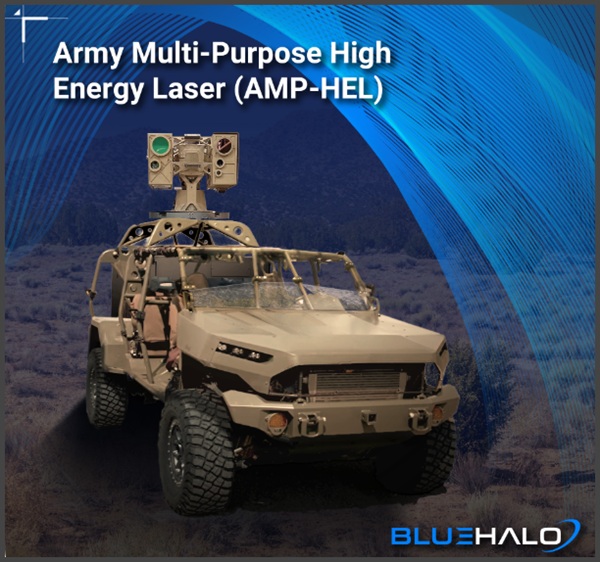
The assessment and resulting agreement were the direct result of two laser incidents along the southern border of Texas in February, which prompted the FAA to abruptly close nearby airspace amid concerns over the potential impact on civilian air traffic. The incidents involved the U.S. Army’s 20 kilowatt Army Multi-Purpose High Energy Laser (AMP-HEL),[1] a vehicle-mounted version of defense contractor AV’s LOCUST Laser Weapon System.
In the first incident, U.S. Customs and Border Patrol personnel used an AMP-HEL on loan from the Pentagon to engage an unidentified target near Fort Bliss, triggering an airspace shutdown above El Paso on February 11. In the second, U.S. military personnel used an AMP-HEL near Fort Hancock to neutralize a “seemingly threatening” drone that turned out to belong to CBP, spurring another shutdown on February 27.
“Following a thorough, data-informed Safety Risk Assessment, we DETERMINED THAT THESE SYSTEMS DO NOT PRESENT AN INCREASED RISK TO THE FLYING PUBLIC,” FAA administrator Bryan Bedford said in a statement. “We will continue working with our interagency partners to ensure the National Airspace System remains safe while addressing emerging drone threats.”
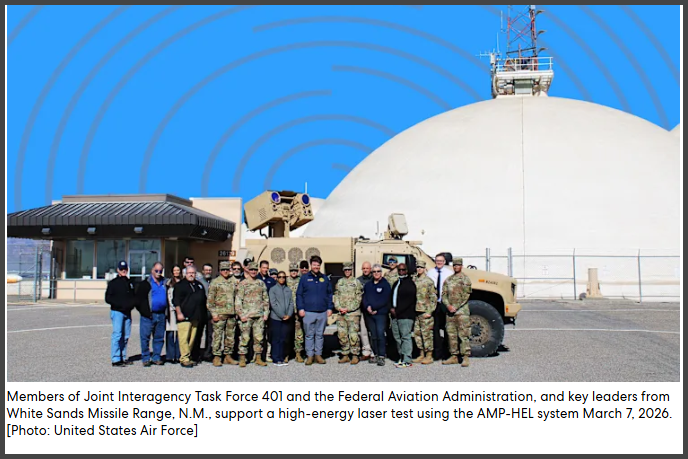
The “first of its kind” safety assessment, conducted in early March by the FAA and the Pentagon’s Joint Interagency Task Force 401 (JIATF-401) counter-drone organization at White Sands Missile Range in New Mexico, reportedly yielded two significant conclusions: 1) the LOCUST’s automatic shutoff mechanism will consistently prohibit the system from firing under unsafe circumstances, a point that AV executives have emphasized in recent weeks, and 2) in the event of a system failure, the laser beam itself cannot inflict catastrophic damage even on aircraft flying at its maximum effective range, let alone those at cruising altitudes.

Here’s how Aaron Westman, AV senior director for business development, described the LOCUST’s safety protocols in a company blog post on March 23:
Every time an operator presses the “fire” button, the system runs through a series of automated checks. Some examples include:
- Is the laser pointing away from protected “keep-out” zones?
- Are all internal subsystems operating within safe parameters?
- Is the system properly locked onto a target?
- Are safety interlock switches engaged?
- Are all software safety checks satisfied?
Each of these checks acts as a safety “vote.”
If any subsystem registers a “no vote,” the laser simply will not fire. An operator can press the trigger—and nothing happens. The system refuses to engage until all conditions are verified as safe.
These automated safeguards are built into both the hardware and the software of the system.
Here’s how DefenseScoop described the LOCUST’s potential effects on passing airframes based on an account from Army Col. Scott McLellan, JIATF-401 deputy director, of the testing at White Sands:
McLellan said the evaluation involved “LOCALIZED” FIRING of the AMP-HEL from various distances at the fuselage of a Boeing 767 airliner that testers lugged on to White Sands to assess the system’s damaging effects, “or lack thereof” on aircraft material. He said it aimed to “disprove some myths” about the capability, noting “that energy clearly dissipates over time and space and doesn’t have the effect everyone thinks it does as far as lasers are concerned.”
A JIATF 401 spokesperson said the laser was fired at its “maximum effective range for up to 8 seconds” at the grounded fuselage, “demonstrating that even at full intensity, the laser caused no structural damage to the aircraft.”
As drone warfare spreads beyond distant conflicts, laser weapons are an increasingly attractive domestic countermeasure. While kinetic interceptors and electronic warfare may be considered suitable for chaotic battlefields, their potential for collateral effects makes them far too risky for consistent domestic applications. And even if collateral damage wasn’t a concern, expending expensive missiles on the 1,000 cartel-operated drones that cross the border with Mexico monthly is economically unsustainable, especially for a Pentagon that’s already rapidly burning through munitions as part of Operation Epic Fury against Iran. On paper, the argument seems obvious: why not save those critical interceptors for high-end threats overseas and let domestic laser emplacements, with their deep magazines and minimal cost-per-shot, pull counter-drone duty at home?
Using laser weapons for domestic air defense wouldn’t be unprecedented.
FRANCE deployed two 2 kw High Energy Laser for Multiple Applications – Power (HELMA-P) systems to secure the airspace over the country’s Île-de-France region during the 2024 Paris Olympics and Paralympics.
This past September, CHINA’S PEOPLE’S LIBERATION ARMY deployed several laser weapons across Beijing during a major military parade marking the 80th anniversary of Japan’s defeat at the end of World War II.
As of January, the UK Ministry of Defense was reportedly drawing up plans to build a domestic laser screen, albeit composed of lower-power laser dazzlers, to protect military installations and other critical infrastructure.
The Pentagon has even already considered laser weapons to reinforce the airspace above Secretary of Defense Pete Hegseth and Secretary of State Marco Rubio’s residences at Fort McNair in Washington DC following a series of unauthorized drone incursions there.
Indeed, there’s a distinct possibility that laser weapons could see increasing domestic applications amid the U.S. military’s growing appetite for novel drone defenses. On April 2, JIATF-401 announced that it had funneled $20 million in counter-drone systems like the Dronebuster EW handset and Smart Shooter computerized riflescope to the U.S.-Mexico border in just four months. Days later, the task force announced $100 million to enhance counter-drone capabilities for the 2026 FIFA World Cup starting in June “to protect stadiums and fan zones in 11 cities across nine states,” part of larger $600 million surge in counter-drone systems that also allocated $158 million to “defend the nation’s highest-priority defense critical infrastructure.” With the Pentagon asking for $580 million in R&D funding just for JIATF-401 in its fiscal year 2027 budget request (and potentially $800 million in procurement cash), the task force appears poised to explore any and all possible solutions to the drone problem—and operationally, the FAA-Pentagon safety agreement helps establish laser weapons as a viable option.
That said, the safety agreement on its own is unlikely to open the floodgates for a sudden spate of laser weapon deployments along the U.S.-Mexico border, let alone for major events like the World Cup or critical infrastructure just yet.
First, the agreement doesn’t appear to clarify who has final say in authorizing a laser engagement when U.S. military, CBP, and FAA jurisdictions overlap—the precise ambiguity that yielded February’s airspace closures and, until resolved, will complicate future engagements during a fast-moving crisis.
Second, the U.S. military’s arsenal of operational laser weapons is currently limited despite a stated goal of rapidly fielding new systems at scale within three years. Even with clear plans to surge directed energy research and development for homeland defense under President Donald Trump’s “Golden Dome for America” missile shield, the age of sleek beam directors quietly standing watch along the U.S.-Mexico border remains a long way off.
The FAA agreement may end up laying the foundation for a true domestic laser air defense architecture—a “Laser Dome” in all but name. Whether the U.S. military actually builds it, however, will depend not just the Pentagon’s promise to deploy laser weapons at scale, but whether Washington can finally sort out who’s in charge when a beam crosses into civilian airspace.
This article is republished with permission from Laser Wars, a newsletter about military laser weapons and other futuristic defense technology.
[1] U.S. Army mobile, vehicle‑mounted, 20‑kW‑class high‑energy laser weapon designed for counter‑UAS (C‑UAS) missions. It is developed under the Army’s Rapid Capabilities and Critical Technologies Office (RCCTO) as part of the service’s push to field operational directed‑energy systems.
The system integrates the LOCUST™ Laser Weapon System—a BlueHalo/AeroVironment design—onto lightweight tactical vehicles. 20 kW‑class LOCUST laser integrated onto:
- Infantry Squad Vehicle (ISV) in Increment 1
- Joint Light Tactical Vehicle (JLTV) in Increment 2 (planned)
Mobile, frontline C‑UAS capability with tracking, targeting, and hard‑kill laser engagement.
AI/ML‑enhanced kill chain for detection, tracking, and engagement of drones (LOCUST subsystem)

