Bedford’s significant trip to Ireland- substance and symbolism
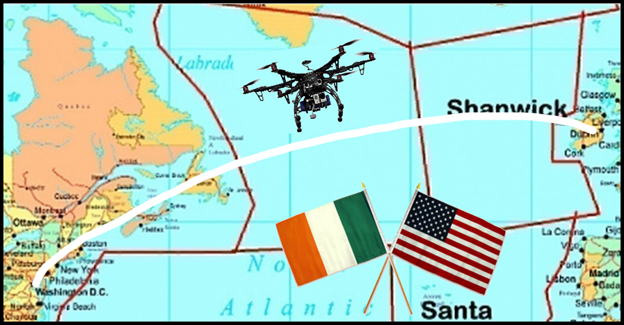
Drone XL has published an insightful article about FAA Administrator’s visit to Irish drone delivery company, MANNA, CEO Bobby Healey. The writer highlights that the Administrator’s purpose in visiting Dublin was to learn about the real world experiences (a/k/a OPERATING DATA) from 250,000 successful BVLOS flights in a densely populated community under EASA and IAI regulations.
The meeting also included highly credentialed (AvTrain drone company executive; former airline, pilot, MX; lawyer; and leader on many, many UAS advisory committees) JULIE GARLAND whose presence, it was reported, contributed to the
Drone XL frequently intoned that Bedford was not comfortable with the FAA Part 108 draft and that he would likely use this visit to formulate a final BVLOS rule. The FAA’s global standing in the world’s community of Civil Aviation Authorities is summarized in the AI research report–
China — The Global Leader
Scale of Operations
-
-
-
- 100,000+ BVLOS[1] commercial drone deliveries in Shenzhen in 2022 alone
- Multiple cities now support routine BVLOS logistics, food delivery, and medical transport.
-
-
Regulatory Model
-
-
-
- Civil Aviation Administration of China (CAAC) uses:
- Standardized BVLOS frameworks for urban logistics corridors.
- “Atypical airspace” approvals enabling BVLOS near structures and dense environments.
- China is drafting a national roadmap to expand civilian drone integration.
- Civil Aviation Administration of China (CAAC) uses:
-
-
Japan — Rapid National Scaling
Scale of Operations
-
-
-
- Japan has granted nationwide BVLOS approval to operators such as Skydio for autonomous missions (infrastructure, security, disaster response).
- Japan’s national approvals allow remote, unattended BVLOS operations using docks and remote ops centers.
-
-
Regulatory Model
-
-
-
- Japan Civil Aviation Bureau (JCAB):
- Introduced Level 3 and Level 4 classifications for BVLOS over people and in populated areas.
- Allows autonomous BVLOS with certified aircraft and remote ID.
- Provides nationwide operational approvals for qualified systems (rare globally).
-
-
European Union (EASA + Member States)
Scale of Operations
-
-
-
- Thousands of BVLOS {MANNA has 250,000}missions across EU states under the Specific category, including:
- Long‑range inspection
- Medical delivery
- Infrastructure monitoring
- EU-wide data is fragmented, but the EU is the largest multi‑country BVLOS ecosystem.
- Thousands of BVLOS {MANNA has 250,000}missions across EU states under the Specific category, including:
-
-
Regulatory Model
-
-
-
- EASA uses:
- SORA (Specific Operations Risk Assessment) as the core BVLOS approval method.
- Remote ID required for all Specific‑category drones.
- U‑space implementation to enable cooperative airspace for BVLOS scaling.
-
-
Canada — One of the Most Mature BVLOS Frameworks
Scale of Operations
-
-
-
- Canada has enabled large‑scale BVLOS operations through standardized frameworks, including long‑range inspection and cargo trials.
- Multiple operators conduct routine BVLOS in rural and industrial corridors.
-
-
Regulatory Model
-
-
-
- Transport Canada:
- Published proposed BVLOS regulations enabling routine operations.
- Uses risk‑based approvals and standard scenarios for BVLOS.
- Supports large‑area BVLOS test ranges and corridor operations.
-
-
United States — High Potential, Limited Scaling
Scale of Operations
-
-
-
- The U.S. has hundreds of BVLOS waivers, but no large‑scale routine BVLOS comparable to China or the EU.
- Operations remain case‑by‑case under Part 107 waivers or BEYOND program pilots.
-
-
Regulatory Model
-
-
-
- FAA currently relies on:
- Part 107 waivers for BVLOS.
- BEYOND program for data gathering.
- ARC (Aviation Rulemaking Committee) recommendations for a future rule.
- The FAA’s ARC report outlines:
- Detect‑and‑avoid (DAA) requirements
- Well‑clear performance standards
- Risk‑based operational levels
- Third‑party services for strategic deconfliction
- FAA currently relies on:
-
-
A formal BVLOS rule has not yet been adopted, limiting scaling relative to global peers.
That said, an equally significant aspect of this event is that THE SENIOR FAA EXECUTIVE visited another country to LEARN. Since the MAX 8 debacle, the “GOLD STANDARD” has been tarnished a bit. US aerospace, industry and government, consciously or subconsciously behaved with a bit of a SUPERIOR ATTITUDE.

For example, assume that the head of the CAA of a country (frequently a person who earned stars on their shoulder bars) meets with a team of FAA aviation safety experts to assess the CAA’s compliance, the IASA review. The end result is a very public report, which by statutory requirement, points out the deficiencies of this PEER aviation safety organization. Now envision that senior CAA executive hears of the performance of the organization that embarrassed his organization.
Administrator Bedford should be commended for the first, hopefully of many, low key discussions with a PEER CAA. US aerospace will greatly benefit from similar efforts.

FAA Administrator Bedford visits Manna’s Dublin HQ, signals US-EU alignment on drone delivery rules
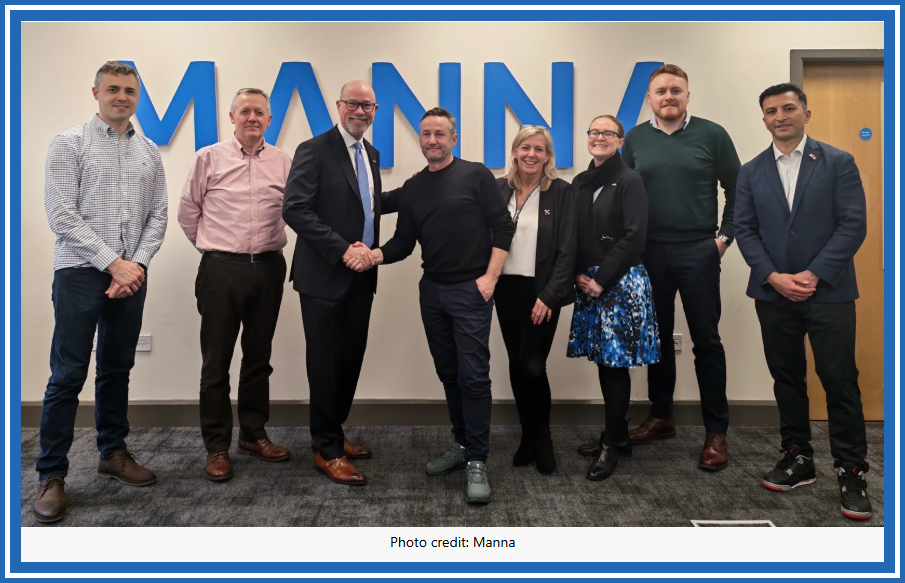
FAA Administrator Bryan Bedford traveled to Dublin last week to meet with MANNA drone delivery founder Bobby Healy at the company’s headquarters.
The visit, which also included Avtrain CEO Julie Garland and representatives from the Irish Aviation Authority (IAA), CENTERED ON HOW EUROPEAN AND US REGULATORY FRAMEWORKS CAN WORK TOGETHER TO SCALE DRONE DELIVERY OPERATIONS.

The meeting comes at a critical moment. The FAA’s proposed Part 108 BVLOS rule is still being finalized after receiving thousands of public comments last October, and Manna just crossed 250,000 commercial drone deliveries under EASA and IAA oversight. Bedford is clearly doing his homework.
Bedford’s Dublin visit puts Europe’s drone delivery track record in the spotlight.

FAA Administrator Bryan Bedford visited Manna’s Dublin headquarters on January 30, 2026, to discuss European and US regulatory frameworks for commercial drone delivery and how industry and regulators can collaborate to bring these operations to scale. The visit included representatives from Ireland’s aviation authority and European drone training organization Avtrain.
Healy posted on X that the meeting was “a positive, forward-looking exchange on European & US regulatory frameworks and how industry and regulators can work together to unlock the next phase of drone delivery at scale.”
Bedford responded publicly, thanking Healy for “welcoming the FAA team” and calling cross-nation partnership “essential to unlocking the full potential of this emerging innovation while maintaining safety.” He also tagged Avtrain and Julie Garland, confirming their involvement in the discussions.
The fact that Bedford personally flew to Dublin to see Manna’s operation is telling. This was not a video call. The FAA Administrator wanted to see what a functioning, scaled drone delivery system looks like under European regulation.
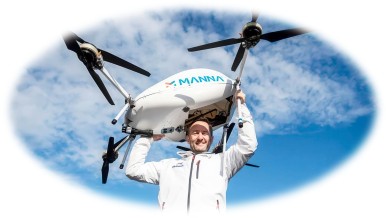
Photo credit: Manna
Manna’s operational data gives the FAA something no US company offers
Manna has completed MORE THAN 250,000 COMMERCIAL DRONE deliveries since launching operations, including over 60,000 flights from its hub in Dublin 15. The company recorded over 100% year-on-year delivery growth throughout 2025 and operates under both EASA certification and IAA authorization, including Ireland’s first Light UAS Operator Certificate (LUC).
That is a volume of real-world BVLOS delivery data that simply does not exist in the United States. Zipline has flown millions of autonomous miles, but mostly outside the US. Wing and Amazon have logged far fewer suburban food deliveries. Manna’s operation in a dense European suburb, with real customers ordering coffee and groceries daily, is exactly the kind of use case that Part 108 is supposed to enable in America.
Bobby Healy has publicly stated that the EU is two to three years ahead of the US on drone delivery regulation. That claim gains weight when the FAA Administrator shows up at your door. Manna’s drones fly autonomously at speeds up to 50 mph, delivering within a 2-mile radius from compact hubs that fit in a few parking spaces. The company claims profitability on each delivery at roughly $4 per flight.
Manna has also expanded to Finland with Wolt, testing cold-weather operations in Nordic conditions. That kind of climate validation data is valuable for an FAA that will eventually have to certify drone delivery in Minnesota winters and Arizona summers.
Julie Garland’s presence connects EU rulemaking directly to the FAA
JULIE GARLAND is the founder and CEO of Avtrain, one of Europe’s leading drone training and consultancy organizations based in Dublin. She is a former airline training captain and aircraft maintenance engineer who also holds a Barrister-at-Law qualification. Her inclusion in the meeting with Bedford was not accidental.
Garland is the founding Chair of the Unmanned Aircraft Association of Ireland (UAAI) and sits on the board of JEDA, the Joint European Drone Associations. Through JEDA, she is the Irish representative on JARUS, the Joint Authorities for Rulemaking on Unmanned Systems, where she is Vice-Chair of the Industry Stakeholder’s Body Steering Committee. JARUS is the international body that develops recommended technical and operational requirements for drones that both EASA and the FAA use as reference points.
In other words, Garland sits at the exact intersection of European drone regulation and international standards development. Her presence in the room gave Bedford direct access to someone who understands both how EASA rules work in practice and how those rules connect to the international frameworks the FAA consults when writing its own regulations.
The visit comes as Part 108 faces its toughest stretch
The FAA published its PART 108 BVLOS NOTICE OF PROPOSED RULEMAKING in August 2025. The 650-page proposal drew thousands of comments before the October 6 deadline, many of them critical. DJI warned the rule could ground most drones currently in use due to country-of-origin restrictions. Pilot Institute argued the proposal eliminates pathways for thousands of current operators while favoring large, well-funded companies.
Bedford himself has acknowledged the rule’s complexity. At a Commercial Drone Alliance event in September 2025, he said the FAA was “breaking some glass internally” to get Part 108 moving, and urged the industry to accept that “we aren’t going to get a perfect rule” but can “get a good rule” out quickly.
The FAA also designated two new drone test sites earlier this month, the first in nearly a decade, at the Choctaw Nation of Oklahoma and Indiana Economic Development Corporation. Those sites will generate safety data to inform the final Part 108 rule.
Against that backdrop, visiting a company that already runs daily BVLOS delivery operations under a mature regulatory framework makes obvious sense. Bedford can see what the finish line looks like. The question is whether the FAA can get there without rewriting the rule from scratch.
DroneXL’s Take
This is not a photo op. When the FAA Administrator flies to Dublin to tour a drone delivery company, he’s gathering intelligence. Bedford inherited Part 108 as an unwieldy 650-page proposal that even he called “schizophrenic.” He needs to see what a working system looks like so he can figure out which parts of the US rule are unnecessary complexity and which are genuine safety requirements.
Manna’s operation is the closest thing to a live Part 108 lab that exists anywhere. Over 250,000 deliveries. EASA-certified aircraft. Autonomous flights over suburban neighborhoods. Real complaints from real residents, and real data on how to address them. That’s the evidence base Bedford needs to push back on the critics who say scaled BVLOS delivery can’t work safely.
The inclusion of Julie Garland is the detail that makes this visit more than a company tour. Garland’s position on JARUS means she can explain not just how Irish regulation works, but how the international standards that inform both EASA and FAA rulemaking are evolving. Bedford got a briefing on the entire regulatory ecosystem in one room.
I expect we’ll see direct references to European operational experience in the FAA’s response to Part 108 comments. Bedford has consistently said he wants to “get a marker in the ground” and iterate from there. Manna’s track record gives him the political cover to push a more permissive initial rule. If a Dublin-based startup can safely deliver 250,000 packages over suburban homes, the argument that American companies need five more years of testing becomes harder to defend.
Watch for the final Part 108 rule to include provisions that more closely mirror EASA’s risk-based approach to BVLOS authorization. This Dublin meeting didn’t happen by accident, and it won’t be the last conversation between the FAA and European operators. The transatlantic drone delivery regulatory gap is about to narrow. I’d put money on a working Part 108 framework by the end of 2026.
Editorial Note: This article was researched and drafted with the assistance of AI to ensure technical accuracy and archive retrieval. All insights, industry analysis, and perspectives were provided exclusively by Haye Kesteloo and our other DroneXL authors, editors, and YouTube partners to ensure the “Human-First” perspective our readers expect.
[1] Some of the AI generated numbers are not congruent with the numbers in the Drone XL article.
