Archer’s Certification Progress, eIPP, OTA and Lloyds??
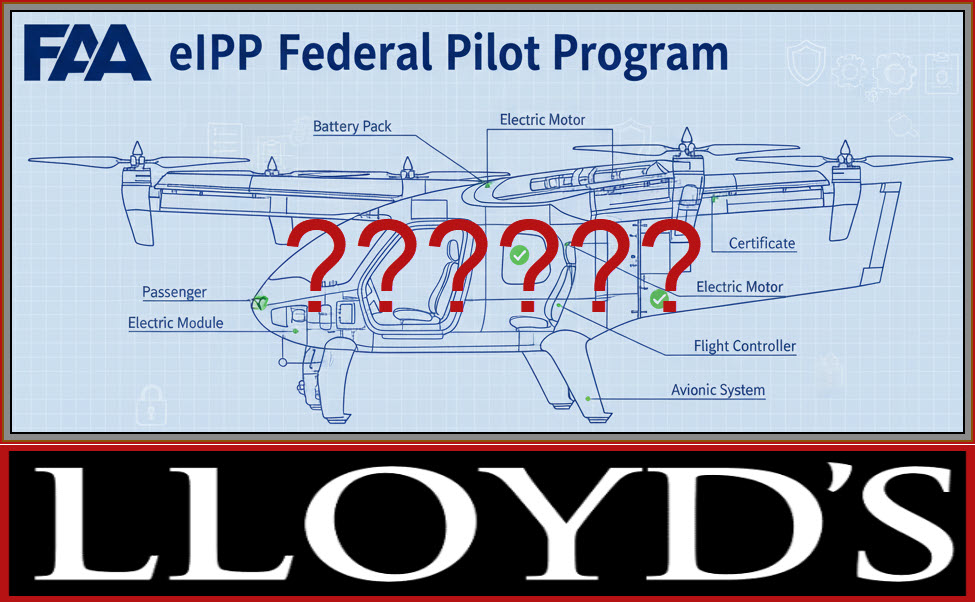
SIMPLY WALL STREET has published the below article headed-lined “Should FAA Acceptance of Archer’s Midnight eVTOL Certification Basis Require Action From Archer Aviation (ACHR) Investors?.” Simply Wall Street is known[1] for data‑driven, automated equity analysis, relies heavily on algorithmic/AI‑assisted modeling, and is generally regarded by investment professionals as useful for visualization but not authoritative research. There are few aviation technical issues that are more complex and less well-tested than the basis for revenue operations under the eIPP program.
PERHAPS THE MOST TELLING RISK is located in LONDON?? That issue will be the subject of the last section of this post.
Before touching on the aptly labeled “Other Transaction Authority,” here are a few important points about the status of the Archer authorization:
-
-
-
-
-
- The FAA’s Final Airworthiness Criteria for the Archer Midnight aircraft was formally published for public inspection in the Federal Register in May 2024. This document establishes the aircraft’s certification basis under 14 CFR §21.17(b) and lays out the special conditions and airworthiness requirements that Archer must meet to obtain a Type Certificate.
- Searches for a new FAA contemporaneous public action of the Archer Midnight did not identify any such announcement since May 2024
- The SMS article mentions that Final Airworthiness Criteria document without a mention of its date.
- The SMS report does accurately states:
- , which, while helpful, is not transformational on its own.
-
-
-
-
So what do all of the entities seeking to fly face to be allowed to fly in the eIPP test that starts this year?
The Trump Executive Order, UNLEASHING AMERICAN DRONE DOMINANCE, is the aegis for this expedited launch of these innovative aircraft. eIPP’s goal is

…to accelerate the safe deployment of Advanced Air Mobility (AAM) vehicles in the National Airspace System. The program will form public-private partnerships with state, local, tribal, and territorial government entities, and private companies to DEVELOP NEW FRAMEWORKS AND REGULATIONS FOR ENABLING SAFE AAM OPERATIONS.
The release explains the process that will allow flights with passengers and cargo aboard , but non-revenue basis, by following this process in lieu of full FAA Type Certification requirements:
There is no FAA‑published OTA application process[2] for eIPP because an OTA is non‑public, bespoke contract!!! Under 49 U.S.C. §106(l)(6) and §106(n), OTA agreements are:
-
-
-
-
-
-
-
- not procurement contracts
- not rulemaking
- not certification actions
- not subject to public comment
- not required to be published
- negotiated privately between FAA and the applicant
-
-
-
-
-
-
✔️ There will be no standardized application?
✔️ There will be no published template?
✔️ There is no public checklist!
✔️ Each OTA is custom‑built for the specific project
AI has researched how NASA, and DoD structure OTA agreements, an eVTOL OTA would likely require:
-
-
-
-
-
-
-
- a detailed prototype operations plan
- a hazard analysis and risk mitigation plan
- a maintenance and inspection program
- a pilot qualification plan
- a data‑sharing plan
- a test area definition
- a public safety plan
- a liability and insurance structure
- a termination and modification clause
-
-
-
-
-
-
eIPP is clearly a very clever construct to avoid the delays that are inherent in FAA certification. This short-circuiting of the much reviled regulators is brilliant, but there is an essential institution that has a final risk analysis
eIPP involves OEMs, UTM systems, government and/or privately owned infrastructures, state/regional/city/county sponsors, and multiple collateral participants. All of them will likely not undertake these eVTOL flights without insurance,
The leader for Commercial Aviation Insurance is Lloyd’s of London is the largest, most specialized, and most globally dominant marketplace for high‑severity aviation risks. Its dominance comes from its structure, history, capital model, and the nature of aviation risk—not from exclusivity. Aviation losses—especially hull, liability, and war risks—can reach hundreds of millions to billions. Only markets with deep capital pools and long experience can underwrite them sustainably. Lloyd’s syndicates have historically specialized in exactly these classes, making the market a natural hub. Lloyd’s aggregates dozens of syndicates that each write aviation. This creates:
- Large aggregate capacity
- Diverse risk appetites
- Ability to place complex risks via subscription (multiple syndicates each take a percentage)
Lloyd’s and its peers[3] are THE experts of aviation coverage and the importance of regulatory imprimatur. Their analyses of the eIPP OTAs will likely conclude that underwriting these flights without a recognized certification basis is not an ACCEPTABLE RISK. These eIPP operations will include flights in urban areas have extremely high liability exposure. Maybe there is an insurance company with sufficient knowledge of and confidence in the eVTOL industry to provide coverage. That informed judgment may facilitate entry into this new enterprise, but it is still open to question that others may join to the level of financial capacity needed.
To summarize this post-
- All potential players in this business face uncertainty about what the OTA will require to participate in the eIPP demonstrations
- The significance of the OTA for the risk market does not look positive.
- Participants in the brave new world of eVTOLs would be well advised to consult with[4] individuals with TC standards about how/if the OTA issued will raise these flights to INSURABLE RISKs.
Should FAA Acceptance of Archer’s Midnight eVTOL Certification Basis Require Action From Archer Aviation (ACHR) Investors?

- Archer Aviation has received FAA acceptance of its certification basis for its Midnight eVTOL aircraft and is working with United Airlines to develop the airport and vertiport infrastructure needed for future commercial routes.
- This combination of regulatory progress and airline-backed infrastructure planning tightens the link between Archer’s technology roadmap and practical urban air mobility deployment.
- Next, we’ll examine how FAA acceptance of Archer’s certification basis feeds into its investment narrative and long-term commercialization prospects.
Archer Aviation Investment Narrative Recap

To own Archer Aviation, you have to believe eVTOLs can transition from prototypes to regulated, scalable transport while the company funds years of heavy losses. FAA acceptance of Midnight’s certification basis directly supports the key short term catalyst of moving into FAA TIA work, THOUGH TIMING RISK AROUND FULL CERTIFICATION and early route launches still feels significant. The biggest near term risk remains execution and cash burn rather than this specific regulatory step, which, while helpful, is not transformational on its own.
Among recent announcements, Archer’s participation in the White House eVTOL Integration Pilot Program and the goal of standing up initial Midnight operations in the second half of 2026 links closely with this FAA milestone. Regulatory alignment plus early route testing in Texas, Florida and New York forms a clearer path from certification progress to actual operations. Together, they sharpen the near term commercialization catalyst while also underscoring how sensitive timelines remain to any regulatory or operational delays.
Yet behind this progress, investors should also be aware of the risk that persistent operating losses and ongoing capital needs could…
Archer Aviation’s narrative projects $533.9 million revenue and $46.6 million earnings by 2029. This requires 1111.8% yearly revenue growth and a $664.8 million earnings increase from $-618.2 million today…
Exploring Other Perspectives
ACHR 1-Year Stock Price Chart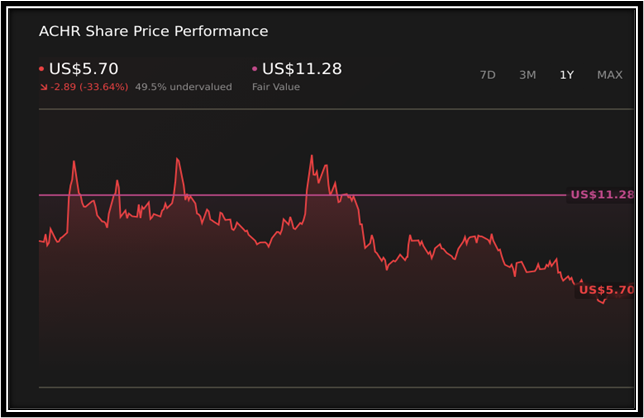
Some analysts were already far more optimistic, assuming revenue could reach about US$868.1 million by 2029, but this latest FAA progress might either reinforce or challenge those expectations depending on how you view the remaining certification and commercialization hurdles.
This article by Simply Wall St is general in nature. We provide commentary based on historical data and analyst forecasts only using an unbiased methodology and our articles are not intended to be financial advice. It does not constitute a recommendation to buy or sell any stock, and does not take account of your objectives, or your financial situation. We aim to bring you long-term focused analysis driven by fundamental data. Note that our analysis may not factor in the latest price-sensitive company announcements or qualitative material. Simply Wall St has no position in any stocks mentioned…
[1] https://mediabiasfactcheck.com/wall-street-journal/?utm_source=copilot.com; https://www.biasly.com/media-bias-chart/us-main/?utm_source=copilot.com; https://www.pewresearch.org/journalism/feature/news-media-tracker/the_wall_street_journal/?utm_source=copilot.com; https://www.earnmorelivefreely.com/simply-wall-street-review/?utm_source=copilot.com; https://adfontesmedia.com/wall-street-journal-bias-and-reliability/?utm_source=copilot.com; https://www.allsides.com/news-source/wall-street-journal-opinion-media-bias?utm_source=copilot.com; https://www.biasly.com/sources/the-wall-street-journal-media-bias/?utm_source=copilot.com; https://www.trustpilot.com/review/simplywall.st?utm_source=copilot.com
[2] All FAA Orders related to R&D, prototype operations, and acquisition; All Advisory Circulars related to powered‑lift, Part 21, and experimental operation; All Federal Register notices related to eVTOL, powered‑lift, and eIPP; DOT/FAA OTA reporting requirements; FAA’s Acquisition Management System (AMS) OTA guidance;FAA’s public eVTOL Integration Pilot Program documentation
[3] Allianz, Global Aerospace, AIG, WTW (Willis Towers Watson) analysis, ATA Insurance (AAM‑focused)

